Riesling
Also known as White Riesling, Weißer Riesling, Rhine Riesling
Riesling is a white Vitis vinifera variety historically centred on the Rhine and its tributaries. It combines pronounced natural acidity with an aromatic character that develops during ripening and in the bottle. Those properties support wines from fully dry to intensely sweet. Sweetness reflects harvest and fermentation.
Sugar, acids, and aroma precursors develop at different rates. Harvest timing sets their starting balance; fermentation determines how much sugar becomes alcohol and how much remains.
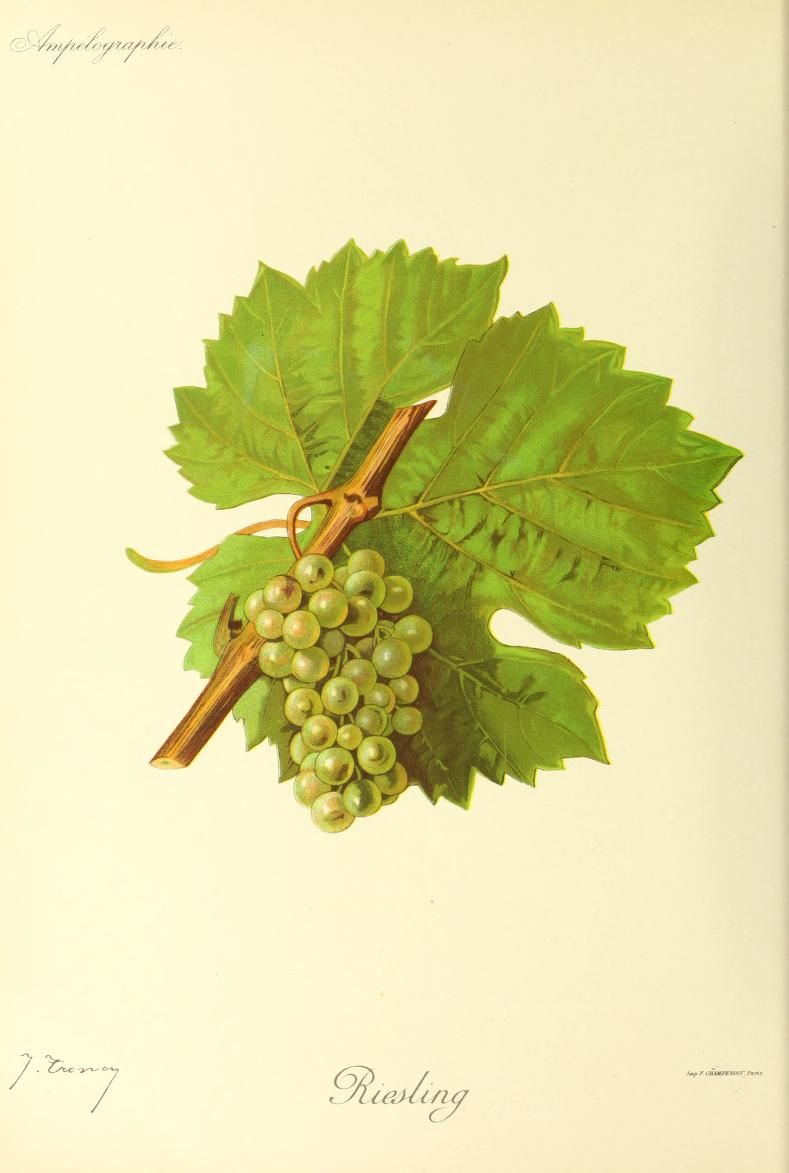
History and identity
Plantgrape places Riesling's probable origin near the Rhine and, based on published genetic analyses, describes it as a probable descendant of Gouais blanc. The original seedling's site and date remain unknown, and the other side of its parentage is less securely established.1. Institut français de la vigne et du vin, INRAE & Institut Agro Montpellier, “Riesling B,” Plantgrape, edited 19 August 2026. A Rheingau document from 1435 is widely cited as an early record of the name. Later fifteenth-century references show the variety spreading through western German vineyards.
White Riesling, Weißer Riesling, and Rhine Riesling denote this variety. Welschriesling, despite its name and importance in Austria and central Europe, is a different grape. Schwarzriesling is the German name for Meunier, a separate variety.
Ripening and acidity
Riesling ripens relatively late—about three weeks after Chasselas in the French reference collection. Actual dates vary with latitude, elevation, aspect, season, crop, and canopy. A long season can extend ripening while leaving its small bunches exposed to autumn rain and grey rot.
In a three-year comparison at matched ripening stages, Riesling berries contained more tartaric acid than Gewürztraminer and, during later sampling, more malic acid as well.2. Eric Duchêne et al., “Genetic variability of descriptors for grapevine berry acidity in Riesling, Gewürztraminer and their progeny,” Australian Journal of Grape and Wine Research 20 (2014), pp. 91–99, https://doi.org/10.1111/ajgw.12051. After véraison, tartaric acid per berry remains comparatively stable, while malic acid is consumed in berry metabolism. Warmth hastens malic loss, though Riesling's tartaric-acid potential can preserve useful acidity after sugar has accumulated.
Earlier picking generally preserves more acid and gives less potential alcohol. Waiting may bring sugar, aroma development, shrivelling, or noble rot, together with greater risks of acid loss and unhealthy rot. Exposure, water status, crop, and weather alter that balance.
Aroma and bottle development
Monoterpenes such as linalool, geraniol, and nerol contribute to Riesling's young perfume, though less directly than in Muscat Blanc à Petits Grains. Some occur freely in the berry; others are bound in precursors that can later release aroma. Clone, sunlight, harvest, fermentation, and bottle age determine what becomes perceptible.3. Joshua VanderWeide et al., “Free monoterpenoid accumulation in ‘Riesling’ (Vitis vinifera L.) is light-sensitive and uncoupled from grape hexose accumulation,” Plant Physiology and Biochemistry 219 (2025), article 109212, https://doi.org/10.1016/j.plaphy.2024.109212.
A controlled study found that excluding light reduced free monoterpenoids, whereas reducing sugar import did not produce the same decline in their total free and bound concentration.3. Joshua VanderWeide et al., “Free monoterpenoid accumulation in ‘Riesling’ (Vitis vinifera L.) is light-sensitive and uncoupled from grape hexose accumulation,” Plant Physiology and Biochemistry 219 (2025), article 109212, https://doi.org/10.1016/j.plaphy.2024.109212. Aroma development can therefore diverge from sugar accumulation. Intense exposure may also increase sunburn.
The best-known aged note is associated with 1,1,6-trimethyl-1,2-dihydronaphthalene (TDN), often described as petrol or kerosene. TDN develops from non-volatile, carotenoid-derived precursors through reactions during wine storage. Research has isolated several such precursors from Riesling wine.4. Recep Gök et al., “Target-Guided Isolation of Progenitors of 1,1,6-Trimethyl-1,2-dihydronaphthalene (TDN) from Riesling Wine by High-Performance Countercurrent Chromatography,” Molecules 27 (2022), article 5378, https://doi.org/10.3390/molecules27175378. Bunch exposure and warmth can increase its potential, while bottle age and storage temperature affect its release. Depending on concentration and drinking culture, it may register as mature character or an obtrusive fault.
Sweetness and cellar choices
Dry wine results when yeast ferments nearly all available grape sugar. Cooling, filtration, and sulfur dioxide can arrest fermentation and preserve some; concentrated must may also stop fermenting. Noble rot or dehydration concentrates the starting fruit enough to support intensely sweet wine.
Acidity changes the perception of residual sugar without changing its amount. Alcohol, extract, temperature, and carbonation matter too, so a lightly sweet, acid-driven Riesling may taste drier than its sugar figure suggests. Riesling's acid retention gives winemakers room to stop fermentation at different points, much as it does for Chenin Blanc.
Most still Riesling is pressed promptly and matured in steel or neutral vessels. Large old casks remain important in Germany and Alsace, while some producers use skin contact, lees, or smaller wood for texture. Malolactic fermentation is often limited to retain malic acidity.
Regional traditions
Germany displays the sweetness range most explicitly. Mosel, Rheingau, Nahe, Rheinhessen, and Pfalz all produce dry Riesling as well as wines with residual sugar. Prädikat terms such as Kabinett, Spätlese, and Auslese refer primarily to grape maturity and minimum must weight, so examples can be dry or sweet. Trocken describes finished sugar, while feinherb is commonly used but not legally defined.5. Deutsches Weininstitut, “Prädikate” and “Geschmacksrichtungen,” accessed 1 September 2026. The institute defines the Prädikat categories by grape must weight and gives separate finished-wine thresholds for trocken and halbtrocken; it describes feinherb as legally undefined.
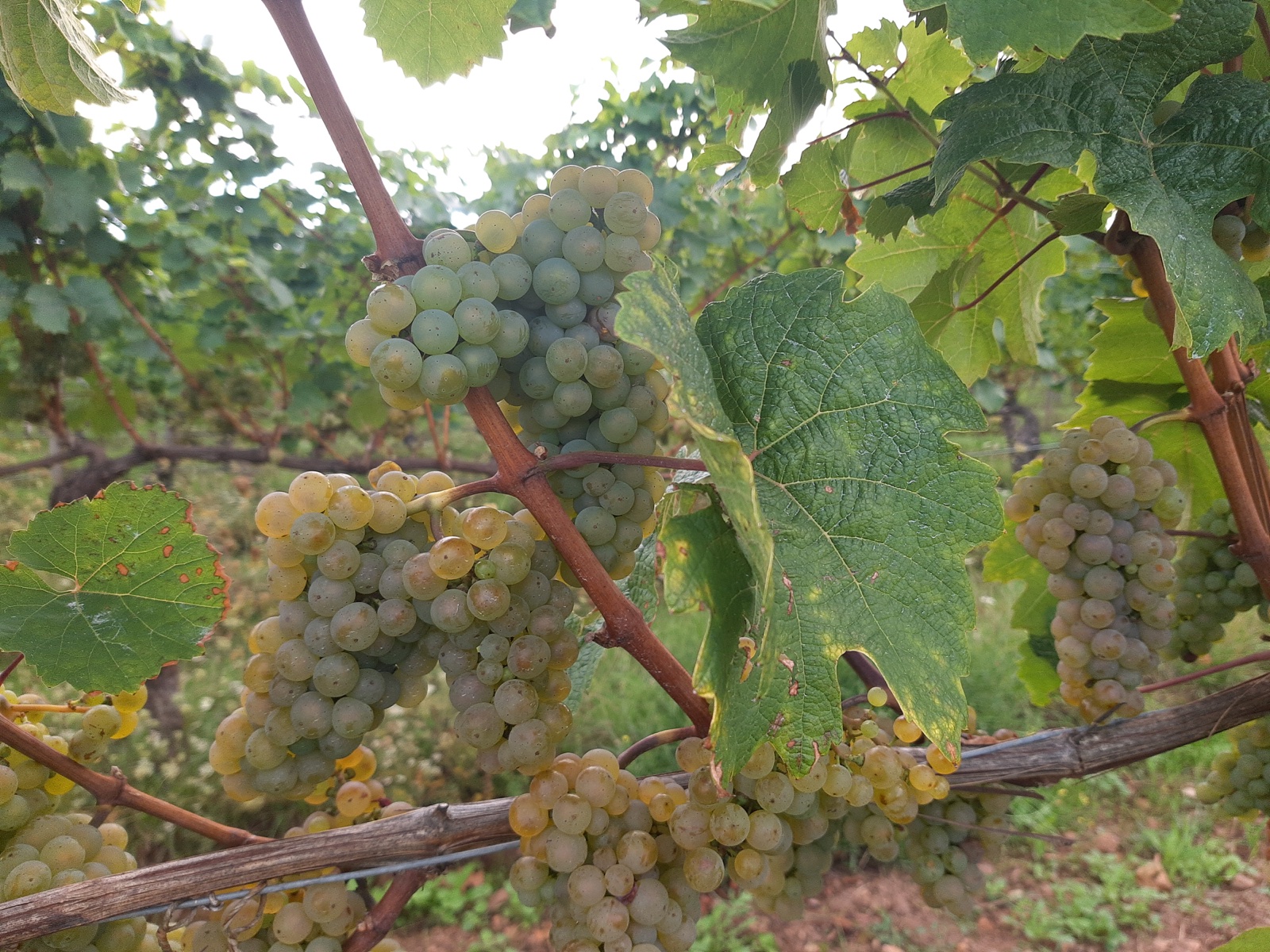
Alsace has a more strongly dry convention for ordinary varietal Riesling. Its current appellation rules cap fermentable sugar after fermentation for wine labelled Riesling, with allowances tied to acidity. Separate vendanges tardives and sélection de grains nobles categories use hand-harvested, sugar-rich grapes under specific conditions.6. Ministère de l'Agriculture et de la Souveraineté alimentaire, Cahier des charges de l'appellation d'origine contrôlée “Alsace” ou “Vin d'Alsace”, modified 29 December 2025, pp. 9–15.
In Austria, Riesling is concentrated in the Danube regions of Lower Austria, including Wachau, Kremstal, and Kamptal. Dry wine predominates: Kremstal DAC Riesling must meet the legal definition of trocken, while Kamptal DAC limits residual sugar by titratable acidity.7. Austrian Federal Ministry of Agriculture and Forestry, Climate and Environmental Protection, Regions and Water Management, DAC-Verordnung “Kremstal”, consolidated 18 September 2024, § 1; DAC-Verordnung “Kamptal”, in force 17 September 2024, § 3. Sweet Austrian Prädikat wines also exist.
Clare Valley and Eden Valley are Australia's principal references, usually for dry wine in neutral vessels. New Zealand also spans dry, off-dry, and sweet forms. Autumn weather, sunlight, and local traditions create distinct balances among acidity, aroma, sugar, and TDN.
In New York's Finger Lakes, Riesling is central to the region's contemporary identity. Nearby lake water can delay spring warming and supply heat in autumn, helping suitable slopes support a longer ripening season. Exposure and distance from the water still matter. Producers' attention to dry, single-vineyard wines makes those differences increasingly visible: North American Riesling is not adequately described by sweetness alone.
Ontario's Niagara Peninsula offers a complementary comparison. Riesling helped shape the region's modern vinifera revival, and growers work with sites on the Niagara Escarpment's benches as well as nearer Lake Ontario. Dry and off-dry table wines sit alongside late-harvest wines and Icewine. Their differing harvest aims direct the same acid-retaining variety toward everyday freshness, site-focused dry wine, or concentrated sweetness; Canada's frozen-grape wines represent only one part of that range.
Related topics
Sources
- Institut français de la vigne et du vin, INRAE & Institut Agro Montpellier, “Riesling B”, Plantgrape varietal record, edited 19 August 2026, accessed 1 September 2026.
- Eric Duchêne, Valérie Dumas, Gaëlle Jaegli, François Merdinoglu & Didier Migneret, “Genetic variability of descriptors for grapevine berry acidity in Riesling, Gewürztraminer and their progeny”, Australian Journal of Grape and Wine Research 20 (2014), pp. 91–99.
- Aroma-chemistry sources: Jerry Lin, Mélanie Massonnet & Dario Cantu, “The genetic basis of grape and wine aroma”, Horticulture Research 6 (2019), article 81; Joshua VanderWeide et al., “Free monoterpenoid accumulation in ‘Riesling’ (Vitis vinifera L.) is light-sensitive and uncoupled from grape hexose accumulation”, Plant Physiology and Biochemistry 219 (2025), article 109212; and Recep Gök et al., “Target-Guided Isolation of Progenitors of 1,1,6-Trimethyl-1,2-dihydronaphthalene (TDN) from Riesling Wine by High-Performance Countercurrent Chromatography”, Molecules 27 (2022), article 5378.
- Deutsches Weininstitut, “Riesling”, “Prädikate”, and “Geschmacksrichtungen”, accessed 1 September 2026.
- Ministère de l'Agriculture et de la Souveraineté alimentaire, Cahier des charges de l'appellation d'origine contrôlée “Alsace” ou “Vin d'Alsace”, modified 29 December 2025 and published 15 January 2026.
- Austrian Federal Ministry of Agriculture and Forestry, Climate and Environmental Protection, Regions and Water Management, DAC-Verordnung “Kremstal”, consolidated 18 September 2024, and DAC-Verordnung “Kamptal”, in force 17 September 2024.
- New York Wine & Grape Foundation, “Finger Lakes”, accessed 17 September 2026.
- Wine Country Ontario, “Riesling”, varietal profile, accessed 17 September 2026.