Mosel
Mosel is a German wine region and protected designation of origin built around the Mosel River and the lower valleys of its tributaries, the Saar and Ruwer. The growing area follows the Mosel from Perl, near the French and Luxembourg borders, to Koblenz, where it meets the Rhine. Its 8,287 hectares of vineyard in 2025 form a long, discontinuous corridor.1. Deutsches Weininstitut, “Mosel,” 2025 vineyard-area figure, accessed 1 September 2026.
The region is closely associated with Riesling. River bends turn slopes toward different parts of the sky; tributary valleys differ in elevation and shelter; and the broad, limestone-influenced Upper Mosel is unlike the slate gorges farther downstream. Harvest timing, fermentation, and the producer's aims widen those differences.
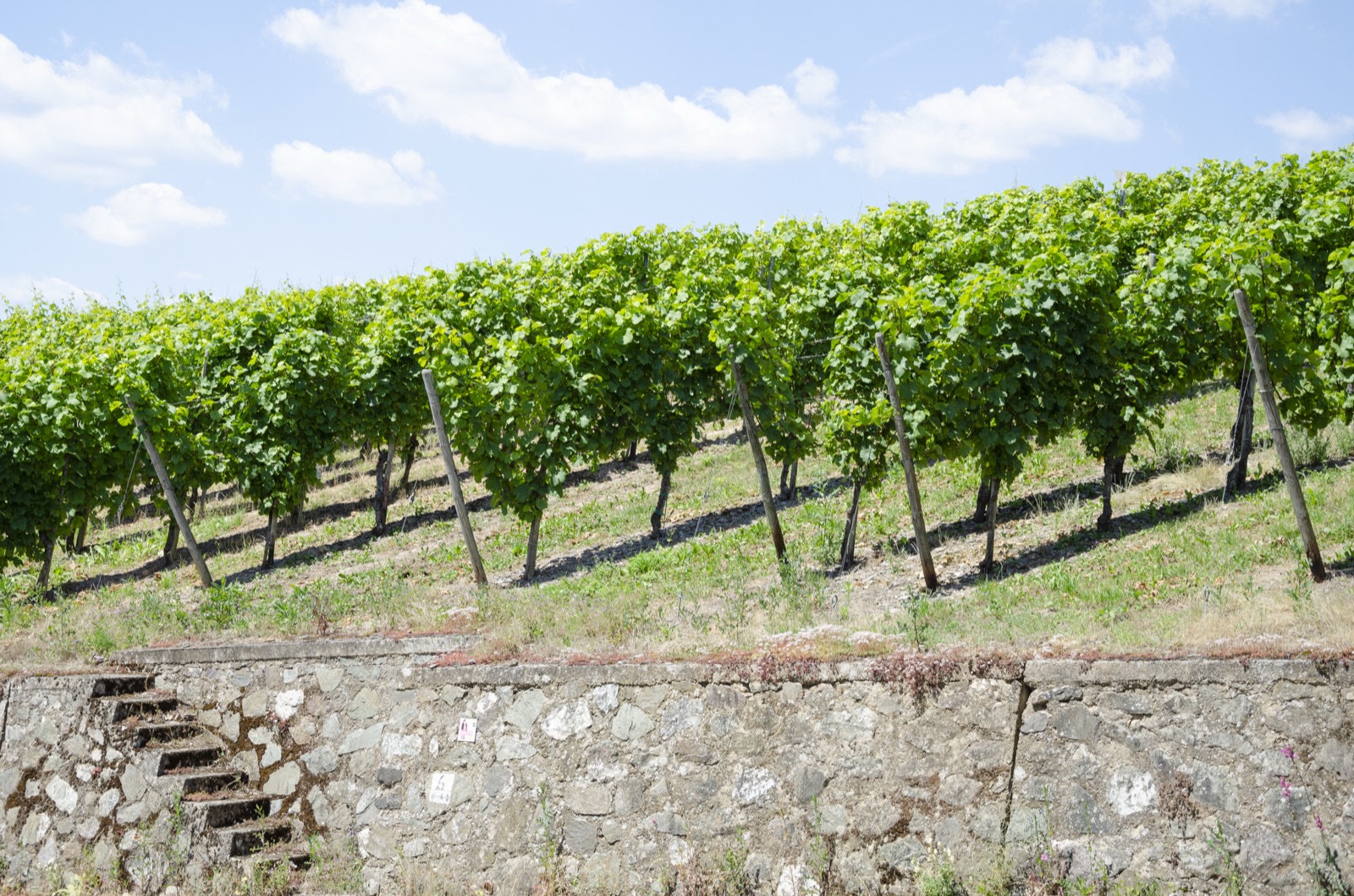
River valleys, slopes, and climate
South of Trier, the Upper Mosel crosses relatively soft sandstone, shell limestone, and Keuper formations. From the Middle Mosel through the Lower Mosel, the river cuts a narrower, winding valley into much older Devonian rocks, including slate, quartzite, and sandstone. The lower reaches are often called the Terrassenmosel because walls and small terraces make cultivation possible on some of the steepest ground. Saar and Ruwer vineyards add separate networks of side valleys.2. European Commission, “Mosel,” current protected-designation single document, published 11 March 2026, sections 9–10.
This topography helped growers obtain ripe grapes in a historically cool setting. A well-exposed slope intercepts more sunlight than flat ground, and the current Mosel specification records its highest direct-sunshine values on steep and very steep sites. Stony, shallow soils can warm readily and drain after rain. These advantages are conditional: a bend can give one bank a sunny aspect and the next a shaded one, while elevation, wind, soil depth, and water supply change over short distances. Slate affects drainage and root conditions.
Steepness also imposes costs. Many parcels allow little machinery, require substantial hand labour, and are vulnerable to erosion. Shallow sites that shed water help in wet seasons but can suffer in drought. The same warm exposure that once made ripening more dependable may hasten sugar accumulation and acid loss in a hot year. More generally, warming advances grapevine development and moves ripening into a warmer part of the season; it can benefit marginal sites while increasing heat, drought, and extreme-weather risks elsewhere.3. Cornelis van Leeuwen et al., “Climate change impacts and adaptations of wine production,” Nature Reviews Earth & Environment 5 (2024), pp. 258–275.
Riesling and the problem of ripeness
Riesling occupies roughly three-fifths of the region's vineyards. Its late ripening and capacity to retain acidity suit a long autumn, provided that the site supplies enough warmth. Waiting can bring more sugar and aromatic development, but exposes grapes longer to rain and harmful rot. Picking early may preserve acidity and produce less potential alcohol; picking later can give riper, fuller material or permit selective sweet-wine harvests. There is no harvest date that maximizes all of these qualities at once.
The grape is not equally dominant everywhere. The slate-influenced Middle and Lower Mosel, Saar, and Ruwer provide the region's familiar Riesling reference, but the shell-limestone soils of the Upper Mosel support significant Elbling and Pinot-family plantings. Müller-Thurgau, Pinot Blanc, and Pinot Noir also matter across the growing area.
Sweetness, Prädikat, and production choices
Mosel Riesling can be fully dry, gently sweet, or concentrated and sweet. The Prädikat terms do not by themselves settle which. Kabinett, Spätlese, and Auslese are legal categories based chiefly on grape maturity, measured through minimum must weight, with thresholds that depend on region and grape. They can be fermented dry or retain sugar. Beerenauslese and Trockenbeerenauslese use overripe, shrivelled, and commonly noble-rotted fruit, while Eiswein is made from grapes harvested and pressed while naturally frozen; these concentrated categories are ordinarily sweet. Prädikatswein may not be enriched to raise alcohol, unlike Qualitätswein under permitted conditions.4. European Commission, “Mosel,” sections 10–11; Deutsches Weininstitut, “Prädikat Categories” and “Levels of Sweetness in German Wines,” accessed 1 September 2026.
Finished-wine language answers a different question. Trocken is the regulated term for dry wine, and halbtrocken for semi-dry wine; both limits allow for a wine's acidity. Feinherb, common on Mosel labels, has no fixed legal sugar range. A bare “Kabinett” may therefore be sweet, off-dry, or dry, while “Kabinett trocken” explicitly combines a harvest category with a finished sweetness category.
Fermentation converts grape sugar into alcohol, so stopping it before all sugar is consumed can preserve sweetness and moderate alcohol. Fermenting farther produces a drier, usually more alcoholic wine from the same must. Acidity changes how sweet the remaining sugar tastes without removing it. Choice of picking date, berry selection, fermentation endpoint, steel or relatively neutral wood, lees contact, and maturation can consequently produce very different wines from neighbouring parcels.
Related topics
Sources
- European Commission, “Publication of the communication of an approved standard amendment to the product specification for ‘Mosel’”, Official Journal of the European Union C/2026/1628, 11 March 2026.
- Deutsches Weininstitut, “Mosel”, regional geography, vineyard area, and grape statistics, accessed 1 September 2026.
- Deutsches Weininstitut, “Prädikat Categories” and “Levels of Sweetness in German Wines”, accessed 1 September 2026.
- Cornelis van Leeuwen et al., “Climate change impacts and adaptations of wine production”, Nature Reviews Earth & Environment 5 (2024), pp. 258–275.