Pinot Noir
Also known as Spätburgunder, Blauer Spätburgunder, Blauburgunder, Pinot Nero
Pinot Noir is a dark-skinned Vitis vinifera variety that ripens early and has an unusually long history of vegetative propagation. Burgundy is its principal historical association. Champagne is a major home for sparkling-wine production. The fruit can yield still red or rosé wine, or be pressed quickly for pale sparkling-wine juice.
Pinot Noir's sensitivity has physical and genetic causes. Small berries with relatively thin skins often sit in compact bunches; its old clonal population varies in yield, bunch form, ripening, and composition; and modest changes in heat, water, exposure, crop, or harvest date can alter the balance of sugar, acidity, and phenolics. Together, these factors help explain why Pinot Noir ranges from light, brisk wines to deeper, firmer reds even within the broad category of cool-climate wine.
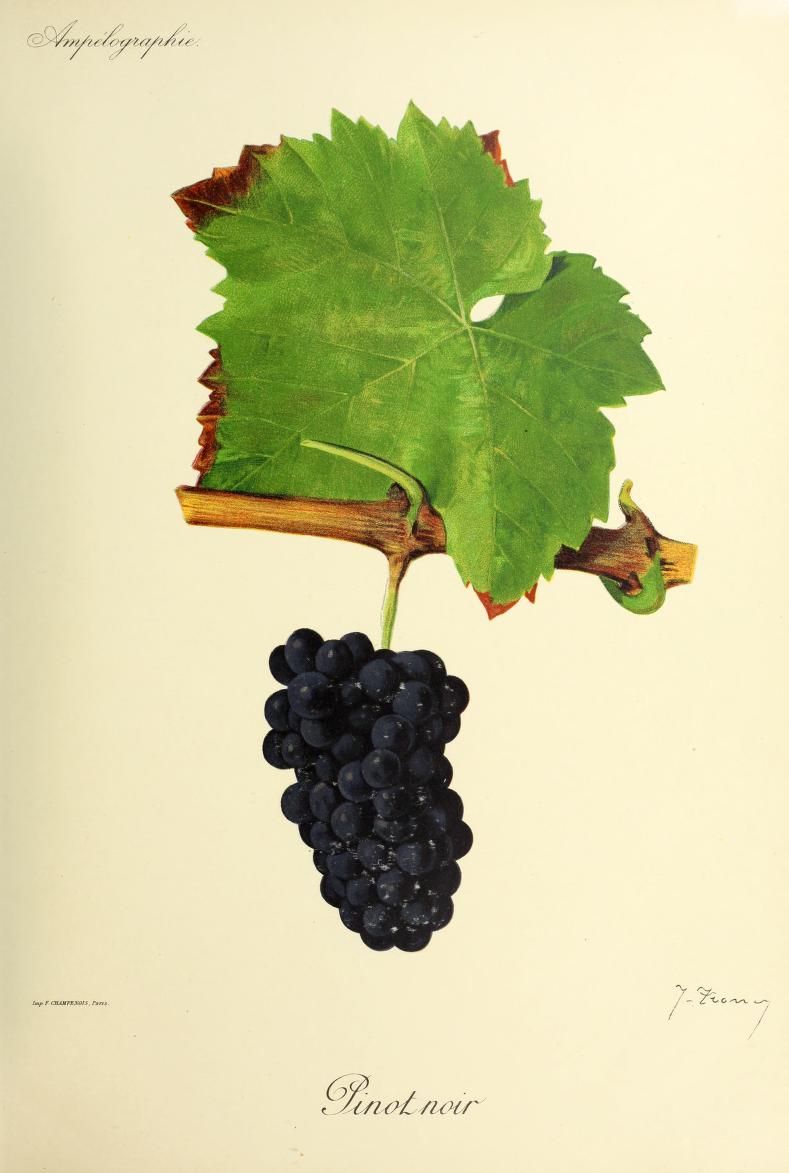
History and clonal diversity
Pinot Noir is clearly old, but its exact birthplace and its identity in antiquity are not securely documented. A historical study places the earliest known use of pinot as a grape name near Auxerre in 1366; other late fourteenth-century records connect Pinot wine with Burgundy and its trade. The often-repeated claim that Philip the Bold's 1395 ordinance explicitly required Pinot needs qualification: the surviving text condemns Gamay and orders its removal without naming a preferred replacement.1. Guillaume Grillon, Jean-Pierre Garcia & Thomas Labbé, “Le « très loyal pinot » : itinéraire d'un cépage mythique de la Bourgogne,” Crescentis (2019), https://doi.org/10.58335/crescentis.1003; Rémi Noraz et al., “Ancient DNA reveals 4000 years of grapevine diversity, viticulture and clonal propagation in France,” Nature Communications 17 (2026), article 2494, https://doi.org/10.1038/s41467-026-70166-z.
Genetics extends the history without resolving the birthplace. A 2026 study of ancient DNA matched a grape pip from fifteenth-century Valenciennes to modern Pinot Noir, evidence that the present genetic lineage has continued for nearly six centuries. Earlier Roman pips found in France are closely related to Pinot Noir but have not been shown to be the same variety. The evidence supports an old, widely connected lineage but cannot establish a continuous record of modern Pinot in Burgundy since Roman times.1. Guillaume Grillon, Jean-Pierre Garcia & Thomas Labbé, “Le « très loyal pinot » : itinéraire d'un cépage mythique de la Bourgogne,” Crescentis (2019), https://doi.org/10.58335/crescentis.1003; Rémi Noraz et al., “Ancient DNA reveals 4000 years of grapevine diversity, viticulture and clonal propagation in France,” Nature Communications 17 (2026), article 2494, https://doi.org/10.1038/s41467-026-70166-z.
Growers normally propagate vines by cuttings or grafting, not by seed. Each new vine retains its parent's identity, but mutations in growing tissue can be preserved in later cuttings. Repeated over centuries, this process has made Pinot especially diverse within the variety. France currently certifies 48 Pinot Noir clones, while conservatory collections established in Alsace, Burgundy, and Champagne hold nearly 800 accessions. Clonal material can differ in crop, bunch compactness, berry size, ripening, and phenolic potential; its performance also depends on site and season.2. Grégory Carrier et al., “Transposable Elements Are a Major Cause of Somatic Polymorphism in Vitis vinifera L.,” PLOS ONE 7 (2012), e32973, https://doi.org/10.1371/journal.pone.0032973; Silvia Vezzulli et al., “Pinot blanc and Pinot gris arose as independent somatic mutations of Pinot noir,” Journal of Experimental Botany 63 (2012), pp. 6359–6369, https://doi.org/10.1093/jxb/ers290.
Genetic work indicates that Pinot Blanc and Pinot Gris arose independently from Pinot Noir through different mutations affecting berry colour. Pinot Blanc and Pinot Gris are distinct cultivated forms, while Spätburgunder, Blauburgunder, and Pinot Nero are regional names for Pinot Noir itself.2. Grégory Carrier et al., “Transposable Elements Are a Major Cause of Somatic Polymorphism in Vitis vinifera L.,” PLOS ONE 7 (2012), e32973, https://doi.org/10.1371/journal.pone.0032973; Silvia Vezzulli et al., “Pinot blanc and Pinot gris arose as independent somatic mutations of Pinot noir,” Journal of Experimental Botany 63 (2012), pp. 6359–6369, https://doi.org/10.1093/jxb/ers290.
Viticulture and site sensitivity
Pinot Noir buds and ripens early. Early budbreak exposes young growth to spring frost, while early maturity lets the fruit complete ripening in places where later grapes may struggle. In hot conditions, ripening can proceed very quickly, acidity can fall, and overripe berries can shrivel; in a cold or wet season, waiting for sugar and skin development can increase exposure to rot. A cool climate can provide a longer, more gradual season; balanced grapes still depend on the site, weather, and harvest date.
Its small berries commonly form compact clusters, increasing disease risk. Damaged fruit, trapped moisture, and limited air movement within them favor grey rot. Microscopy of Champagne fruit found thinner skin cell walls in Pinot Noir than in Chardonnay, while other work shows that skin structure, cuticle, cluster compactness, maturity, and weather interact in disease susceptibility. Looser-clustered clones, canopy management, crop level, and an open, well-drained site can reduce some pressure.
Pinot Noir's site sensitivity reflects its linked responses to the vineyard environment. Aspect, elevation, wind, soil depth and water supply, canopy shade, and crop load change the heat, light, and water experienced by the fruit. In a controlled study, researchers harvested the same clone from twelve vineyards in California and Oregon and made the wines with a standard protocol. The wines differed in sensory and chemical composition, and many differences persisted with ageing.3. Annegret Cantu et al., “Investigating the impact of regionality on the sensorial and chemical aging characteristics of Pinot noir grown throughout the U.S. West coast,” Food Chemistry 337 (2021), article 127720, https://doi.org/10.1016/j.foodchem.2020.127720. The study covered one clone and one vintage across a large distance, with climatic and management differences that prevent isolating the effect of place. Clone, rootstock, vintage, farming, and harvest date can strengthen or blur any site pattern.
Wine character and cellar choices
Pinot Noir often gives paler wine than many dark-skinned varieties. Its grapes tend to contain relatively modest phenolics and lack the acylated anthocyanins that help stabilize colour in some other red grapes. Small berries can still provide substantial skin relative to juice. Tannin and pigment are distinct parts of the phenolic composition, and extraction determines how much of each enters the wine.
For red wine, harvest date sets a range of potential alcohol, acidity, fruit condition, and phenolic maturity. Fermenting crushed berries on their skins supplies colour and tannin; the duration and force of extraction can keep the result delicate or make it firmer. Whole-cluster fermentation introduces stems as well as intact berries and can change tannin, aroma, and the course of fermentation. Destemming, vessel choice, oxygen exposure, new or used oak, and bottle age add further variation. Younger wines often suggest red fruit and flowers, while savoury character can become more apparent with age.
Rapid pressing offers another path. Because most pigment is in the skin and the pulp is pale, dark grapes can yield a light base wine when skin contact is minimized. This is central to white sparkling wines made partly or wholly from Pinot Noir by the traditional method. Shorter contact can give rosé; longer contact produces red wine. Harvest and skin contact begin shaping the style before fermentation.
Where it is grown
Burgundy shows Pinot Noir as still red wine tied to named places. Across the Côte d'Or and other Burgundian districts, exposure, soil depth, elevation, vintage, crop, and cellar practice can produce wines of very different weight and tannic shape. Wines from each named place still vary by producer and vintage.
Champagne uses Pinot Noir for another purpose: fruit from the cool Montagne de Reims and Côte des Bar commonly enters sparkling blends, rosé Champagne, and white blanc de noirs. Picking for sparkling base wine generally prioritizes lower potential alcohol and retained acidity, while gentle pressing limits colour. Burgundy and Champagne apply different harvest and cellar goals to the same early-ripening grape.
In Germany, Spätburgunder is important in Baden, the Pfalz, Rheinhessen, Württemberg, the Rheingau, and the Ahr. The German Wine Institute distinguishes an older pattern of pale, mild wines from a more recent pattern with deeper colour, more tannin, and small-barrel maturation. German Pinot is also used for sparkling wine.
Beyond Europe, the Willamette Valley and cool parts of coastal California have become major American centres. New Zealand grows Pinot Noir principally in its cooler southerly regions, including Marlborough, Central Otago, Wairarapa, and North Canterbury; differences within those regions can be as important as the national label. Tasmania, Victoria's cooler districts, coastal Chile, South Africa's cooler sites, Canada, and England add further still and sparkling interpretations. Across this geography, “cool climate” covers maritime, continental, dry, and wet growing seasons that produce varied Pinot Noir styles.
Argentina's Río Negro supplies another contemporary context through surviving old Pinot Noir vineyards. Alejandro Iglesias's August 2026 regional survey reports growers adjusting harvest dates, extraction, and wood use there, connecting vineyard continuity with changing wine styles.
Related topics
Sources
- Alejandro Iglesias, “Argentine Pinot Noir: a challenging grape asserts itself across a range of terroirs”, Wines of Argentina, 16 August 2026, updated 24 August 2026, Río Negro section.
- Institut français de la vigne et du vin, INRAE & Institut Agro Montpellier, “Pinot noir N”, Plantgrape varietal record, edited 28 August 2026, accessed 1 September 2026.
- Guillaume Grillon, Jean-Pierre Garcia & Thomas Labbé, “Le « très loyal pinot » : itinéraire d'un cépage mythique de la Bourgogne”, Crescentis, 2019.
- Rémi Noraz et al., “Ancient DNA reveals 4000 years of grapevine diversity, viticulture and clonal propagation in France”, Nature Communications 17 (2026), article 2494.
- Grégory Carrier et al., “Transposable Elements Are a Major Cause of Somatic Polymorphism in Vitis vinifera L.”, PLOS ONE 7 (2012), e32973.
- Silvia Vezzulli et al., “Pinot blanc and Pinot gris arose as independent somatic mutations of Pinot noir”, Journal of Experimental Botany 63 (2012), pp. 6359–6369.
- Paul F. W. Mawdsley, Jean Catherine Dodson Peterson & L. Federico Casassa, “Agronomical and Chemical Effects of the Timing of Cluster Thinning on Pinot Noir (Clone 115) Grapes and Wines”, Fermentation 4 (2018), article 60.
- Alice André et al., “Physical, Anatomical, and Biochemical Composition of Skins Cell Walls from Two Grapevine Cultivars (Vitis vinifera) of Champagne Region Related to Their Susceptibility to Botrytis cinerea during Ripening”, Horticulturae 7 (2021), article 413.
- Annegret Cantu et al., “Investigating the impact of regionality on the sensorial and chemical aging characteristics of Pinot noir grown throughout the U.S. West coast”, Food Chemistry 337 (2021), article 127720.
- Comité Champagne, “Champagne and its grape varieties”, accessed 1 September 2026.
- Deutsches Weininstitut, “Spätburgunder”, accessed 1 September 2026.
- New Zealand Winegrowers, Pinot Noir, regional overview, accessed 1 September 2026.