Chardonnay
Chardonnay is a white Vitis vinifera variety historically associated with Burgundy and Champagne and now grown across much of the wine-producing world. Compared with strongly aromatic grapes, it has a relatively low concentration of free monoterpenes—the compounds that supply much of the overt perfume of Muscat and help distinguish Riesling. In this sense, Chardonnay is a “neutral” variety. Grape-derived precursors, ripeness and fermentation still contribute aroma, but no single varietal perfume consistently overrides place and production method.1. Jerry Lin, Mélanie Massonnet & Dario Cantu, “The genetic basis of grape and wine aroma,” Horticulture Research 6 (2019), article 81, https://doi.org/10.1038/s41438-019-0163-1; Dimitra Capone et al., “'Tropical' thiols are important contributors to the flavour of Chardonnay wines,” AWRI Technical Review 222 (2016), pp. 12–15.
This relative neutrality helps make site and cellar choices unusually legible. Chardonnay can become a taut, minimally oaked still wine, a broader wine shaped by malolactic fermentation, lees ageing, and barrels, or a base for sparkling wine. Butter, cream, vanilla, and toast have different causes.
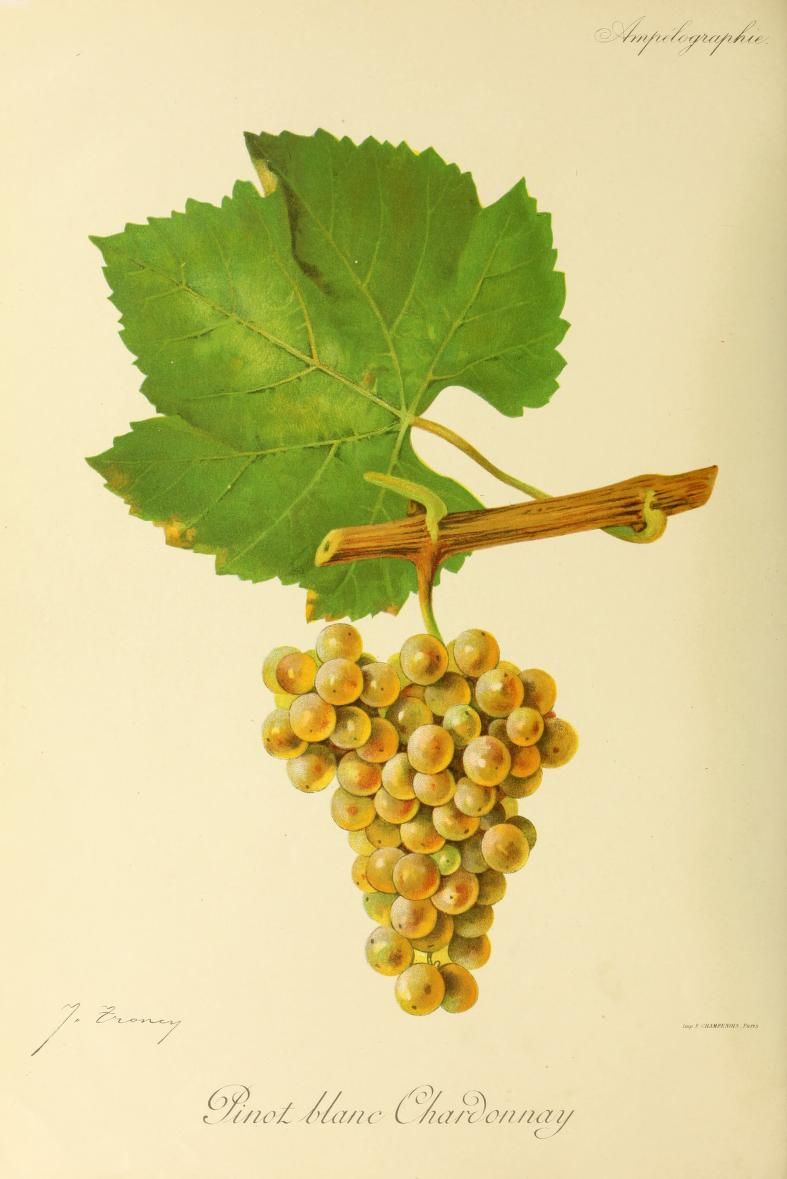
Origins and identity
Genetic analysis indicates that Chardonnay is an offspring of Pinot and Gouais blanc. The study found a parentage match across 32 microsatellite markers and placed Chardonnay among varieties long grown in northeastern France.2. John Bowers et al., “Historical Genetics: The Parentage of Chardonnay, Gamay, and Other Wine Grapes of Northeastern France,” Science 285 (1999), pp. 1562–1565, https://doi.org/10.1126/science.285.5433.1562. The evidence establishes biological parentage but cannot locate or date the original seedling. Burgundy is the variety's strongest historical home, while the modern distribution of its parents does not establish a precise birthplace. In the genetic study, Pinot denotes the old lineage represented by Pinot Noir, not a named modern clone.
Viticulture and site
Chardonnay buds and ripens early. Early budbreak makes spring frost a recurring risk. Early maturity allows it to ripen in relatively cool districts and can compress the harvest window in warm ones. Its small bunches and berries can reach substantial sugar while retaining useful acidity in suitable conditions. Powdery mildew is a concern, and vigorous vines whose fruit hangs late can suffer damaging grey rot. Clone, crop level, canopy management, and fruit health consequently shape the variety's performance.
Site acts through several connected routes. Elevation, aspect, wind and surrounding topography alter heat and light; soil depth and drainage affect the vine's water supply; season and farming change all of these effects. Cooler or less exposed sites may slow sugar accumulation and preserve more malic acid. Greater heat can accelerate sugar accumulation and malic-acid loss, while severe water stress may restrict photosynthesis and ripening. Harvest date then selects from that moving balance of sugar, acid, aroma precursors and fruit condition.
These relationships underlie Chardonnay's reputation for transparency to site. Vineyard comparisons must also account for clone, rootstock, crop, canopy, harvest date, and winemaking alongside geology.
Wine character and cellar choices
Chardonnay's fruit expression changes with growing conditions and picking. Research has found aroma-active thiols in the variety, including in unoaked wines made under a standardized protocol, while also showing that their sensory effect depends on concentration and interaction with the wine's other compounds.1. Jerry Lin, Mélanie Massonnet & Dario Cantu, “The genetic basis of grape and wine aroma,” Horticulture Research 6 (2019), article 81, https://doi.org/10.1038/s41438-019-0163-1; Dimitra Capone et al., “'Tropical' thiols are important contributors to the flavour of Chardonnay wines,” AWRI Technical Review 222 (2016), pp. 12–15. Yeast strain, fermentation temperature, juice solids, oxygen management and skin contact can further change fermentation-derived aroma.
Malolactic fermentation is a bacterial conversion, usually after or alongside alcoholic fermentation, in which malic acid becomes lactic acid and carbon dioxide. The conversion lowers titratable acidity and can make the acid profile seem softer. The buttery-smelling compound diacetyl can also arise as bacteria metabolise citric acid. Its concentration depends on bacterial strain, oxygen, redox conditions, timing, sulfur dioxide and continued contact with active yeast or bacteria; it can also be reduced to less aromatic compounds.3. Jan Clair Nielsen & Marianne Richelieu, “Control of Flavor Development in Wine during and after Malolactic Fermentation by Oenococcus oeni,” Applied and Environmental Microbiology 65 (1999), pp. 740–745, https://doi.org/10.1128/AEM.65.2.740-745.1999. Malolactic fermentation can therefore produce much, little, or no perceptible butter. A producer may encourage, limit or prevent the conversion according to the base wine's acidity and the intended style.
Lees are the yeast and other particles that settle after fermentation. Keeping wine on its fine lees allows yeast-cell material, including mannoproteins and other polysaccharides, to enter the wine over time. Chardonnay trials have found greater polysaccharide content with lees ageing, though the result varies with the retained lees, yeast, time, temperature, and whether the sediment is stirred.4. Sandra Pati, Maria Teresa Liberatore, Carmela Lamacchia & Ennio La Notte, “Influence of ageing on lees on polysaccharide glycosyl-residue composition of Chardonnay wine,” Carbohydrate Polymers 80 (2010), pp. 332–336, https://doi.org/10.1016/j.carbpol.2009.11.017. These compounds can influence texture, aroma interactions, and colloidal stability. Stirring, known as bâtonnage, increases contact between wine and sediment and can also change oxygen exposure. Lees ageing may broaden texture, but its effects are separate from bacterial diacetyl production.
Fermentation or maturation in barrel can add oak lactones, vanillin, volatile phenols, and compounds formed by toasting. The vessel also changes oxygen exposure during maturation. The effect depends on oak species, seasoning, and toast as well as barrel size, age, and contact time. New barrels generally yield more extractable aroma than barrels already used for wine.5. M. R. González-Centeno, K. Chira & P. L. Teissedre, “Use of oak wood during malolactic fermentation and ageing: Impact on Chardonnay wine character,” Food Chemistry 278 (2019), pp. 460–468, https://doi.org/10.1016/j.foodchem.2018.11.049; Encarna Gómez-Plaza et al., “The effect of successive uses of oak barrels on the extraction of oak-related volatile compounds from wine,” International Journal of Food Science and Technology 39 (2004), pp. 1069–1078, https://doi.org/10.1111/j.1365-2621.2004.00890.x. Vanilla and toast belong to the wood's influence. The effects of oak maturation, lees, and malolactic fermentation can integrate, so producers often combine them or use one without the others.
Sparkling wine
Sparkling production applies a different harvest and cellar objective to the same grape. Fruit for base wine is generally picked with less potential alcohol and more retained acidity than fruit intended for many still wines. The first fermentation makes a still, usually restrained base wine. In the traditional method, a measured addition of wine, sugar, and yeast starts a second fermentation in the sealed bottle; the carbon dioxide retained there supplies the bubbles. Time on the resulting yeast lees then introduces autolytic and maturation character before the sediment is removed.
Champagne demonstrates both blending and varietal expression. Chardonnay may be combined with Pinot Noir and Meunier or used alone for blanc de blancs. The appellation's production sequence requires the second fermentation in the bottle and subsequent maturation on its lees.6. Comité Champagne, “Bottling and second fermentation” and “Maturation on lees,” accessed 1 September 2026. England is another important contemporary setting. Chardonnay is used for blanc de blancs and blends with Pinot Noir and Meunier, with cool growing conditions supporting fresh base wines. Producers' increasing stocks of reserve wine allow more non-vintage blending alongside vintage releases. English Chardonnay also makes still wine, extending the regional comparison beyond sparkling production.7. WineGB, “Sparkling Wines” and “Our wine styles,” accessed 17 September 2026; “Record performance for still wines at this year's WineGB Awards,” 24 June 2025, documents both blanc de blancs and still Chardonnay entries.
Where it is grown
Burgundy and Champagne remain the clearest historical reference points. Chablis, the Côte de Beaune, and the Mâconnais use Chardonnay for still wines that can differ markedly in ripeness, acidity, texture, and oak expression. These differences reflect mesoclimate, vineyard position, season and production choices together; “Burgundian” covers many cellar approaches. In Champagne, Chardonnay is especially associated with the Côte des Blancs, where it serves a sparkling-wine objective distinct from Burgundy's still-wine one.
Beyond France, the variety is grown in Italy, California, Oregon, Australia, New Zealand, Chile, Argentina and South Africa, among many other places. Maritime influence, elevation and cool nights can extend the effective ripening season even at relatively warm latitudes.
In Chile, Casablanca and Limarí give Chardonnay contemporary coastal homes. Pacific cooling supports its role there, while vineyard position and cellar choices distinguish the resulting wines.
California provides two useful regional connections. Livermore Valley is associated with Wente's selection and dissemination of Chardonnay material. In the Santa Lucia Highlands, Talbott's Sleepy Hollow vineyard illustrates the combination of marine cooling, varied parcels, and clonal material behind several estate Chardonnay styles.
Related topics
Sources
- Wines of Chile, “Wine Regions Map”, Casablanca and Limarí entries, accessed 10 October 2026.
- Wente Vineyards, “Morning Fog Chardonnay,” Chardonnay legacy section, selection and dissemination of plant material, accessed 6 October 2026.
- Talbott Vineyards, “Sleepy Hollow Vineyard”, regional vineyard and clonal context, accessed 6 October 2026.
- Institut français de la vigne et du vin, INRAE & Institut Agro Montpellier, “Chardonnay B”, Plantgrape varietal record, edited 1 September 2026, accessed 1 September 2026.
- John Bowers et al., “Historical Genetics: The Parentage of Chardonnay, Gamay, and Other Wine Grapes of Northeastern France”, Science 285 (1999), pp. 1562–1565.
- Jerry Lin, Mélanie Massonnet & Dario Cantu, “The genetic basis of grape and wine aroma”, Horticulture Research 6 (2019), article 81.
- Joanna M. Gambetta, Susan E. P. Bastian, Daniel Cozzolino & David W. Jeffery, “Factors Influencing the Aroma Composition of Chardonnay Wines”, Journal of Agricultural and Food Chemistry 62 (2014), pp. 6512–6534.
- Dimitra Capone, Leigh Francis, Alice Barker & Patricia Williamson, “'Tropical' thiols are important contributors to the flavour of Chardonnay wines”, AWRI Technical Review 222 (2016), pp. 12–15.
- Jan Clair Nielsen & Marianne Richelieu, “Control of Flavor Development in Wine during and after Malolactic Fermentation by Oenococcus oeni”, Applied and Environmental Microbiology 65 (1999), pp. 740–745.
- Sandra Pati, Maria Teresa Liberatore, Carmela Lamacchia & Ennio La Notte, “Influence of ageing on lees on polysaccharide glycosyl-residue composition of Chardonnay wine”, Carbohydrate Polymers 80 (2010), pp. 332–336.
- M. R. González-Centeno, K. Chira & P. L. Teissedre, “Use of oak wood during malolactic fermentation and ageing: Impact on Chardonnay wine character”, Food Chemistry 278 (2019), pp. 460–468.
- Encarna Gómez-Plaza, Luis J. Pérez-Prieto, José I. Fernández-Fernández & José M. López-Roca, “The effect of successive uses of oak barrels on the extraction of oak-related volatile compounds from wine”, International Journal of Food Science and Technology 39 (2004), pp. 1069–1078.
- Comité Champagne, “Grape varieties”, “Bottling and second fermentation”, and “Maturation on lees”, accessed 1 September 2026.
- WineGB, “Sparkling Wines” and “Our wine styles”, accessed 17 September 2026.
- WineGB, “Record performance for still wines at this year's WineGB Awards”, 24 June 2025.