Canopy management
Canopy management is the deliberate arrangement or removal of a grapevine's shoots and leaves during the growing season. Shoot thinning, shoot positioning, leaf removal, hedging, and control of lateral shoots all change the small-scale environment around leaves and bunches. They can also change how much leaf area supports the crop. Growers adjust the canopy to suit the vine, site, season, and intended harvest.
Opening a canopy admits light, may expose berries to direct solar heating, allows wind and spray material to enter more readily, and can shorten the time that leaves and bunches remain wet. In a cool, humid vineyard those changes may help fruit ripen and limit disease. In a hot, dry vineyard, retaining shade may instead protect berries from overheating, sunburn, and dehydration.
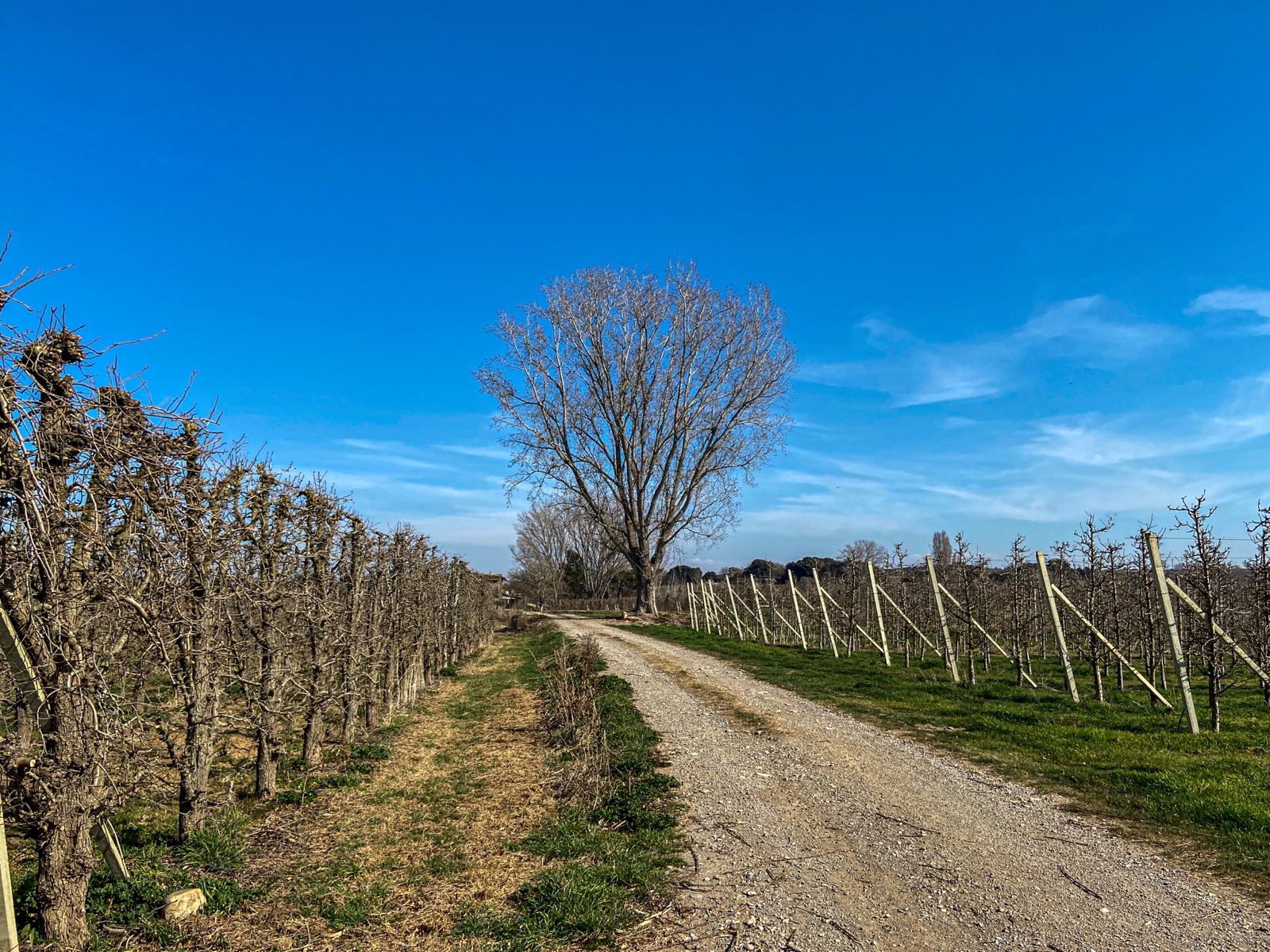
The canopy as a microclimate
Leaves intercept light for photosynthesis, but leaves layered on top of one another do not contribute equally. A dense canopy shades its interior leaves, fruit, and the buds that may bear the following year's crop. Crowded shoots also restrict air movement and spray penetration. Moisture can therefore persist longer around compact bunches, favouring diseases such as grey rot when the pathogen, variety, and weather are otherwise conducive. An open canopy can reduce this risk and improve the coverage of protective treatments.
A sunlit berry can become substantially warmer than the surrounding air, with the difference shaped by wind, time of day, row direction, and which side of the canopy it occupies. In a two-season Washington experiment, east-exposed Merlot had more skin anthocyanin than shaded fruit, while the hotter west-exposed fruit had less than the eastern fruit. Cooling and heating treatments showed that light promoted some pigments, whereas excessive berry temperature worked against their accumulation.1. S. E. Spayd et al., “Separation of Sunlight and Temperature Effects on the Composition of Vitis vinifera cv. Merlot Berries,” American Journal of Enology and Viticulture 53 (2002), pp. 171–182, https://doi.org/10.5344/ajev.2002.53.3.171.
Exposure also changes ripening in more than one dimension. Better-lit leaves can support sugar accumulation, while warmer berries generally lose malic acid more quickly. Light and temperature affect pigments, aroma precursors, and other metabolites through partly separate pathways. Varieties differ in pigment chemistry, and compounds important to Sauvignon Blanc or Riesling may respond differently from those in a dark grape.
The main interventions
Shoot thinning removes surplus shoots early, usually while they are still easy to detach. It can reduce crowding and separate bunches, but removing fruitful shoots can also reduce the crop. The remaining shoots may grow more strongly. Shoot positioning directs growth into the space provided by the training system. In vertical shoot positioning, catch wires hold shoots upright in a narrow wall; other systems may direct them downward or divide vigorous growth into separate curtains. Good positioning spreads leaves and bunches to limit dense pockets.
Fruit-zone leaf removal opens the area immediately around the bunches. Its effect depends especially on timing and degree. Removal after fruit set can improve light, drying, and spray access without necessarily taking away a large share of the vine's total leaf area. Removing leaves around bloom is a different intervention: those leaves are then important sources of carbohydrates for flowers. A meta-analysis of 59 publications found that pre-bloom removal reduced fruit set, yield, bunch compactness, and bunch rot on average, while responses still varied with cultivar, rootstock, and treatment.2. Joshua VanderWeide et al., “Impacts of Pre-bloom Leaf Removal on Wine Grape Production and Quality Parameters: A Systematic Review and Meta-Analysis,” Frontiers in Plant Science 11 (2021), article 621585, https://doi.org/10.3389/fpls.2020.621585. Looser bunches may be the intended result for a rot-prone variety, but the same yield loss could be undesirable in a low-cropping vineyard.
Late removal can expose berries that developed in shade to abrupt heat. This is especially risky on the side receiving intense afternoon sun. University of California guidance therefore couples leaf removal for grey-rot control with a warning against excessive or late removal in warm districts.3. University of California Statewide Integrated Pest Management Program, UC IPM Pest Management Guidelines: Grape, “Botrytis Bunch Rot,” updated August 2023, pp. 99–101. Growers may open only the cooler or morning-sun side of a row, remove leaves selectively, or retain more cover during a hot season. Earlier exposure can allow berries to acclimate, but it does not make them immune to an extreme heat event.
Hedging, also called shoot trimming, cuts growth that extends beyond the planned canopy. It keeps shoots out of alleys, limits renewed shading, and makes spraying and other work practical. A moderate cut may have little effect on ripening when ample functional leaf area remains. An early cut can, however, stimulate lateral shoots and rebuild a denser canopy; a severe or late cut may remove enough active leaf area to slow sugar accumulation. Laterals can either crowd the fruit zone or supply useful young leaves, depending on their position and the condition of the canopy.
Matching practice to conditions
Canopy decisions begin before summer work. Row direction, vine spacing, training system and pruning, rootstock, water, and nitrogen supply influence how much growth must later be arranged or removed. A vigorous vine forced into a narrow canopy may require repeated passes yet quickly refill its shaded interior. Dividing the canopy or moderating vigour may address the cause more effectively, while a weak or drought-stressed vine may need its limited leaf area and protective shade.
Climate supplies the broad constraint, but the current season supplies the immediate one. A wet flowering period, a disease-susceptible compact bunch, and a cool site strengthen the case for early opening. Drought, a heatwave, exposed western fruit, or a variety prone to sunburn strengthen the case for cover. Crop load and harvest goal matter as well: taking away shoots, leaves, or clusters changes both the bunch microclimate and the balance between leaf photosynthesis and fruit demand.
Related topics
- The vineyard year places canopy work within the full growing cycle.
- Botrytized sweet wine
Sources
- Stefano Poni, Tommaso Frioni & Matteo Gatti, “Summer pruning in Mediterranean vineyards: is climate change affecting its perception, modalities, and effects?”, Frontiers in Plant Science 14 (2023), article 1227628.
- Peter R. Dry, “Canopy management for fruitfulness”, Australian Journal of Grape and Wine Research 6 (2000), pp. 109–115.
- S. E. Spayd, J. M. Tarara, D. L. Mee & J. C. Ferguson, “Separation of Sunlight and Temperature Effects on the Composition of Vitis vinifera cv. Merlot Berries”, American Journal of Enology and Viticulture 53 (2002), pp. 171–182.
- Joshua VanderWeide et al., “Impacts of Pre-bloom Leaf Removal on Wine Grape Production and Quality Parameters: A Systematic Review and Meta-Analysis”, Frontiers in Plant Science 11 (2021), article 621585.
- University of California Statewide Integrated Pest Management Program, UC IPM Pest Management Guidelines: Grape, “Botrytis Bunch Rot,” updated August 2023, pp. 99–101, accessed 1 September 2026.
- William Nail, “Mature Vine Training”, eViticulture, reviewed by Bruce Bordelon and Patty Skinkis, 2019, accessed 1 September 2026.