The vineyard year
Vineyard management follows a living plant through a recurring sequence: dormancy, new growth, flowering, fruit development, ripening, and preparation for another winter. The grower's task is to bring in suitable grapes while keeping the vine productive in future seasons. Pruning, arranging shoots, managing water, and protecting against disease all serve that shared purpose.
This guide follows an established vineyard through the year. Read it alongside From harvest to bottle, which follows the fruit into the winery. The linked concept pages explain individual processes in greater depth.
Follow the vine, then the calendar
The sequence is more portable than the dates. Winter and summer fall in opposite halves of the calendar in the two hemispheres, and varieties in the same vineyard can reach a growth stage at different times. A warm spring may advance budbreak without removing the possibility of a later freeze. Growers therefore record what the vines are doing as well as the weather forecast.
| Stage | What changes | Main management questions |
|---|---|---|
| Dormancy | Leaves are absent; buds and woody tissues carry the vine through winter. | Which wood and buds should remain? Has cold damaged them? |
| Budbreak and shoot growth | Buds open and the new canopy develops. | Can shoots survive frost? Which shoots should be retained? |
| Flowering and fruit set | Some flowers become berries. | How much crop is forming, and how vulnerable is it to disease? |
| Berry growth | Bunches enlarge while shoots and leaves continue growing. | Does the canopy have enough useful leaf area for the crop? |
| Véraison and ripening | Berries soften and their composition changes. | Is ripening progressing towards the intended wine style? |
| Harvest and autumn | Fruit leaves the vine; surviving leaves can continue working. | When should each block be picked, and what does the vine need afterwards? |
These stages overlap with continuing work on soil, water, equipment, and vine health. A grower may be planning harvest while still managing disease and preparing a cover crop for the next season.
The plant that pruning leaves behind
A grapevine keeps its roots and woody framework between seasons. A shoot is the green growth produced during the current season; after it matures into wood, growers call it a cane. A cordon is an older arm of the vine, often trained along a wire. Buds on last season's canes can produce the shoots that carry this year's bunches.
That distinction explains why a vineyard can look drastically cut back each winter yet return to a leafy canopy. The grower preserves the framework and selected young wood from which the next crop can grow. Meanwhile, buds forming on this year's shoots contain the beginnings of future growth. Conditions in one summer can therefore affect fruitfulness in the next.1. Edward W. Hellman, “Grapevine Structure and Function,” Oregon Viticulture, pp. 5–19, especially vine structures and annual growth.
Longer-term choices constrain the annual work. The variety must fit the available growing season, and the training system must accommodate its growth. Grafting allows a fruiting variety to grow on a different rootstock, chosen partly for resistance to phylloxera and adaptation to soil conditions. Annual pruning cannot fully compensate for unsuitable planting material or a poorly chosen site.
Winter: set the framework and potential crop
Dormant pruning decides how many buds remain and where their shoots will grow. Leaving more fruitful buds generally creates more potential shoots and bunches; the eventual harvest also depends on bud survival, flowering, fruit set, and berry growth. Growers assess the previous season's growth and winter injury before deciding how much wood to retain.
In cane pruning, selected canes are retained relatively long and positioned to carry the coming season's shoots. In spur pruning, selected canes are cut back to short lengths bearing a few buds, commonly distributed along a cordon. A spur is thus shortened young wood, even when it sits on a much older arm. Both approaches renew fruiting growth; their suitability depends on the variety's bud fruitfulness, the training system, labour, and climate.2. Madeline Wimmer, Cold Climate Grape Management: Dormant Pruning, University of Minnesota Extension, anatomy and pruning sections.
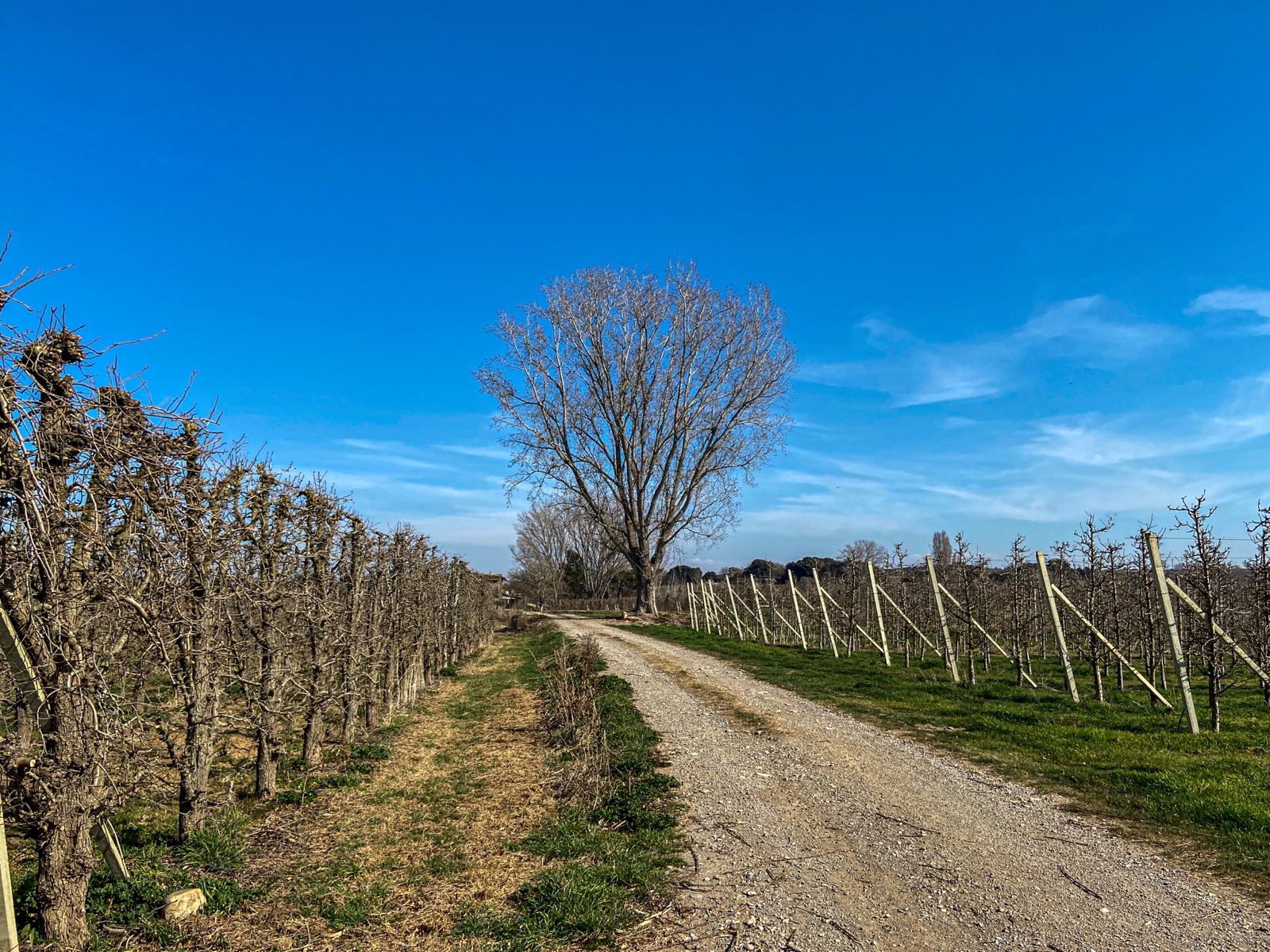
Pruning is also an opportunity to inspect damaged wood and plan renewal. Winter hardiness concerns survival during dormancy; it does not guarantee that the new green shoots will survive spring frost. In cold regions, a damaged vine may need rebuilding as well as a smaller crop.
Spring: establish the canopy and protect new growth
At budbreak, stored reserves help support growth before the new leaves become a substantial source of carbohydrates. Shoots then expand rapidly. The grower checks which buds survived and removes unwanted shoots where they would crowd the canopy or interfere with the planned vine structure.
Spring frost can destroy tender shoots and their developing bunches. A vineyard in a hollow may collect cold air even when nearby slopes escape injury. Wind machines can help during suitable temperature inversions, when warmer air lies above colder air near the vines; they have little useful warm air to mix during a widespread windy freeze. Delayed or staged pruning can postpone budbreak in some systems, but its timing must fit the vineyard.
The distinction between a living vine and an intact crop matters after damage. Replacement shoots can restore foliage without replacing every lost bunch. Growers reassess yield expectations and canopy work rather than continuing with the plan made before the frost.3. NC State Extension, “Prevention and Management of Frost Injury in Wine Grapes,” site selection, active protection, and delayed pruning.
Flowering: find out how much fruit has set
Grape flowers are small, and most cultivated wine grapes have flowers capable of self-pollination. Each successful flower can become a berry, but only a proportion does. Fruit set is this transition from flowers to developing fruit. Weather and the vine's resource supply during flowering help determine how many berries a bunch carries.
Cold, prolonged cloud, rain, water stress, and nutritional problems can impair the process. Excessive shedding of flowers or young berries is called coulure, or shatter. Poor set may leave a loose, light bunch; the grower then has less crop than a winter bud count suggested. Conversely, strong set can produce compact bunches and a larger harvest to support.4. Joseph Fiola, “Grape Fruit Set and Shatter (Coulure),” University of Maryland Extension, updated 2024.
This is why crop estimates become more useful as the season progresses. Removing fruit before the remaining crop is understood can compound an unexpectedly small set. Decisions about yield need observations from the current season.
Summer: arrange leaves, light, and air
The canopy supplies the carbohydrates needed for growth and ripening. Its outer leaves intercept sunlight, while deeply shaded leaves contribute less. Canopy management arranges that leaf area and the environment around the bunches.
Shoot thinning reduces crowding. Shoot positioning spreads growth into the space provided by wires or another training system. Selective leaf removal opens the fruit zone, improving ventilation and access for protective sprays. Hedging trims growth beyond the intended canopy. These operations have different consequences: removing a shoot may remove its bunches too, whereas positioning it can improve its exposure while retaining both fruit and leaves.
Opening a dense canopy is particularly useful where damp conditions encourage rot. Shade also influences the fruitfulness of developing buds, connecting summer work to next year's potential crop.5. NC State Extension, “Chapter 7. Canopy Management,” microclimate and bud fruitfulness.
Exposure needs restraint in hot conditions. Berries in direct sun can become warmer than the air, and abrupt late leaf removal can expose previously shaded fruit to sunburn. A grower may retain afternoon shade while opening another part of the canopy. The desired result is enough functioning leaf area and appropriate fruit exposure for that site, rather than maximum removal.6. Stefano Poni, Tommaso Frioni, and Matteo Gatti, “Summer pruning in Mediterranean vineyards,” 2023, leaf-removal timing and heat exposure.
Crop load: when a vine has too much fruit
Overcropping means carrying more fruit than the vine can ripen adequately under the prevailing conditions. The same fruit weight can be manageable on a large, healthy canopy and excessive on a small or stressed one. Yield per hectare also depends on vine density, so it cannot describe this balance by itself.
Cluster thinning, sometimes called green harvesting, removes bunches to reduce demand. It can help an overburdened vine ripen its remaining fruit and maintain reserves. Removing fruit from a vine that already has sufficient capacity may offer little improvement. Timing matters too: late removal of damaged bunches can simplify harvest without substantially changing the ripening of what remains.
Oregon State University's synthesis finds no universal crop level that guarantees quality. Growers compare crop weight with canopy development, ripening, and the weight of canes removed at winter pruning, building a record of how each block performs.7. Patricia A. Skinkis and Amanda J. Vance, “Understanding vine balance,” EM 9068; Oregon State University Extension, “The role of canopy management in vine balance,” EM 9071, crop-thinning discussion.
Kemmeter Wines provides a concrete Finger Lakes example. Its vineyard account describes winter pruning, tying two canes to the wires in spring, repeated summer shoot and leaf work, and vine-by-vine crop thinning in late July or early August. The producer connects that thinning with its aim of ripening the remaining crop. This is a documented approach in one vineyard; whether another block needs the same intervention depends on its growth, fruit set, and season.8. Kemmeter Wines, “Vineyards,” seasonal account, accessed 22 September 2026. Its quality aspirations are the producer's own account.
Water, nutrients, and the ground between the rows
Water supports both the development of the canopy and its continued function. Severe drought can restrict photosynthesis and slow ripening. Shrivelling can also raise a berry's measured sugar concentration simply by removing water. A higher reading under those conditions does not necessarily mean that the vine has delivered more sugar to the berry.9. Joseph Fiola, “Drought Stress, Vine Performance, and Grape Quality,” University of Maryland Extension, updated 2021.
Irrigation, where available and permitted, is adjusted to soil moisture, vine condition, and the stage of growth. Nutrition needs similar observation: too little nitrogen can restrict growth, while excess can encourage a dense canopy. Tissue analysis helps distinguish a deficiency from a problem that fertiliser will not solve.
The vineyard floor is part of this system. Cover crops can protect soil from erosion, improve its structure, and provide habitat for beneficial insects. Legumes can contribute nitrogen; grasses can capture nutrients. Living ground cover also uses resources, so its species, location, and mowing or termination date must fit water availability and vine vigour. The strip beneath the vines and the alley used by machinery can be managed differently.10. Melissa Fery, “The function and selection of cover crops,” Oregon State University Extension; EM 9071, nutrition and vineyard-floor management.
Disease management starts before symptoms dominate
Disease control runs through the growing season. Growers combine vineyard history, weather, growth stage, and scouting to judge risk. Protecting susceptible tissue before infection is often more effective than responding after damaged fruit becomes conspicuous.
Different diseases follow different rules. Powdery mildew can spread through repeated infections without requiring rain for every cycle. Downy mildew is especially associated with wet conditions and can damage both bunches and the leaves needed to ripen them. Black rot can survive in mummified berries and other infected material, making removal of that material useful between seasons. Symptoms may appear well after the infection that caused them.11. UC IPM, “Powdery Mildew”; Campbell et al., downy mildew report (2018); Madeline Wimmer, “Black rot on grapes” (2026).
Botrytis bunch rot adds a particular late-season concern. Flowers can become infected earlier, with the fungus remaining inactive until berries ripen. Damaged ripe berries also provide entry points. Humid, sheltered bunches favour its spread, connecting early canopy work and protection with the condition of fruit at harvest.12. UC IPM, “Botrytis Bunch Rot,” infection timing and cultural controls.
An open canopy can improve drying and treatment coverage, but it does not replace protection when infection pressure is high. Nor does one successful spray settle the season: new growth, further infection periods, and resistance of pathogens to particular treatments complicate control. Varieties with disease resistance change the level of risk, while still requiring observation.
Pierce's disease introduces a different pattern: insects carry a bacterium into the vine's water-conducting tissue. Management therefore includes attention to insect vectors and infected vines, beyond the canopy and fungal-disease protection described above.13. UC IPM, “Pierce's Disease,” vector biology and management.
Véraison to harvest: decide what ripe means
Véraison marks the onset of ripening. Berries soften; dark varieties begin changing colour. Thereafter, growers follow sugar, acids, berry condition, and flavour together. Colour change is a useful landmark, not a signal that picking should begin immediately.
Sampling needs to represent the block, including its variation in exposure and development. A handful of attractive berries from the sunny edge can give a misleading impression. Repeated sampling reveals the direction and pace of change more usefully than one isolated measurement.
Degrees Brix estimates soluble solids, mostly sugars in ripe grape juice. It helps anticipate potential alcohol. Titratable acidity measures the quantity of acid neutralised in a standard test. pH reflects hydrogen-ion activity: a lower value means a more acidic environment. It affects microbial behaviour and wine stability. These two measures of acidity are related but not interchangeable.14. Iowa State University, “Grape Sampling for Maturity Analysis”; James Osborne, “Preparing for harvest: Grape chemistry and prefermentation adjustments,” Oregon State University Extension.
The intended wine supplies the endpoint. Fruit for a sparkling base may be picked with more acidity and less sugar than fruit for a fuller still wine. Waiting can improve the desired flavour or texture, but also expose the crop to rain, rot, heat, or animal damage. Harvest is a judgement about those changes, with labour and winery capacity determining what can be brought in and processed promptly.
After harvest: support the next season
Where healthy leaves remain, photosynthesis continues after picking and can replenish reserves in woody tissues. This opportunity is shorter in a cool region with an early autumn frost than in a region with a long, mild autumn. Reserves also begin accumulating before harvest when the vine's supply exceeds current demand; autumn is not their only source.15. Mardi Longbottom, “Post-harvest care of tired vines,” 2019.
Premature defoliation from drought or disease can reduce that contribution. Post-harvest attention to water, leaf health, and nutrition therefore serves the following season, even though this year's grapes are already in the winery. As leaves age and fall, the vine returns to dormancy. Harvest records, disease observations, and winter pruning weights inform the next round of decisions.
Sources
- UC Statewide IPM Program, “Pierce's Disease”, Pest Management Guidelines: Grape, accessed September 2026.
- Peter Dry and Bryan Coombe, eds., “Grapevine growth stages – The modified E-L system”, Viticulture 1: Resources, second edition (2004), figure 7.3, p. 153.
- Edward W. Hellman, “Grapevine Structure and Function”, Oregon Viticulture, pp. 5–19, reproduced chapter.
- Madeline Wimmer, Cold Climate Grape Management: Dormant Pruning, University of Minnesota Extension.
- NC State Extension, “Prevention and Management of Frost Injury in Wine Grapes” and “Chapter 7. Canopy Management”, North Carolina Winegrape Grower's Guide.
- Patricia A. Skinkis and Amanda J. Vance, “Understanding vine balance”, Oregon State University Extension, EM 9068 (2013).
- Oregon State University Extension, “The role of canopy management in vine balance”, EM 9071 (2013).
- Stefano Poni, Tommaso Frioni, and Matteo Gatti, “Summer pruning in Mediterranean vineyards: is climate change affecting its perception, modalities, and effects?”, Frontiers in Plant Science 14 (2023), article 1227628.
- Kemmeter Wines, “Vineyards”, accessed 22 September 2026.
- Joseph Fiola, “Grape Fruit Set and Shatter (Coulure)”, updated 2024, and “Drought Stress, Vine Performance, and Grape Quality”, updated 2021, University of Maryland Extension.
- Melissa Fery, “The function and selection of cover crops”, Oregon State University Extension, reviewed 2024.
- UC Statewide IPM Program, “Powdery Mildew” and “Botrytis Bunch Rot”, Pest Management Guidelines: Grape.
- Sarah Campbell et al., “Downy mildew resistance to QoI fungicides is rampant in Georgia vineyards”, University of Georgia (2018).
- Madeline Wimmer, “Black rot on grapes (Guignardia bidwellii)”, University of Minnesota Extension, 23 June 2026.
- Iowa State University Extension, “Grape Sampling for Maturity Analysis”, Grape Maturity Series, FS 0049A (2020).
- James Osborne, “Preparing for harvest: Grape chemistry and prefermentation adjustments”, Oregon State University Extension (2023).
- Mardi Longbottom, “Post-harvest care of tired vines”, Australian & New Zealand Grapegrower & Winemaker 664 (2019), pp. 37–38.