From harvest to bottle
Winemaking turns harvested grapes into a wine that can be kept, transported, and poured. Fermentation is the central transformation, but it sits within a longer sequence of decisions about grape solids, microorganisms, oxygen, and time. Those decisions explain why fruit from the same variety can become very different wines.
This guide follows the cellar work from reception to bottling, continuing The vineyard year. It concentrates on still wine, with links to the additional routes used for sparkling, sweet, and fortified styles. Here, cellaring means making and maturing wine at the winery; keeping a finished bottle is covered in bottle aging.
The main paths through the winery
The most useful first question is when the liquid leaves the grape skins. Maceration is contact with grape solids; pressing extracts liquid from them. Fermentation converts sugar to alcohol. These are separate processes, and their order matters.
| Wine route | Early sequence | What the sequence makes possible |
|---|---|---|
| Most white wines | Press grapes, clarify juice, then ferment. | Limit skin extraction while retaining juice and fermentation aromas. |
| Direct-press rosé | Press dark grapes promptly, then ferment the pink juice. | Extract some skin colour during pressing, with limited contact. |
| Most red wines | Ferment with skins, then drain and press. | Extract colour and tannin as fermentation changes the liquid. |
| Skin-contact white wines | Ferment white grapes with skins, then drain and press. | Develop phenolic texture without red-grape pigmentation. |
After those early differences, the routes converge. The winemaker decides whether to encourage malolactic conversion, how long to retain lees, where to mature the wine, and how to prepare it for packaging. Several operations can overlap. A white wine might ferment in a barrel, undergo malolactic conversion there, and remain on its lees in the same vessel.
Reception: preserve the fruit and understand the lot
At the winery, fruit can be inspected and sorted before processing. The condition of the grapes matters immediately: breaking berries brings their sugary contents into contact with organisms on the skins and equipment. Time, temperature, oxygen exposure, and cleanliness then influence what grows. Cleaning and sanitation of equipment remain important throughout production, including when the producer intends to ferment without adding yeast.1. University of California, Davis, “Grape, Juice and Must Processing Impacts on Flora,” particularly processing and equipment flora.
Each batch, or lot, is identified so its vineyard origin and subsequent treatments can be followed. The winemaker measures sugar and acidity, tastes the juice, and assesses the condition of the fruit. Analysis of yeast-assimilable nitrogen helps establish whether the juice can support a healthy fermentation. Any permitted adjustment is chosen for that particular lot and the intended wine, rather than a universal recipe.
Destemming removes berries from the stalks. Crushing breaks berries open. A machine can do both, but they are distinct choices: destemmed berries can remain partly intact, while whole bunches can be pressed without first being crushed. Retaining bunches for whole-cluster fermentation introduces stems and intact berries into a red ferment, changing extraction and fermentation conditions.
White juice: pressing, then clarification
For most white wine, the skins and seeds are separated early. Some producers press whole bunches; others destem and crush, sometimes allowing a period of skin contact to extract aroma precursors and other compounds. Prolonging that contact also changes phenolic extraction and the juice's composition. Fermenting with skins takes the wine into the distinct route described under skin-contact white wine.
Freshly pressed juice contains suspended pulp and other particles. The winemaker can let these settle and transfer the clearer juice, or use another separation method such as flotation or centrifugation. This preparation is often called juice clarification, or débourbage in French cellar accounts.
Some solids can support yeast nutrition and affect fermentation, so clarity is a choice of degree. Over-clarified juice can be difficult to ferment; excessive or unhealthy solids can create other problems. The desired solids content depends on the fruit and style.2. The same UC Davis account, clarification discussion; AWRI, “Winemaking treatment – Skin contact.”
Rosé: choose the skin contact deliberately
Most dark wine grapes have pale juice, with much of their red pigment in the skins. The exceptions include teinturier varieties with coloured flesh. For rosé, the winemaker manages contact to obtain the desired colour, aroma, and texture, then generally ferments the separated juice.
Direct pressing takes dark grapes to the press without a separate period of maceration. Contact still occurs as the press fills and operates, allowing some colour to enter the juice. Short skin maceration deliberately holds juice with the skins before separating it. Duration, temperature, variety, and fruit condition affect extraction, so no single contact time defines rosé. Provence's wine body describes both routes as established regional practice.3. Conseil Interprofessionnel des Vins de Provence, “Elaboration of Rosé,” direct pressing and skin-maceration descriptions.
Saignée, meaning bleeding, draws off some liquid from a red-grape vat. That portion can become rosé, while the remaining ferment has more skins relative to its liquid. The harvest and extraction decisions may therefore serve two wines at once. A dedicated rosé harvest can instead be chosen entirely for the pink wine's desired acid, sugar, and flavour balance. These are different production aims, not a fixed quality ranking.4. Australian Wine Research Institute, “Winemaking treatment – Saignée.”
Alcoholic fermentation: keep the yeast working
During alcoholic fermentation, yeast consumes glucose and fructose and produces ethanol, carbon dioxide, heat, and numerous other compounds. Fermentation aromas become part of the wine alongside grape-derived aroma. The process needs a sufficiently healthy yeast population to continue as sugar falls and alcohol rises.
A producer can inoculate with a selected culture or allow organisms already present to start the fermentation. Uninoculated fermentation draws on winery populations as well as those arriving with grapes. Either approach requires monitoring and suitable conditions.5. University of California, Davis, “Overview of Grape Juice Fermentation” and “Fermentation Management Practices.”
The winemaker follows temperature and the fall in density, which tracks the progress of sugar consumption. Cooling removes fermentation heat; nutrient decisions respond to the juice and yeast. Controlled oxygen exposure can help active yeast, even though the finished wine will usually need much tighter protection from air. Conditions that favour fermentation are not identical to those required for storage.
A ferment that stops with unwanted sugar remaining is stuck. It differs from a wine whose residual sugar is intentional. For a sweet wine, preserving sugar creates a later stability problem: yeast must not restart uncontrolled in the bottle. Nor does a quiet tank prove that fermentation is complete; analysis establishes what remains.
Red wine: ferment and extract together
In a red ferment, carbon dioxide lifts skins into a floating cap. Winemakers keep that material in contact with the liquid through cap management. A punch-down pushes the cap under the surface. A pump-over draws liquid from below and distributes it over the cap. Rack-and-return temporarily drains the liquid to another vessel and returns it over the collapsed solids.
These operations redistribute heat and change extraction and oxygen exposure. The force, frequency, and timing matter. Pigment, flavour compounds, and tannin do not all enter the wine at the same rate, and the rising alcohol changes what can be extracted. More work on the cap does not produce an unlimited increase in desirable colour or texture.6. Geoff Cowey, “Traditional cap management techniques,” 2023; AWRI, “Winemaking treatment – Extended post-fermentation maceration.”
The decision to separate the wine from its skins ends this stage of maceration. Some wines are pressed before alcoholic fermentation finishes and complete it as liquid; others stay with skins after the sugar has been consumed. Continued contact changes texture and extraction while requiring ongoing protection against spoilage. The appropriate endpoint depends on the grapes and the wine being made.
Pressing: separate the liquid and choose the fractions
Liquid that drains without applied pressing pressure is called free-run. The press then recovers more from the remaining material. In white winemaking this is usually juice; in red winemaking it is commonly fermenting or fermented wine. Later fractions can differ in acidity, phenolics, and solids, so they can be kept apart for assessment and eventual blending.
A basket press compresses grapes within a draining basket, often with a mechanical or hydraulic plate. A pneumatic press uses an inflatable membrane to squeeze them against a draining surface. Pressure is usually applied in stages, with pauses or redistribution of the grape mass to let more liquid escape. Equipment, loading, pressure, and the programme together determine extraction.7. Simon Nordestgaard, “The history of wine presses. Part 1: Batch presses,” 2015.
“Whole-bunch pressed” describes what entered the press. “Direct press” describes the early production route. “Basket pressed” describes equipment. They answer different questions and can apply to the same wine.
Malolactic conversion: decide what happens to malic acid
Malolactic fermentation, or MLF, uses bacteria to convert malic acid into lactic acid and carbon dioxide. It generally reduces acidity and can alter aroma and texture. It commonly follows alcoholic fermentation, but the bacteria can also be introduced while the yeast is still working. Calling it a “second fermentation” can obscure that overlap and confuse it with the bottle fermentation of sparkling wine.
Most red wines undergo MLF. In whites and rosés, the decision depends on the desired acid profile and style. Completing conversion removes malic acid that could otherwise support an unwanted conversion later; preventing it preserves that acid but requires continued control of bacteria.8. OIV, “Microbiological de-acidification by lactic acid bacteria”; AWRI, “Malolactic fermentation in red wine” (2024) and “Using malolactic fermentation to modulate wine style” (2020).
The buttery compound diacetyl can develop through bacterial metabolism, but its eventual prominence depends on the organisms and subsequent handling. MLF need not make a wine conspicuously buttery. Likewise, softness in a white wine can also reflect lees contact, residual sugar, or other choices.
Timing affects the next operation. An addition of sulfur dioxide intended to protect a finished wine can inhibit a desired MLF. The winemaker therefore monitors malic acid and coördinates protection with the chosen microbial sequence, instead of treating every post-fermentation addition as automatic.
Racking and lees: decide what stays with the wine
As wine settles, it deposits lees: yeast and bacteria, grape fragments, tartrate crystals, and other solids. Racking transfers the liquid into another vessel while leaving a deposit behind. It can follow fermentation, clarification, or a treatment that creates sediment. It is a separation step, not a synonym for every movement of wine.
Racking can be carried out with limited air contact, using protected receiving vessels and careful transfers, or with intentional aeration when that serves a particular purpose. Each transfer also offers an opportunity for oxygen pickup or contamination. Its timing follows the condition of the wine and deposit.9. OIV, “Racking,” International Code of Oenological Practices, II.3.2.3.
Coarse, rapidly settling gross lees commonly contain more grape debris; fine lees are the smaller, slower-settling fraction and can be rich in yeast. A wine can be separated from an undesirable coarse deposit while retaining sound fine lees for lees aging.
As yeast material breaks down and interacts with the wine, lees contact can modify texture and aroma. Stirring the deposit into suspension, or bâtonnage, increases contact. It is optional: some wines mature on undisturbed lees. Retaining a deposit also means monitoring it for unwanted sulfur aromas or microbial activity, then racking when contact has served its purpose.10. Peter Godden, “Understanding the effects of lees contact in white wine,” 2020.
Maturation: manage the vessel, air, and time
The period between fermentation and bottling is often called élevage. Wine continues changing while the producer tastes, analyses, blends, clarifies, and protects it. The vessel helps set the conditions for those changes.
Stainless steel supplies storage without oak extraction. In oak maturation, wine can take up compounds from the wood while receiving small amounts of oxygen. Barrel age, size, construction, and time influence the result. An old cask may give little obvious oak flavour and still behave differently from a sealed steel tank. Fermenting in wood and moving an already fermented wine into wood also create different conditions.
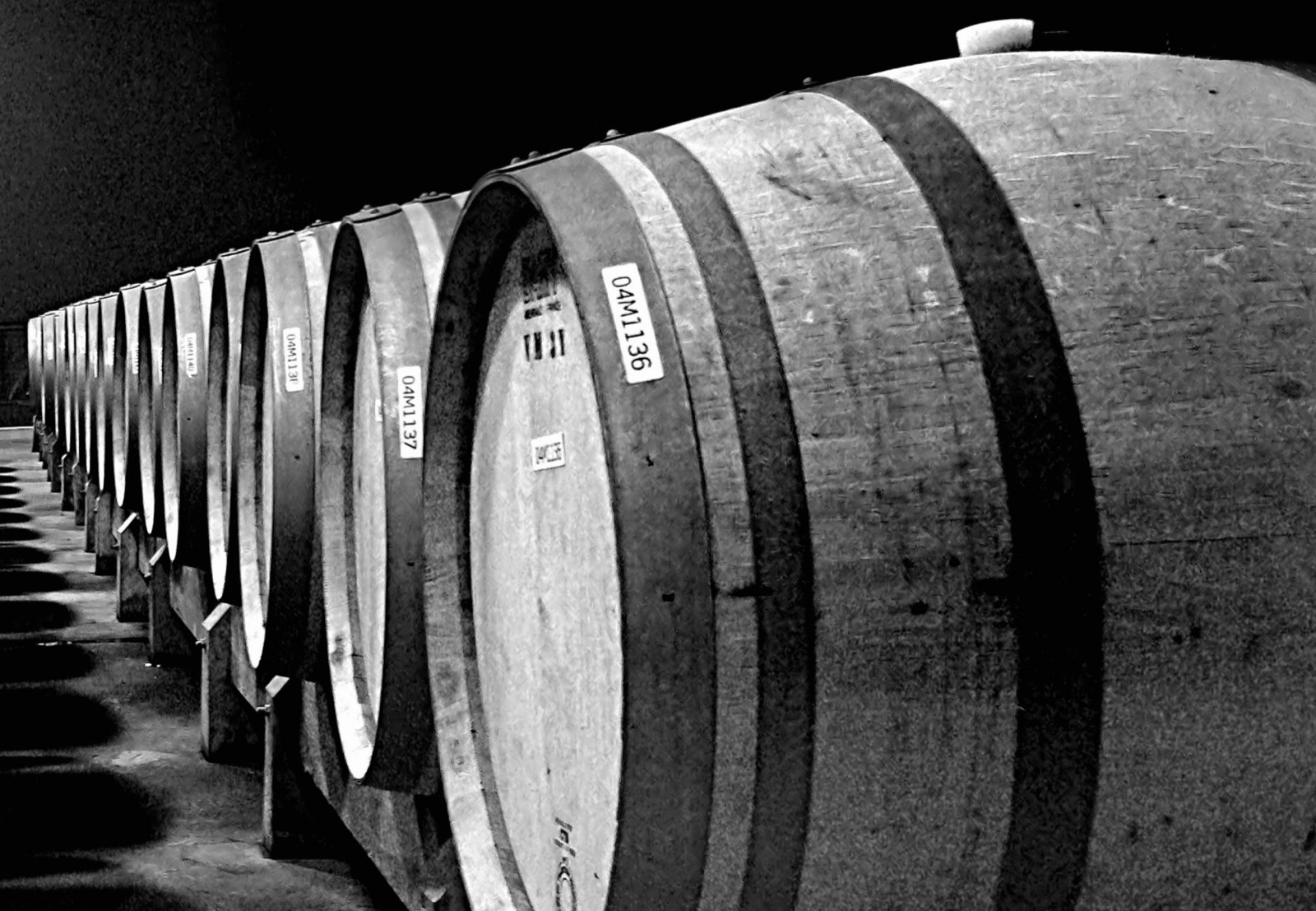
Topping adds wine to replace losses and reduce the air space, or ullage, above it. Wine can be lost through evaporation, absorption into new wood, and sampling. A barrel with a growing pocket of air presents different oxidative and microbial conditions from one kept full. Topping and checks on protective sulfur dioxide are recurring cellar work.11. AWRI, “Cleaning, storage and maintenance of barrels,” topping, evaporation, and sanitation sections; OIV, “Ageing in small capacity wooden containers.”
The topping wine must itself be sound. Filling a vessel cannot remove microorganisms already established in it, which is why barrel cleaning and monitoring remain necessary. Deliberately untopped wines matured under flor, such as Vin Jaune, follow a different intended process.
Sulfur dioxide helps control microorganisms and oxidative change. Some becomes bound to wine components, leaving a smaller free fraction; pH affects how much of that free fraction is in the most antimicrobial form. The amount originally added therefore cannot stand in for a current analysis. Protection must be considered alongside oxidation, vessel management, and the expected conditions after bottling.12. Geoff Cowey and Adrian Coulter, “How much sulfur dioxide (SO₂) is needed at bottling?”, 2021.
Blending and preparation for bottling
Blending can combine varieties, vineyard parcels, picking dates, vessels, or press fractions. Small trial blends let the producer compare proportions before committing the entire volume. Even a single-variety wine may be an assembly of lots that fermented or matured differently.
The final blend then needs assessment. Two wines that were stable separately can change behaviour when mixed, and later treatments can change stability again. Decisions made earlier in the cellar must be checked against the wine actually going into the bottle.
Clarity, physical stability, and microbial stability answer different questions:
- Clarity concerns material already suspended in the wine. Settling and racking can remove much of it.
- Physical stability concerns material that might form later. Dissolved proteins can produce haze, while tartrate salts can form crystals.
- Microbial stability concerns surviving organisms and what they could still consume, including sugar or malic acid.
Fining adds a material that binds or gathers selected wine components for removal. Bentonite, for example, can remove proteins that would otherwise form haze. Other agents can reduce unwanted bitterness or astringency. Bench trials help establish whether treatment achieves its purpose without taking away too much desirable character.13. AWRI, “Fining Agents,” purposes and trial treatments.
Tartrate stabilization addresses crystal formation. Chilling encourages potassium bitartrate to precipitate before bottling; other methods remove relevant ions or inhibit crystal growth. The crystals are harmless, but producers may wish to avoid a deposit in a wine intended to remain bright. Cold treatment does not resolve every form of tartrate instability.14. AWRI, “Cold stabilisation,” including effects of blending and subsequent treatments on stability.
Filtration passes wine through a material that retains particles. Removing visible solids and removing microorganisms require different performance. A suitable final membrane, integrity checks, and clean equipment after the filter work together to prevent renewed contamination. A clear-looking wine can still contain organisms capable of activity in bottle.15. AWRI, “Filtration – physical removal of microorganisms.”
These treatments solve particular problems; every wine does not need every treatment. The appropriate sequence depends on its composition, previous handling, desired presentation, and storage expectations.
Bottling: preserve the result of the cellar work
Before filling, the producer checks the finished wine, including its gas content and protection against spoilage. Dissolved carbon dioxide can affect the palate even when a wine is sold as still. Oxygen can enter through transfers and filling, so a well-prepared wine still needs careful packaging.
Total package oxygen includes oxygen dissolved in the wine and oxygen in the bottle's headspace. Managing only the dissolved portion misses part of the exposure. Inert gas, suitable filling conditions, and correct closure application help limit pickup. Bottle headspace also provides room for thermal expansion, so it is managed differently from topping a storage barrel.16. AWRI, “Oxygen pick-up during packaging – understanding total package oxygen.”
Once sealed, the wine continues to change under conditions influenced by its composition, closure, temperature, and time. Bottling preserves a chosen stage of development; it does not stop wine chemistry.
Sparkling and fortified wines branch from this general route. A traditional-method sparkling wine undergoes another alcoholic fermentation in its final bottle, followed by lees maturation and removal of that deposit. Fortification adds spirit, sometimes early enough to stop fermentation and retain sugar. Those differences build on the same underlying questions of extraction, microbial activity, separation, and preservation.
Sources
- University of California, Davis, “Overview of Grape Juice Fermentation”, “Fermentation Management Practices”, and “Grape, Juice and Must Processing Impacts on Flora”, Fermentation Management Guides.
- Conseil Interprofessionnel des Vins de Provence, “Elaboration of Rosé”.
- Australian Wine Research Institute, “Winemaking treatment – Saignée”, “Winemaking treatment – Skin contact”, and “Winemaking treatment – Extended post-fermentation maceration”.
- Geoff Cowey, “Traditional cap management techniques”, Australian & New Zealand Grapegrower & Winemaker 712 (2023), pp. 58–59.
- Simon Nordestgaard, “The history of wine presses. Part 1: Batch presses”, Australian & New Zealand Grapegrower & Winemaker 619 (2015).
- International Organisation of Vine and Wine, “Racking”, “Microbiological de-acidification by lactic acid bacteria”, and “Ageing in small capacity wooden containers”, International Code of Oenological Practices, accessed 22 September 2026.
- Australian Wine Research Institute, “Malolactic fermentation in red wine”, updated November 2024, and “Using malolactic fermentation to modulate wine style”, updated August 2020.
- Peter Godden, “Understanding the effects of lees contact in white wine”, AWRI Technical Review 249 (2020), pp. 4–8.
- Australian Wine Research Institute, “Cleaning, storage and maintenance of barrels”.
- Geoff Cowey and Adrian Coulter, “How much sulfur dioxide (SO₂) is needed at bottling?”, Australian & New Zealand Grapegrower & Winemaker 687 (2021), pp. 76–77.
- Australian Wine Research Institute, “Fining Agents”, “Cold stabilisation”, and “Filtration – physical removal of microorganisms”.
- Australian Wine Research Institute, “Oxygen pick-up during packaging – understanding total package oxygen”.