Finger Lakes
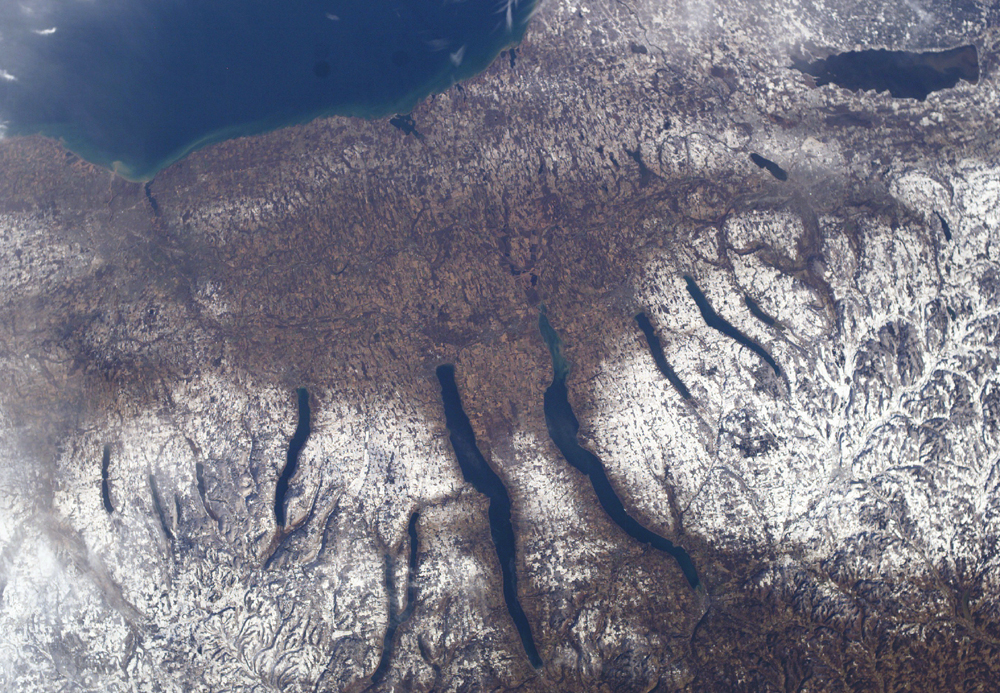
The Finger Lakes is a wine region in west-central New York and an American viticultural area (AVA), the United States legal category for a delimited grape-growing region distinguished by geographic features. The AVA was established in 1982. Its name refers to the long, narrow lakes left in valleys shaped and deepened by Pleistocene glaciation. Vineyards occupy slopes that vary in elevation, exposure, and distance from the water, with consequences for cold protection and ripening.
Riesling is the region's best-known wine grape, yet the Finger Lakes also produces Chardonnay, Pinot Noir, Cabernet Franc, Gewürztraminer, Grüner Veltliner, and hybrid grapes such as Cayuga White. That range reflects a central fact about the region: its lakes make vinifera possible in many sites, but they do not remove winter injury, spring frost, or the challenge of ripening later varieties.
Lakes, slopes, and climate
The larger Finger Lakes occupy deep glacial troughs. Cornell's Finger Lakes Grape Program identifies Canandaigua, Keuka, Seneca, and Cayuga as roughly 300 to 650 feet deep and says they rarely freeze. Their water stores heat and releases it slowly, moderating nearby winter lows and summer heat. In spring, cool water can delay budbreak; in autumn, the relatively warm lakes can delay the first frost. Hillsides add a second mechanism: cold air drains downhill, so a vineyard partway up a slope may avoid the coldest air that settles on the valley floor.1. Timothy E. Martinson, Cornell Cooperative Extension, “Second Year Pre-Plant: Site Selection.”
The lake effect varies with location. Cornell advises growers to evaluate macroclimate together with elevation, topography, and proximity to a body of water. A site a few miles from a deep lake, on a suitable slope, may have a different frost and winter-injury risk from a site at the same latitude on a high or poorly drained position.
The region's history as a legal AVA reflects this geography. In its 1982 final rule, the Bureau of Alcohol, Tobacco and Firearms adopted boundaries closer to the eleven Finger Lakes than the much larger area first petitioned. The agency accepted the combination of lake moderation, air drainage, and a relatively uniform growing season as evidence of a distinct grape-growing area, while distinguishing the AVA from New York's broader tourism and statistical boundaries.2. Bureau of Alcohol, Tobacco and Firearms, “Finger Lakes,” Federal Register, 1 September 1982, especially the sections on boundaries and geographical evidence.
Winter and ripening constraints
New York's growing-season temperatures can resemble those of northern Europe, but its winter lows are more severe. Cornell lists extreme winter cold, late spring frosts, and insufficient heat among the limits that affect vine survival, yield, and consistent ripening. Variety choice therefore joins site selection: grapes differ in both cold tolerance and the length of season they need to ripen.1. Timothy E. Martinson, Cornell Cooperative Extension, “Second Year Pre-Plant: Site Selection.”
The lakes help in several seasons, but a sudden deep freeze can still injure buds and trunks. Winter hardiness also depends on how fully vines acclimated before the cold arrived. In the growing season, growers must balance the desire to leave fruit hanging for more maturity against autumn rain, rot, and the risk that a late crop will not ripen evenly. A warm site may support Cabernet Franc or Pinot Noir in a favorable year, while a cooler or more exposed site may favor an earlier-ripening grape or a hybrid bred for regional conditions.
The region is changing as well as varying from site to site. Cornell reported that growing degree days in the Finger Lakes rose from about 2,400 in 2000 to 2,700 in 2020, while warmer winters have encouraged earlier budbreak and greater exposure to spring frost. More heat can improve ripening in some years, including for red grapes, but it also changes harvest timing and the balance between sugar, acidity, fruit health, and alcohol.3. Cornell University, “Climate change brings challenges, and opportunities to Finger Lakes wineries,” 16 October 2024.
Grapes and wine styles
Riesling fits the region's long, cool ripening season because it can retain acidity while accumulating flavor and sugar. It appears as dry, off-dry, and sweet wine, and as sparkling wine; harvest date and fermentation endpoint are more useful guides to style than the regional name alone. Cool conditions can preserve freshness, but the final wine also reflects crop level, picking date, fruit health, yeast and fermentation choices, and maturation.
The wider grape mix shows how growers respond to the climate. Chardonnay and Pinot Noir can make still or sparkling wines where the site and vintage allow them to ripen. Cabernet Franc is an important red-wine option, while other vinifera, including Gewürztraminer and Grüner Veltliner, occupy suitable sites. Hybrids such as Cayuga White combine Vitis vinifera ancestry with genes from other grape species and have a place in the region because cold tolerance, reliable cropping, and ripening are practical concerns.
Comparing sites within a lake district
A lake name still leaves considerable variation unexplained. Hermann J. Wiemer's Seneca Lake vineyards offer a documented comparison. The estate describes HJW as a cooler site, higher and farther from the water, with shallow topsoil over shale. Its Magdalena property benefits from closer air exchange with the lake and deeper soil. Those differences influence which grapes can ripen and how the estate allocates fruit among wines.4. Hermann J. Wiemer Vineyard, “Vineyards,” estate descriptions of HJW and Magdalena. The site's effects are the producer's field account, rather than a controlled experiment isolating soil from climate.
The comparison joins soil with climate. Rooting depth and soil water storage affect growth and drought exposure, while distance from the lake and cold-air movement alter temperatures. The same shoreline consequently contains several growing environments; “shale” alone gives an incomplete account of how a particular wine developed.
Wiemer's Dry Riesling combines sites and picking dates, while its vineyard bottlings offer narrower comparisons. The estate describes early selections from HJW contributing structure and acidity to the blend. Blending here is a way to assemble different expressions of the region, alongside the choice to bottle particular sites separately.
Cellar decisions and a wider regional identity
Wiemer's winemaking account describes indigenous-yeast fermentation, careful fruit selection, and fermentations that can proceed slowly. It connects this approach with healthy fruit and continued cellar observation. Fermentation endpoint, residual sugar, and time on the lees can then change how Riesling's acidity and texture are perceived. These are producer choices within the Finger Lakes, with other cellars using different fermentation strategies.
Dr. Konstantin Frank supplies a complementary reference on Keuka Lake. Cornell's account places the winery among the growers who helped establish the region's modern vinifera industry in collaboration with research and extension. That history continues through wines beyond Riesling: its 2025 Rkatsiteli comes from a variety the estate grows on both Keuka and Seneca. It describes a late white-grape harvest and stainless-steel fermentation, producing an unoaked wine with some remaining sugar.5. Dr. Konstantin Frank Winery, “Rkatsiteli 2025,” vineyard and winemaking notes; the description concerns that bottling.
This broader identity also includes Cayuga White's still and sparkling wines and Léon Millot reds. Modern vinifera production and the region's hybrid tradition coexist. Their different growing needs and cellar uses make the Finger Lakes more varied than a single Riesling style, even though Riesling remains its clearest international reference.
Usonia adds a current example of vineyard renewal on Cayuga Lake. Its New Suns account describes replacing dead or declining vines with hybrids while retaining healthy Riesling and Cabernet Franc. Aravelle and Marquette are among the replacements. The producer expects blends to change as the new vines become productive; this is a documented estate strategy within the wider regional response to vineyard pressures.6. Usonia, “New Suns,” dated planting account. The expected change in wine composition is the producer's stated plan.
Its purchased-fruit wines broaden that picture further. Usonia bottles Steuben as rosé, and Goode's 2026 report documents a Sabrevois red. Its 2024 ’Member When? combines Verdelet with Geneva White #2, using different skin contact and maturation for each. The producer also reports a 2025 wine from Cornell's experimental selection NY 06.0514.06.
The regional AVA and the lake AVAs
“Finger Lakes” and “Seneca Lake” or “Cayuga Lake” are related but distinct appellations of origin. The Cayuga Lake AVA was established in 1988 within the Finger Lakes AVA.7. Bureau of Alcohol, Tobacco and Firearms, “Cayuga Lake Viticultural Area, NY”, Federal Register, 25 March 1988, final rule. Its federal description places it in Seneca, Tompkins, and Cayuga counties around Cayuga Lake. The Seneca Lake AVA was established in 2003 and surrounds Seneca Lake across portions of Schuyler, Yates, Ontario, and Seneca counties.8. Bureau of Alcohol, Tobacco and Firearms, “Seneca Lake Viticultural Area”, Federal Register, 3 July 2003, final rule. The current eCFR lists Cayuga Lake at § 9.127 and Seneca Lake at § 9.128 as separate approved American viticultural areas.9. Electronic Code of Federal Regulations, 27 CFR § 9.127 and 27 CFR § 9.128.
Sources
- Bureau of Alcohol, Tobacco and Firearms, “Finger Lakes,” Federal Register, 1 September 1982, final rule establishing 27 CFR § 9.34.
- Bureau of Alcohol, Tobacco and Firearms, “Cayuga Lake Viticultural Area, NY,” Federal Register, 25 March 1988, final rule establishing 27 CFR § 9.127.
- Bureau of Alcohol, Tobacco and Firearms, “Seneca Lake Viticultural Area,” Federal Register, 3 July 2003, final rule establishing 27 CFR § 9.128.
- Timothy E. Martinson, Cornell Cooperative Extension, “Second Year Pre-Plant: Site Selection”, extension guidance on climate limitations, lake moderation, and mesoclimate, accessed 20 October 2026.
- Cornell University, “Climate change brings challenges, and opportunities to Finger Lakes wineries”, Cornell Chronicle, 16 October 2024.
- Electronic Code of Federal Regulations, 27 CFR § 9.127, Cayuga Lake and 27 CFR § 9.128, Seneca Lake, current approved American viticultural area regulations, accessed 7 September 2026.
- Hermann J. Wiemer Vineyard, “Vineyards” and “Winemaking”, Seneca site comparisons, blending, and fermentation practices, accessed 20 October 2026.
- Dr. Konstantin Frank Winery, “Rkatsiteli 2025”, vineyard locations and wine production, accessed 20 October 2026.
- Usonia, “New Suns”, “Pompliano Pink 2025”, “’Member When? 2024”, and “Something Celestial 2025”, planting, sourcing, and cellar accounts, accessed 20 October 2026.
- Jamie Goode, “Usonia, a really innovative wine project from New York's Finger Lakes”, Wine Anorak, 19 October 2026, Sabrevois bottling.