Cabernet Franc
Also known as Breton, Bouchet
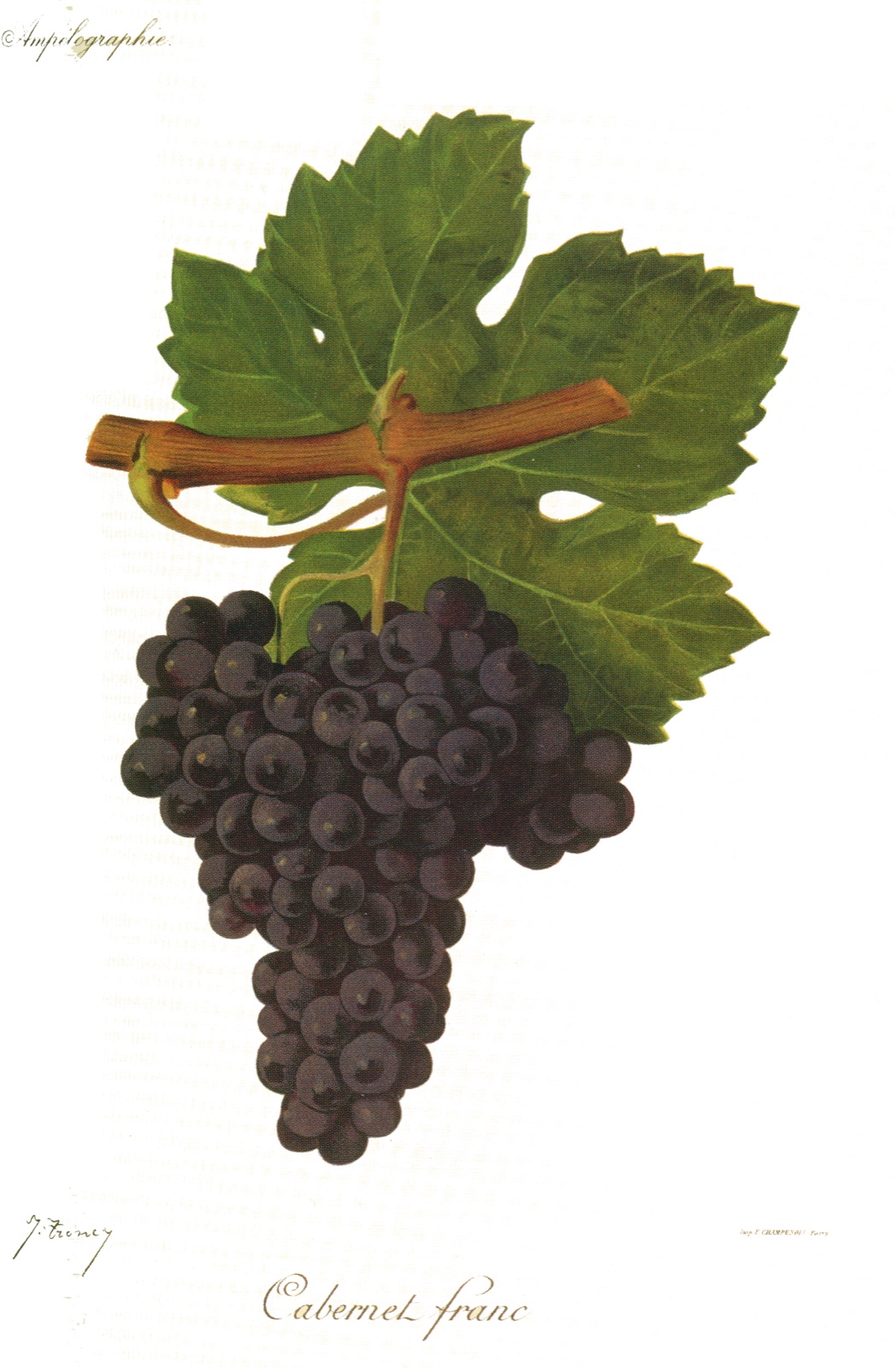
Cabernet Franc is a dark-skinned Vitis vinifera variety long established in southwestern France and the Loire Valley. It is a parent of better-known grapes and a component of Bordeaux blends. In the central Loire, northeastern Italy, and several New World regions, it also makes red and rosé wines under its own name.
It commonly combines red-fruit and floral aromas with a leafy or pepper-like accent, and it normally ripens before Cabernet Sauvignon. Climate, crop level, canopy, harvest date, extraction, and blending can shape those traits into a fresh, fragrant wine or one dominated by green aroma and firm texture.
History and family
Cabernet Franc's origin remains unsettled. The French Plantgrape catalogue places it probably in southwestern France. DNA analysis has also found first-degree relationships with the old Basque variety Morenoa and an accession recorded as Txakoli. The direction of each relationship remains unresolved, so the evidence proves neither a particular pair of parents nor a precise birthplace.1. Jean-Michel Boursiquot et al., “Parentage of Merlot and Related Winegrape Cultivars of Southwestern France: Discovery of the Missing Link,” Australian Journal of Grape and Wine Research 15 (2009), pp. 144–155, https://doi.org/10.1111/j.1755-0238.2008.00041.x; John E. Bowers & Carole P. Meredith, “The Parentage of a Classic Wine Grape, Cabernet Sauvignon,” Nature Genetics 16 (1997), pp. 84–87, https://doi.org/10.1038/ng0597-84. Breton in the Loire and Bouchet in Bordeaux are regional names for the same variety.
Its role as a parent is much clearer. Microsatellite analysis identified Cabernet Franc and Sauvignon Blanc as the parents of Cabernet Sauvignon. Separate work established Cabernet Franc and Magdeleine Noire des Charentes as the parents of Merlot and proposed Cabernet Franc and Gros Cabernet as those of Carménère. The Carménère analysis contained discrepancies at three genetic markers, making it less secure than the other two parentages.1. Jean-Michel Boursiquot et al., “Parentage of Merlot and Related Winegrape Cultivars of Southwestern France: Discovery of the Missing Link,” Australian Journal of Grape and Wine Research 15 (2009), pp. 144–155, https://doi.org/10.1111/j.1755-0238.2008.00041.x; John E. Bowers & Carole P. Meredith, “The Parentage of a Classic Wine Grape, Cabernet Sauvignon,” Nature Genetics 16 (1997), pp. 84–87, https://doi.org/10.1038/ng0597-84. These relationships help explain shared family traits, including methoxypyrazine production. Each grape also inherited half its genome from a different parent and has its own ripening and structural behaviour.
Viticulture and ripening
In the French reference collection, Cabernet Franc reaches maturity roughly two and a half to three weeks after Chasselas, compared with about three to three and a half weeks for Cabernet Sauvignon. The ranges overlap, but Cabernet Franc generally provides the earlier harvest window.2. Institut français de la vigne et du vin, INRAE & Institut Agro Montpellier, Plantgrape records for Cabernet franc N and Cabernet-Sauvignon N, accessed 1 September 2026. That difference can be decisive where autumn rain, cooling temperatures, or frost may end the season. It helps explain why Cabernet Franc can play a leading role in the Loire and in cool parts of North America, where Cabernet Sauvignon is harder to ripen consistently.
Cabernet Franc also breaks bud before Cabernet Sauvignon, leaving its young shoots more exposed to late frost. The vine is fairly vigorous and bears small berries in medium bunches. Unchecked growth can shade the fruit, while an excessive crop can prolong ripening; both can preserve green character even though the variety is earlier than Cabernet Sauvignon. Moderate resistance to grey rot is useful in humid autumns. Trunk diseases and leafhoppers are among its other concerns.
Plantgrape associates good results with clay-limestone sites and with sandy soils without water stress. Drainage, available water, exposure, and climate shape vine growth and fruit development. The same soil can behave differently in a wet Loire season, maritime Bordeaux, or an irrigated dry region.
Wine character and cellar choices
Cabernet Franc often produces less deeply coloured and less densely tannic wine than Cabernet Sauvignon, while retaining enough acidity and tannin to make structured wines. Red-cherry or raspberry-like fruit and floral impressions are common reference points. A key aroma compound is 3-isobutyl-2-methoxypyrazine (IBMP). This potent grape-derived compound can contribute leafy, herbal, or green-pepper aromas.3. John D. Dunlevy et al., “A Methyltransferase Essential for the Methoxypyrazine-Derived Flavour of Wine,” The Plant Journal 75 (2013), pp. 606–617, https://doi.org/10.1111/tpj.12224; Mengqi Ling et al., “Modification of Sensory Expression of 3-Isobutyl-2-methoxypyrazine in Wines through Blending Technique,” Molecules 26 (2021), article 3172, https://doi.org/10.3390/molecules26113172.
IBMP is produced early in berry development and generally declines during ripening. Its sensory effect depends on concentration, season, and fruit-zone microclimate. Warmth and well-judged exposure often reduce it, while shade, high vigour, and delayed fruit development can preserve more. In hot sites, greater exposure raises competing risks of sunburn, water stress, and acid loss. Small amounts of IBMP can sit within the variety's aroma, and other volatile compounds can suppress or amplify the perception of green character. Herbal aroma alone does not prove that the fruit was unripe.
Winemaking changes the frame around that aroma. Shorter skin contact and gentle extraction can emphasize fragrance and freshness; longer or more forceful extraction can build colour and tannin when the fruit supports it. Blending can alter the perception of both IBMP and texture, while oak and bottle age add new aromas. Mature Cabernet Franc styles vary accordingly.
Regional roles
Loire Valley
In the central Loire, Cabernet Franc is principally used on its own. Chinon, Bourgueil, Saint-Nicolas-de-Bourgueil, Saumur-Champigny, and parts of Anjou and Touraine use it for dry reds, and some appellations also make rosé. The current Chinon specification names Cabernet Franc as the principal grape for red and rosé, limits Cabernet Sauvignon to 10 percent of an estate's plantings, and requires a Cabernet Franc majority when the two are blended.4. Ministère de l'Agriculture et de la Souveraineté alimentaire, Cahier des charges de l'appellation d'origine contrôlée “Chinon”, homologated 8 June 2026, pp. 2–4.
Its relative precocity makes red wine possible near the cool edge of its useful range. Its weight and flavour vary across the Loire. Warm, exposed sites and favourable years can support fuller ripeness and longer extraction; cooler sites, higher crops, or difficult seasons tend toward lighter structure and more obvious herbal character. Sand and gravel may warm and drain quickly, while limestone-derived and clay-rich sites regulate water differently. Their effects on the finished wine depend on the season and farming.
Bordeaux
Bordeaux usually gives Cabernet Franc a supporting role. It is most important on the Right Bank, where Saint-Émilion's official description places it behind dominant Merlot but ahead of Cabernet Sauvignon. Relative to Merlot it can add a different aromatic lift, acidity, and tannic line; relative to Cabernet Sauvignon it offers an earlier harvest. The proportions change by site, estate, and vintage, with a few wines relying heavily on Cabernet Franc within this broader regional pattern.
On the Left Bank it is generally a smaller part of Cabernet Sauvignon-led blends. There its earlier maturity can diversify harvest risk and its aroma can modify a blend, while Cabernet Sauvignon usually provides the principal colour and tannic mass.
Northeastern Italy
In Friuli-Venezia Giulia and Veneto, Cabernet Franc has both varietal and blending identities. The Friuli regional denomination permits a wine labelled Cabernet Franc when at least 85 percent comes from the variety; it also allows Cabernet Franc in Rosso and in a generic Cabernet that may combine Cabernet Franc, Cabernet Sauvignon, and Carménère. The Venezia denomination similarly provides for varietal Cabernet Franc, two-variety wines, and broader red blends.5. Ministero dell'agricoltura, della sovranità alimentare e delle foreste, production specifications for Friuli or Friuli Venezia Giulia and Venezia protected designations of origin. A label reading Cabernet may therefore identify either Cabernet Franc alone or a blend.
Historical confusion with Carménère further complicates older accounts of plantings. One Italian selection imported to the University of California as Cabernet Franc was later identified by morphology and DNA as Carménère. Modern catalogues and regulations distinguish the two, so past figures or traditions that treated every “Cabernet Franc” vine as correctly identified deserve caution.
New World regions
New World producers use Cabernet Franc in both Bordeaux-family blends and varietal wines. California has cultivated it since the nineteenth century and uses it in both roles. In cooler northeastern and mid-Atlantic North America, including Ontario, the Finger Lakes, and Virginia, its earlier maturity and somewhat better cold hardiness than many dark-skinned vinifera varieties make it a practical option, although winter injury, humid-season disease, and excessive vigour remain real limits. Ontario's appellation authority lists it among the common varieties in Niagara and among the popular grapes for Vintners Quality Alliance table wines.6. Nancy L. Sweet, The Black Grapes of Bordeaux, University of California, Davis Foundation Plant Services, 2018; Ontario Wine Appellation Authority, “Wine Categories and Labelling” and “Niagara Peninsula”; Instituto Nacional de Vitivinicultura, “Informe de variedad: Cabernet Franc,” 2024.
New York State deserves particular attention for varietal Cabernet Franc. The Finger Lakes and Long Island offer different settings for wines that can emphasize acidity, herbal fragrance, and moderate weight. Interviews with growers in both regions document choices ranging from unoaked, partly carbonic wines to longer-macerated, barrel-aged examples. That range reflects deliberate stylistic choices as well as the conditions in which the fruit ripens.7. Britt Karlsson, “Cabernet Franc in Finger Lakes and Long Island in New York,” BKWine Magazine, 28 March 2022, interviews and tastings with three regional producers.
In drier regions, the challenge often shifts from completing ripening to preserving acidity and avoiding excessive heat or water stress. Argentina's official 2024 report recorded Cabernet Franc in 17 wine-producing provinces, with most of the area in Mendoza, and documented both varietal wine and blends. The category therefore spans cool lake-moderated vineyards, warm valleys, and high or coastal sites. Local season length, water, exposure, crop, and harvest timing provide the useful basis for comparison.
Related topics
Sources
- Institut français de la vigne et du vin, INRAE & Institut Agro Montpellier, “Cabernet franc N”, Plantgrape varietal record, edited and accessed 1 September 2026.
- Institut français de la vigne et du vin, INRAE & Institut Agro Montpellier, “Cabernet-Sauvignon N”, Plantgrape varietal record, edited and accessed 1 September 2026.
- Jean-Michel Boursiquot et al., “Parentage of Merlot and Related Winegrape Cultivars of Southwestern France: Discovery of the Missing Link”, Australian Journal of Grape and Wine Research 15 (2009), pp. 144–155.
- John E. Bowers & Carole P. Meredith, “The Parentage of a Classic Wine Grape, Cabernet Sauvignon”, Nature Genetics 16 (1997), pp. 84–87.
- John D. Dunlevy et al., “A Methyltransferase Essential for the Methoxypyrazine-Derived Flavour of Wine”, The Plant Journal 75 (2013), pp. 606–617.
- Mengqi Ling et al., “Modification of Sensory Expression of 3-Isobutyl-2-methoxypyrazine in Wines through Blending Technique”, Molecules 26 (2021), article 3172.
- Nancy L. Sweet, The Black Grapes of Bordeaux, University of California, Davis Foundation Plant Services, 2018.
- Ministère de l'Agriculture et de la Souveraineté alimentaire, Cahier des charges de l'appellation d'origine contrôlée “Chinon”, homologated 8 June 2026.
- Institut national de l'origine et de la qualité, “Saint-Émilion”, accessed 1 September 2026.
- Ministero dell'agricoltura, della sovranità alimentare e delle foreste, Disciplinare di produzione dei vini a denominazione di origine controllata “Friuli” o “Friuli Venezia Giulia”, consolidated following European Commission observations in 2019.
- Ministero dell'agricoltura, della sovranità alimentare e delle foreste, Disciplinare di produzione della denominazione di origine controllata dei vini “Venezia”, consolidated in 2019.
- Ontario Wine Appellation Authority, “Wine Categories and Labelling” and “Niagara Peninsula”, accessed 1 September 2026.
- Instituto Nacional de Vitivinicultura, “Informe de variedad: Cabernet Franc”, 3 December 2024.
- Britt Karlsson, “Cabernet Franc in Finger Lakes and Long Island in New York”, BKWine Magazine, 28 March 2022.