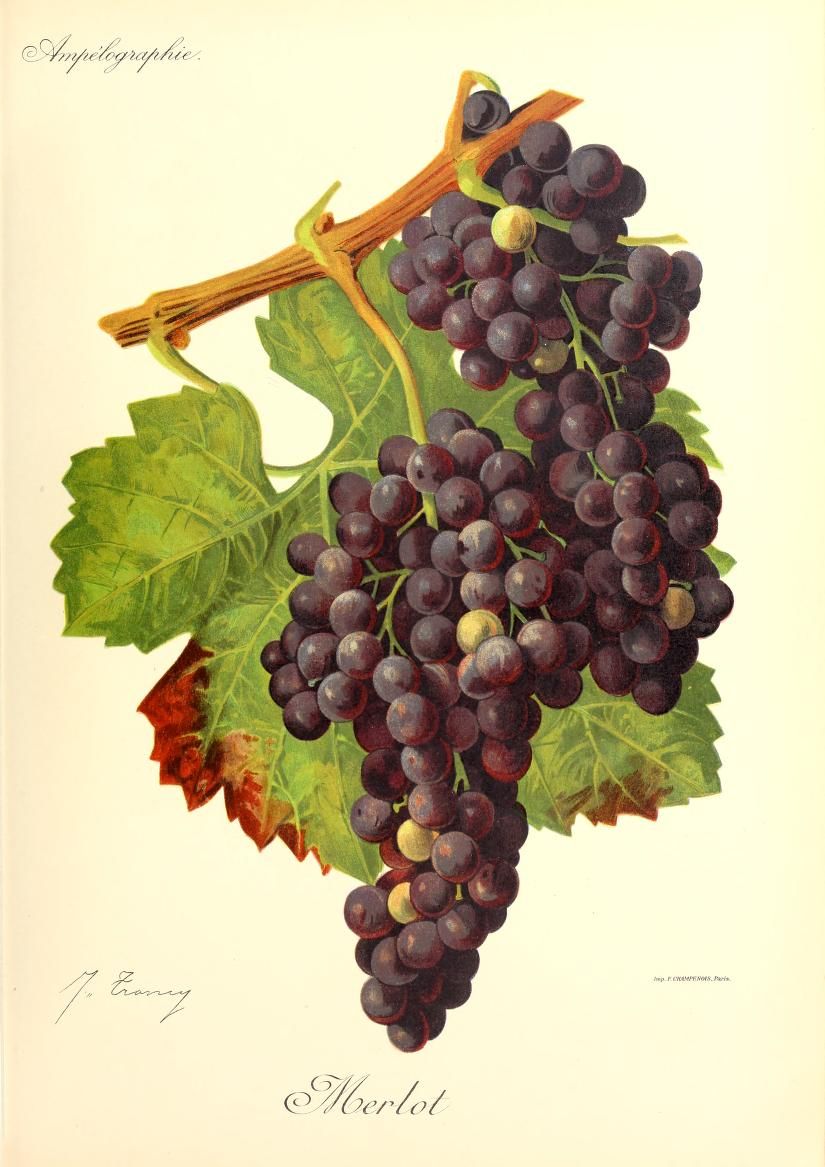
Merlot
Merlot is a dark-skinned Vitis vinifera variety historically associated with Bordeaux and now planted widely. It usually ripens sooner than Cabernet Sauvignon, often lends a more supple texture to a blend, and can make complete, structured wines on its own.
Those tendencies are shaped by water supply, crop level, weather, and harvest date. Merlot begins its growing season fairly early. Fermentation and maturation further shape whether the wine is fruit-led and made for early drinking or more tannic and suited to bottle development.
History and identity
DNA parentage analysis identified Cabernet Franc and Magdeleine Noire des Charentes as Merlot's parents. A later phased assembly of the Merlot genome used both parental genomes to separate the inherited lineages.1. Jean-Michel Boursiquot et al., “Parentage of Merlot and Related Winegrape Cultivars of Southwestern France: Discovery of the Missing Link,” Australian Journal of Grape and Wine Research 15 (2009), pp. 144–155, https://doi.org/10.1111/j.1755-0238.2008.00041.x; Victoria Sichel et al., “Chimeras in Merlot Grapevine Revealed by Phased Assembly,” BMC Genomics 24 (2023), article 396, https://doi.org/10.1186/s12864-023-09453-8. This establishes the relationship, but not the date or exact place of the original seedling. Merlot is documented in French literature only from the late eighteenth century. Its name is often connected to merle, the French word for blackbird, but proposed explanations variously refer to the berries' colour and to birds eating the early-ripening fruit; the etymology remains unsettled.
The variety was established in Bordeaux by the nineteenth century and expanded greatly there and abroad during the twentieth, producing many regional styles.
Viticulture and ripening
Merlot normally reaches harvest before Cabernet Sauvignon in the same region. French catalogue benchmarks place both in the broad mid-season ripening group, with Merlot ahead; multi-year Bordeaux observations likewise found a shorter ripening period and earlier harvest for Merlot.2. Institut français de la vigne et du vin, INRAE & Institut Agro Montpellier, Plantgrape records for Merlot N and Cabernet-Sauvignon N; Nancy L. Sweet, The Black Grapes of Bordeaux, University of California, Davis Foundation Plant Services, 2018. Its earlier harvest can help it reach adequate maturity before autumn rain becomes pressing and gives growers separate harvest windows when both grapes are planted.
Merlot also breaks bud earlier than Cabernet Sauvignon, exposing young growth to more spring-frost risk. Weather around flowering can cause coulure, in which flowers fail to become berries, making yields irregular. The vine is fertile and moderately to strongly vigorous, so pruning, canopy management, and crop level matter: excess growth can shade clusters, while too much fruit can delay ripening.
Water supply is another important limit. Merlot is poorly suited to severe drought, while persistent dampness can encourage downy mildew on flowers and clusters and, to a lesser degree, grey rot. Clay-rich soils are often associated with it in Bordeaux because they can retain useful water. Drainage still matters: Pomerol's official specification favours sites with regulated water supply and excludes waterlogged ground.
In a Bordeaux study of Merlot and the two Cabernets across gravel, clay, and sand, year and soil both altered vine growth and berry composition, with many effects mediated by vine water status.3. Cornelis van Leeuwen et al., “Hierarchy of the Role of Climate, Soil and Cultivar in Terroir Effect Can Largely Be Explained by Vine Water Status,” Terroir 2004. A warm, dry season may advance sugar accumulation and reduce acidity but can also impose damaging water stress; a cooler or wetter season may slow development and increase disease pressure. Rootstock, rooting depth, canopy, yield, and harvest decisions all modify the result.
Wine character and cellar choices
Ripe Merlot commonly gives deeply coloured wine with moderate acidity and a rounded, supple impression. Dark-fruit character is frequent, while cooler conditions or an earlier harvest can preserve herbal notes and firmer acidity. In hotter conditions or with a later harvest, the wine may become broader and higher in alcohol as acidity falls.
Merlot skins and seeds contain ample phenolic material, and extraction determines how much reaches the wine. In controlled Merlot trials, longer skin contact increased seed-derived tannin and astringency; fruit maturity also changed colour, aroma, and mouthfeel.4. L. Federico Casassa et al., “Influence of Fruit Maturity, Maceration Length, and Ethanol Amount on Chemical and Sensory Properties of Merlot Wines,” American Journal of Enology and Viticulture 64 (2013), pp. 437–449, https://doi.org/10.5344/ajev.2013.13059. Gentle extraction and earlier pressing can emphasize roundness, while longer or more forceful extraction can build a firmer frame. Oak maturation and bottle age can further alter tannin perception.
Bordeaux and varietal wines
In Bordeaux, Merlot is both a blending grape and the principal component of many wines. It is especially prominent on the Right Bank: the Pomerol and Saint-Émilion specifications describe it as very largely dominant.5. Ministère de l'Agriculture et de l'Alimentation, specifications for the protected designations of origin Pomerol (2021) and Saint-Émilion (2023). Cabernet Franc and Cabernet Sauvignon can add a different tannic and aromatic shape. On the Left Bank, the balance is often reversed, with Merlot contributing earlier-ripening fruit and a rounder texture to Cabernet Sauvignon-led blends.
Outside Bordeaux, Merlot is commonly bottled under its grape name, including in parts of the United States and northern Italy. Rules vary by country; in the United States, a single-variety label generally requires at least 75 percent of the named grape and an appellation of origin.6. United States Alcohol and Tobacco Tax and Trade Bureau, “Grape Variety Designations on American Wine Labels,” accessed 3 September 2026, https://www.ttb.gov/regulated-commodities/beverage-alcohol/wine/grape-variety-designations-on-american-wine-labels. The remaining portion may serve the same balancing role that blending does in Bordeaux.
Varietal Merlot ranges from wines made for early drinking to examples with substantial structure and capacity to age. Restrained yields, a site with adequate water and good drainage, appropriate harvest timing, and measured extraction can support the latter. High yields, severe drought, delayed harvest in a hot site, or aggressive extraction can each upset the balance differently.
Sources
- Institut français de la vigne et du vin, INRAE & Institut Agro Montpellier, “Merlot N”, Plantgrape varietal record, edited 2 September 2026, accessed 3 September 2026.
- Institut français de la vigne et du vin, INRAE & Institut Agro Montpellier, “Cabernet-Sauvignon N”, Plantgrape varietal record, edited 2 September 2026, accessed 3 September 2026.
- Jean-Michel Boursiquot et al., “Parentage of Merlot and Related Winegrape Cultivars of Southwestern France: Discovery of the Missing Link”, Australian Journal of Grape and Wine Research 15 (2009), pp. 144–155.
- Victoria Sichel et al., “Chimeras in Merlot Grapevine Revealed by Phased Assembly”, BMC Genomics 24 (2023), article 396.
- Nancy L. Sweet, The Black Grapes of Bordeaux, University of California, Davis Foundation Plant Services, 2018.
- Cornelis van Leeuwen et al., “Hierarchy of the Role of Climate, Soil and Cultivar in Terroir Effect Can Largely Be Explained by Vine Water Status”, Terroir 2004.
- L. Federico Casassa et al., “Influence of Fruit Maturity, Maceration Length, and Ethanol Amount on Chemical and Sensory Properties of Merlot Wines”, American Journal of Enology and Viticulture 64 (2013), pp. 437–449.
- Ministère de l'Agriculture et de l'Alimentation, Cahier des charges de l'appellation d'origine contrôlée “Pomerol”, published 21 October 2021.
- Ministère de l'Agriculture et de la Souveraineté alimentaire, Cahier des charges de l'appellation d'origine contrôlée “Saint-Émilion”, published 24 August 2023.
- United States Alcohol and Tobacco Tax and Trade Bureau, “Grape Variety Designations on American Wine Labels”, accessed 3 September 2026.