Champagne
Champagne is a delimited wine appellation in northeastern France and the name reserved for its white and rosé sparkling wines. It is not a generic term for bottle-fermented wine: grapes must come from approved parcels, and growing, pressing, winemaking, ageing, and release are governed by the appellation's rules. Within that shared framework, Champagne can differ markedly with place, grape, harvest, blending, reserve wine, fermentation, lees ageing, and dosage.
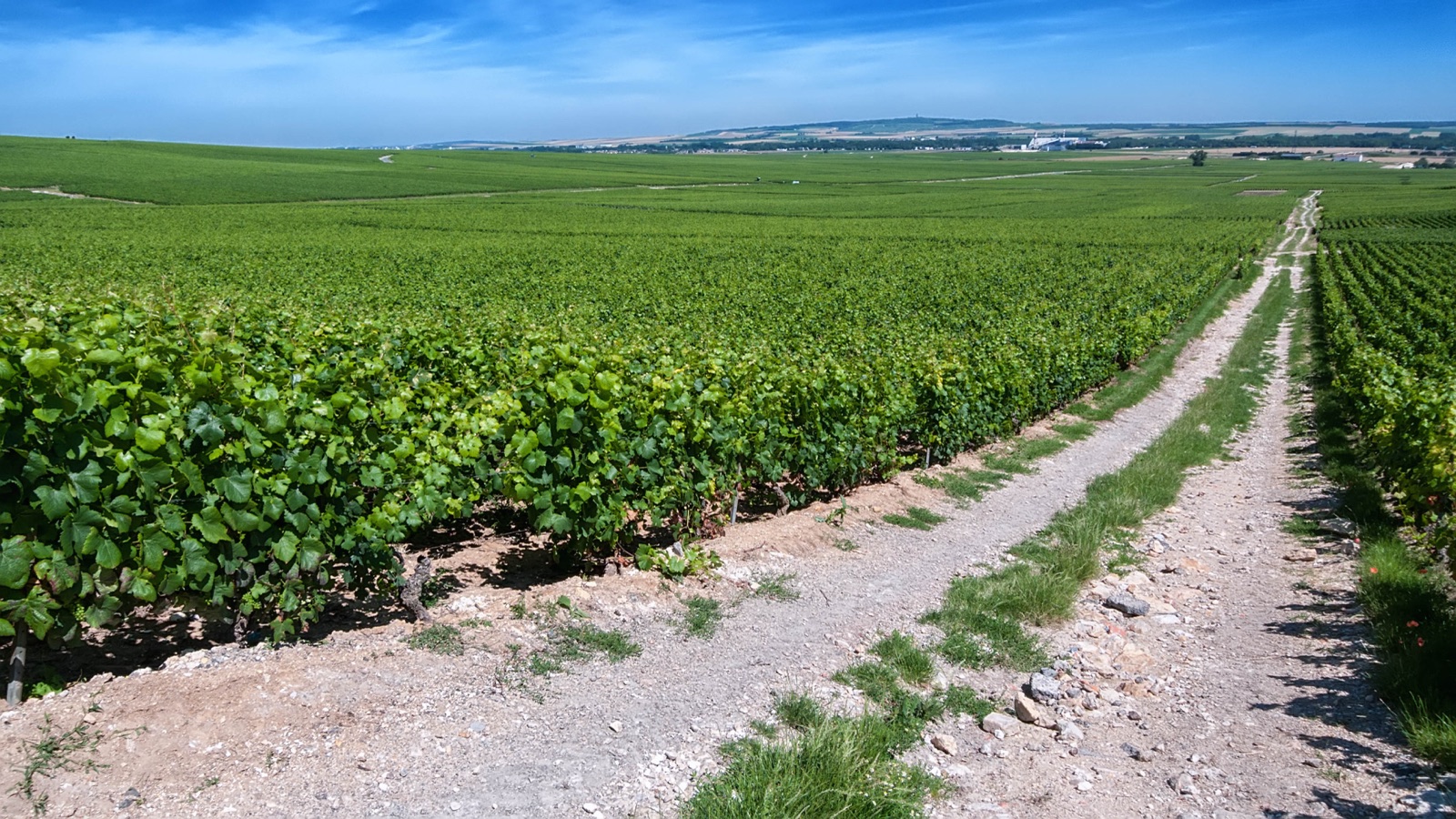
Geography and climate
The appellation's vineyards are dispersed around Reims, Épernay, and farther south. Its precisely delimited parcels lie across communes in the Marne, Aube, Aisne, Haute-Marne, and Seine-et-Marne departments. Most vines occupy slopes cut into the eastern edge of the Paris Basin. Chalk is important, especially in the central districts, while marl, harder limestone, sand, and overlying slope deposits alter drainage, water supply, and vine behaviour from one sector to another.1. French Ministry of Agriculture, Cahier des charges de l'appellation d'origine contrôlée « Champagne », approved 31 July 2025, sections IV–V and X.
Champagne's northern position and combined oceanic and continental influences have historically produced a relatively cool growing season. Regular rain can support vine growth but also raises disease pressure, while continental weather brings useful summer sunshine as well as damaging frost. Slopes and exposure help fruit receive enough light and shed excess water; differences in aspect, soil depth, and shelter can nevertheless change ripening over short distances. Retained acidity is valuable in a base wine that will undergo a second fermentation. Growers balance it against sugar, fruit health, and maturity. The Comité Champagne reports increasingly early harvest starts as the climate warms, alongside continuing frost and weather risks.
Subregions and grapes
Four broad names provide a useful first map: Montagne de Reims, Vallée de la Marne, Côte des Blancs, and Côte des Bar. They are not separate appellations or uniform style zones. The Montagne de Reims is strongly associated with Pinot Noir, yet its north- and south-facing slopes ripen differently, and Chardonnay and Meunier also have important sites. The long Vallée de la Marne contains more clay-rich as well as chalky and sandy ground; Meunier is particularly important toward the west, while Pinot Noir is more prominent in parts nearer Épernay.
The chalk slopes of the Côte des Blancs are dominated by Chardonnay. Farther south, the Côte des Bar is a discontinuous landscape of valleys, with more marl and limestone and a strong Pinot Noir majority. Even this four-part description leaves out meaningful districts such as the Côte de Sézanne, Vitryat, and Montgueux.
Chardonnay, Pinot Noir, and Meunier account for nearly all current plantings. Chardonnay can retain acidity while ripening gradually; Pinot Noir ripens early and can contribute phenolic structure even when pressed without prolonged skin contact. Meunier buds later than the other two, which can reduce exposure to spring frost, and is well established in cooler or more clay-influenced sites. Each grape can also be bottled alone. Current rules additionally name Arbane, Petit Meslier, Pinot Blanc, Pinot Gris, and Chardonnay Rose; Voltis has tightly limited status as a variety of interest for climate adaptation.1. French Ministry of Agriculture, Cahier des charges de l'appellation d'origine contrôlée « Champagne », approved 31 July 2025, sections IV–V and X.
Production, reserve wines, and blending
Whole bunches are harvested by hand and taken intact to the press. Controlled pressing limits colour and coarse extraction, allowing pale base wines to be made from dark-skinned Pinot Noir and Meunier as well as Chardonnay. Juice fractions are separated, and producers may then keep parcels, villages, grapes, and press fractions apart. Fermentation in steel or wood, the use or avoidance of malolactic fermentation, and oxygen management give the blender base wines with different properties.
Blending may cross grapes and origins, but it need not: Champagne can come from one variety, one village, or a single parcel. A non-vintage cuvée may also combine the current harvest with reserve wines—still base wines retained from earlier years. Reserves can supply maturity and continuity or become part of a deliberately changing blend; their proportion, age, storage vessel, and oxidative history all matter. “Reserve wine” here names a blending component, not a general quality rank. Vintage Champagne, by contrast, must derive its base wines from the year shown and cannot include earlier reserve wines.2. Ibid., sections IX.2 and IX.5. Vintage base wines must come from the stated harvest, apart from authorized winemaking products and the contents of tirage or expedition liqueurs.
After blending, the traditional method creates the bubbles. The base wine is bottled with yeast and tirage liqueur for a second fermentation in that bottle. It then matures on the yeast deposit before riddling moves the sediment to the neck, disgorgement removes it, and dosage may adjust the final balance. Rosé can be made through skin contact or by blending red and white base wines before tirage; blanc de blancs and blanc de noirs identify white Champagne from white or dark grapes respectively.
Ageing and variation
Disgorgement may not occur until at least 12 months after tirage, during which the wine must remain continuously in bottle. Release to consumers requires at least 15 months from tirage for Champagne without a vintage indication and 36 months for vintage Champagne.2. Ibid., sections IX.2 and IX.5. Vintage base wines must come from the stated harvest, apart from authorized winemaking products and the contents of tirage or expedition liqueurs. Producers may keep wines on their lees or in cellar longer.
Lees contact can change texture, foam, and aroma as yeast cells break down, yet the result also depends on the base wine, temperature, oxygen, and duration. Disgorgement and dosage establish a new stage of development under the final closure. A young multi-vintage blend built around fresh base wines, an oxidatively handled blend with old reserves, and a long-aged single-vineyard vintage wine may all satisfy the same appellation.
Benchmark producers
Bollinger is a useful reference for Pinot Noir-led blending and the role of mature reserves. Its Special Cuvée combines the latest harvest with a majority of reserve wines, including a portion kept for years in magnums under cork. Those reserves contribute a developed aromatic component before the finished blend begins its own bottle ageing. Independent coverage has singled out this reserve-wine contribution to the house's broad, mature style.3. La Revue du vin de France, “Champagne : Bollinger, Special Cuvée”; Champagne Bollinger, current “Special Cuvée” and “Reserve magnums” pages, accessed 14 September 2026.
Pierre Péters, based in Le Mesnil-sur-Oger, offers a grower's perspective on Côte des Blancs Chardonnay. Small steel tanks preserve separate origins and press fractions before blending. Cuvée de Réserve draws on several harvests, while Les Chétillons is a vintage wine from a single vineyard in Le Mesnil. The contrast makes Péters useful for comparing a sustained blending tradition with a more tightly defined origin, within one estate's Blanc de Blancs range.4. Le Figaro Vin, “Pierre Péters”; Champagne Pierre Péters, current estate, winemaking, and wine-range pages, accessed 14 September 2026.
Related topics
Sources
- Ministère de l'Agriculture et de la Souveraineté alimentaire, Cahier des charges de l'appellation d'origine contrôlée « Champagne », approved 31 July 2025 and published 7 August 2025, accessed 1 September 2026.
- Comité Champagne, “The Champagne region”, “Champagne and its climate”, and “Grape varieties”, accessed 1 September 2026.
- Comité Champagne, “Blending”, “Bottling and second fermentation”, and “Maturation on lees”, accessed 1 September 2026.
- Tom Hewson, “Champagne Report: The two faces of the Montagne de Reims”, Decanter, 13 April 2026.
- La Revue du vin de France, “Champagne : Bollinger, Special Cuvée”, accessed 14 September 2026.
- Champagne Bollinger, “Special Cuvée” and “Reserve magnums”, accessed 14 September 2026.
- Le Figaro Vin, “Pierre Péters”, accessed 14 September 2026.
- Champagne Pierre Péters, estate overview, “Winemaking”, and wine range, accessed 14 September 2026.