Paso Robles
Paso Robles is a wine region in northern San Luis Obispo County on California's Central Coast. Its vineyards occupy the inland side of the Santa Lucia Range, where warm summer days meet varying amounts of Pacific cooling. The region combines an established Zinfandel tradition with Cabernet Sauvignon, Rhône varieties, and a wide range of blends.
The American viticultural area (AVA) contains eleven smaller AVAs established in 2014. These districts give more precise geographical information than a simple division into vineyards east and west of the Salinas River.1. Alcohol and Tobacco Tax and Trade Bureau, final rule establishing eleven viticultural areas within Paso Robles, 9 October 2014, effective 10 November 2014.
Heat, air flow, and water
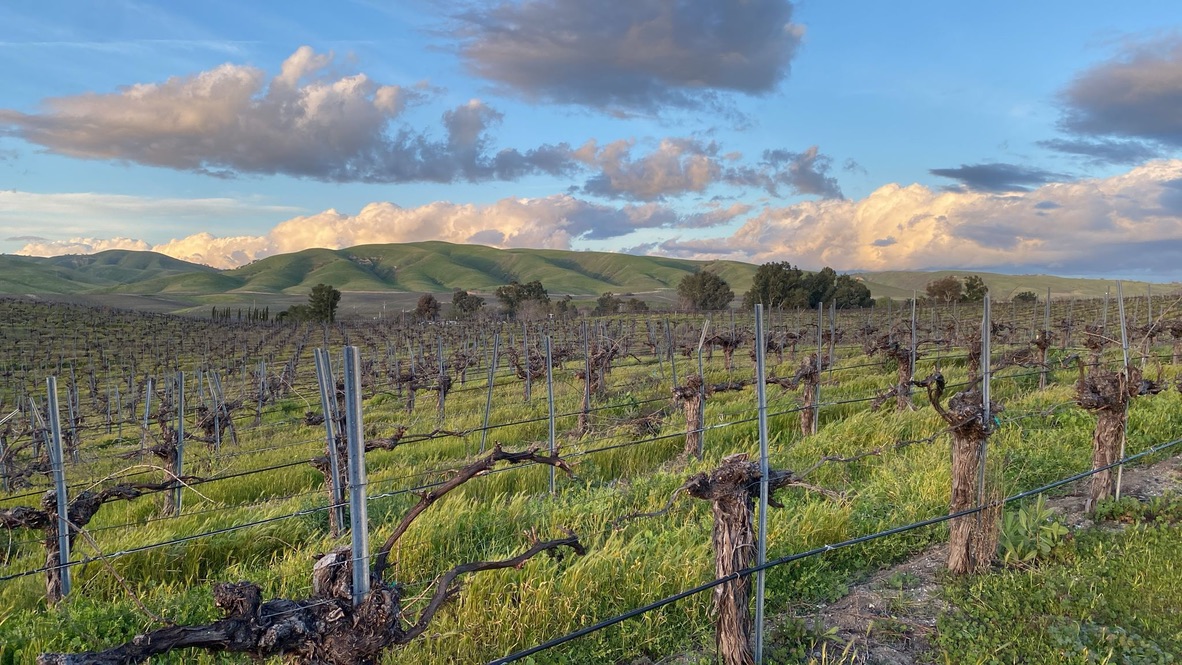
The mountains partly shelter Paso Robles from the ocean. Western hills are steeper and broken by canyons; farther east, vineyards spread across rolling terrain and river plains. Calcareous shale is important in some western vineyards, alongside soils derived from sandstone, granite, volcanic rock, and river deposits elsewhere. Differences in soil depth and water storage change how a vineyard handles a dry summer.
The Templeton Gap describes both a district and the route by which cool marine air enters through passes in the Santa Lucia Range. Afternoon breezes reach beyond the named district into other parts of Paso Robles. Their strength depends on the vineyard's position relative to those air routes. Two sites at similar distances from the coast can consequently experience different ripening conditions.
Warm days support the ripening of later varieties, while cooler evenings change the pace of ripening and acid loss. That combination leaves growers with important harvest choices: waiting for more mature flavors also permits further sugar accumulation. Picking date, crop level, and water availability help determine whether a wine feels supple and fresh or broader and more alcoholic.
Grapes and blending
Cabernet Sauvignon and Merlot share the region with Syrah, Grenache, and Mourvèdre. Rhône-inspired blends provide a particularly useful way to understand Paso Robles: a producer can adjust fruit, color, tannin, and freshness through the proportions of varieties as well as through extraction and maturation.
Tablas Creek offers a documented example in the Adelaida District. The Perrin and Haas families purchased its site in 1989, imported vine material from Château de Beaucastel, and multiplied it for their own vineyards and other growers. Its red blends draw principally on Mourvèdre, Grenache, Syrah, and Counoise; whites use grapes including Roussanne, Viognier, and Grenache Blanc. Native-yeast fermentation and large, neutral oak vessels are part of its approach. The estate connects Rhône-inspired winemaking with a nursery program that made those grapes available to other growers.
Zinfandel's continuity
The Dusi family's vineyards connect contemporary Paso Robles to earlier Italian-American farming. The Wine History Project of San Luis Obispo County documents Dante Dusi's transmission of head pruning and dry farming to later generations. Head-trained vines form individual bushes instead of a continuous trellised wall; dry farming relies on stored soil moisture and rainfall.
J Dusi Wines continues that family connection through Janell Dusi's wines from the family's vineyards. Its vineyard account describes the west-side property planted in 1945 and continuing use of cover crops and dry farming. These practices show why old vineyards are valuable historical records, while also making clear that vine age, training, soil, and farming act together. Dry farming's suitability remains site-specific.
Related topics
Sources
- Alcohol and Tobacco Tax and Trade Bureau, “Establishment of the Adelaida District … and Templeton Gap District Viticultural Areas”, Federal Register, 9 October 2014.
- Paso Robles Wine Country Alliance, “Geography & Climate”, accessed 6 October 2026.
- Christopher Taranto, “Templeton Gap District”, Paso Robles Wine Country Alliance, 4 August 2021.
- Tablas Creek Vineyard, “History”, accessed 6 October 2026.
- Wine History Project of San Luis Obispo County, “Dante Silvestro Dusi (1925–2015), Zinfandel Grower”.
- J Dusi Wines, “Dusi Vineyard”, accessed 6 October 2026.