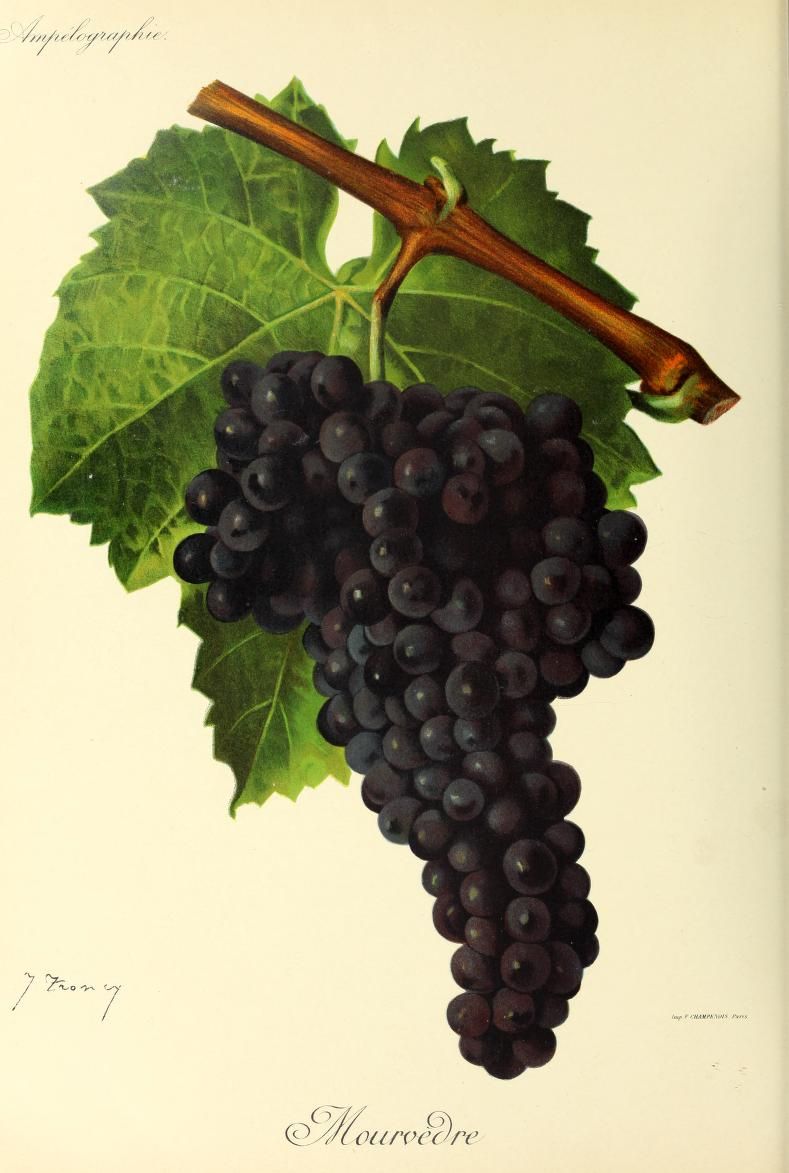
Mourvèdre
Also known as Mourvedre, Monastrell, Mataro, Mataró
Mourvèdre is a dark-skinned Vitis vinifera variety known as Monastrell in Spain and traditionally as Mataro or Mataró in Australia and California. The names identify the same grape and reflect different regional histories. Spanish Monastrell is often presented as a varietal wine, while French Mourvèdre and Australian Mataro often share a blend with Grenache and Syrah.
The variety combines late ripening with an ability to remain productive in warm, dry country. Mourvèdre needs a long season and enough heat to ripen its skins and seeds, but it also benefits from a modest, continuing water supply. Soil depth, rootstock, vine material, crop level, and harvest timing help explain differences among wines from semi-arid Mediterranean Spain and maritime Bandol.
History and identity
Official catalogues align the principal names. France registers the variety as Mourvèdre and recognizes Monastrell and Mataro as European Union synonyms. Spain registers Monastrell with Mourvedre as a synonym. In California, DNA analysis also confirmed that two selections long held as Mataró matched an authenticated French Mourvèdre sample.1. Institut français de la vigne et du vin, INRAE & Institut Agro Montpellier, “Mourvèdre N,” Plantgrape varietal record, edited 19 August 2026, https://www.plantgrape.fr/en/varieties/fruit-varieties/177/export; Ministerio de Agricultura, Pesca y Alimentación, “Monastrell,” national variety catalogue, https://servicio.mapa.gob.es/germenwai/DetalleVariedad.aspx?IDVariedad=10900140&TipoV=C&id=es; Nancy L. Sweet, Grapes of Southern France, University of California, Davis Foundation Plant Services, revised 23 February 2021, pp. 99–103, https://fps.ucdavis.edu/grapebook/Rhone.pdf. A regional name may still accompany distinct clones and local selections within that common varietal identity.
Spain is the most likely country of origin, although the original seedling's place and date have not been documented. Mourvèdre is commonly connected with the former name Murviedro, now Sagunt in Valencia, and Mataró with the Catalan coastal town of that name. Those associations may explain how the names travelled, but they do not prove where the vine first arose. Accounts that push its history back to ancient Mediterranean settlers are more speculative than the varietal evidence allows.
Viticulture
French observations place both budbreak and maturity late. At the reference collection used by Plantgrape, Mourvèdre buds about two weeks after Chasselas and reaches maturity about four and a half weeks after it.2. Institut français de la vigne et du vin, INRAE & Institut Agro Montpellier, “Mourvèdre N,” Plantgrape varietal record. A site must supply sustained warmth, including warm nights late in the season. In a marginal site or cool year, sugar can lag and tannin remain severe. In a very hot site, waiting can instead raise potential alcohol while acidity falls.
Mourvèdre's upright growth suits short pruning and traditional bush-vine or cordon training. Its relatively sparse foliage means repeated trimming can leave too little leaf area to finish ripening a crop. Plantgrape accordingly describes it as demanding despite its association with heat, favoring well-exposed sites and limestone soils deep enough to provide limited but regular water.
In southeastern Spain, deep, calcareous soils can store some of the region's irregular rain, and dry air reduces pressure from several fungal diseases. That setting helps explain the variety's reputation for drought adaptation. A four-season field study of seven traditional Monastrell clones found substantial differences in water use, yield, and grape and wine composition even though all were grafted to the same rootstock. The most drought-tolerant clone was not the most productive, nor did it produce the grape and wine composition that best matched the researchers' objectives.3. Pascual Romero et al., “Evaluation of the Effect of Water Stress on Clonal Variations of Cv. Monastrell (Vitis vinifera L.) in South-Eastern Spain: Physiology, Nutrition, Yield, Berry, and Wine-Quality Responses,” Agronomy 13 (2023), article 433, https://doi.org/10.3390/agronomy13020433. Under severe stress, reduced leaf area, berry size, and yield can become the cost of survival.
Wine character and cellar choices
Mourvèdre can supply substantial tannin and color, but those traits vary with plant material and conditions. The French catalogue calls its color potential moderate and notes that acidity can be lacking, whereas Jumilla's specification describes its local Monastrell grapes as dark and thick-skinned and the region's reds as tannic.
Fruit picked before the skins and seeds have matured can give an especially hard texture. Later harvest may soften that impression but also bring more sugar and less acidity. Longer or more forceful skin contact can extract more tannin, while rosé production limits it. Mourvèdre can add structure to blends with the broader fruit and softer texture of Grenache or complement Syrah's color and aroma. Site, harvest date, and cellar practice also create wide variation among varietal reds.
Mediterranean Spain and Bandol
Monastrell's Spanish centre lies along the dry southeastern Mediterranean arc, especially in Jumilla, Yecla, Bullas, and Alicante. Jumilla's elevated inland plateau has strong continental influence, very low and irregular rainfall, hot summers, and cold winters. Its vineyards also range widely in altitude. Warmth and dryness can favor complete ripening and healthy fruit, while elevation, exposure, stored soil water, crop load, and harvest date determine whether a wine feels broad and ripe or more restrained. The current rules permit dry red, rosé, sweet, fortified, and white blanc de noirs expressions. A wine labelled Jumilla Monastrell must contain at least 85% of the variety.4. Ministerio de Agricultura, Pesca y Alimentación, Pliego de condiciones de la DOP “Jumilla”, modified 24 February 2025, https://www.mapa.gob.es/dam/mapa/contenido/alimentacion/temas/calidad-agroalimentaria/2017-calidad-diferenciada/nuevo_denominaciones/htm/pliego_de_condiciones_dop_jumilla_.pdf; Ministère de l'Agriculture et de la Souveraineté alimentaire, Cahier des charges de l'appellation d'origine contrôlée “Bandol”, published 24 April 2025, https://info.agriculture.gouv.fr/boagri/document_administratif-1b235ad6-e22e-485f-a0e0-daa90a278546/telechargement.
Bandol occupies stony slopes in a coastal amphitheatre open to the sea and sheltered from colder northern influence. The sea moderates summer heat and contributes some night humidity, giving Mourvèdre a different balance of warmth and water during ripening. For red Bandol, Mourvèdre must make up 50–95% of the vineyard and the finished blend. Grenache and Cinsaut are the other principal red varieties. The rules also require at least 18 months of maturation in barrel or large wooden cask.4. Ministerio de Agricultura, Pesca y Alimentación, Pliego de condiciones de la DOP “Jumilla”, modified 24 February 2025, https://www.mapa.gob.es/dam/mapa/contenido/alimentacion/temas/calidad-agroalimentaria/2017-calidad-diferenciada/nuevo_denominaciones/htm/pliego_de_condiciones_dop_jumilla_.pdf; Ministère de l'Agriculture et de la Souveraineté alimentaire, Cahier des charges de l'appellation d'origine contrôlée “Bandol”, published 24 April 2025, https://info.agriculture.gouv.fr/boagri/document_administratif-1b235ad6-e22e-485f-a0e0-daa90a278546/telechargement. Site, mandatory blending proportions, low permitted yields, and extended maturation all contribute to Bandol's structured, age-oriented expression.
Elsewhere in southern France, Mourvèdre is more often a supporting component in Mediterranean blends. In Australia, Mataro appears both varietally and with Grenache and Shiraz, particularly in warm South Australian regions. California also preserves old plantings historically called Mataro, although Mourvèdre is now commoner on labels.
Sources
- Institut français de la vigne et du vin, INRAE & Institut Agro Montpellier, “Mourvèdre N”, Plantgrape varietal record, edited 19 August 2026, accessed 1 September 2026.
- Ministerio de Agricultura, Pesca y Alimentación, “Monastrell”, national variety catalogue, updated 26 April 2026, accessed 1 September 2026.
- Wine Australia, Mataro/Mourvedre Variety Snapshot 2026, prepared August 2026.
- Nancy L. Sweet, Grapes of Southern France, University of California, Davis Foundation Plant Services, revised 23 February 2021.
- Pascual Romero et al., “Evaluation of the Effect of Water Stress on Clonal Variations of Cv. Monastrell (Vitis vinifera L.) in South-Eastern Spain: Physiology, Nutrition, Yield, Berry, and Wine-Quality Responses”, Agronomy 13 (2023), article 433.
- Ministerio de Agricultura, Pesca y Alimentación, Pliego de condiciones de la DOP “Jumilla”, modified 24 February 2025.
- Ministère de l'Agriculture et de la Souveraineté alimentaire, Cahier des charges de l'appellation d'origine contrôlée “Bandol”, published 24 April 2025.