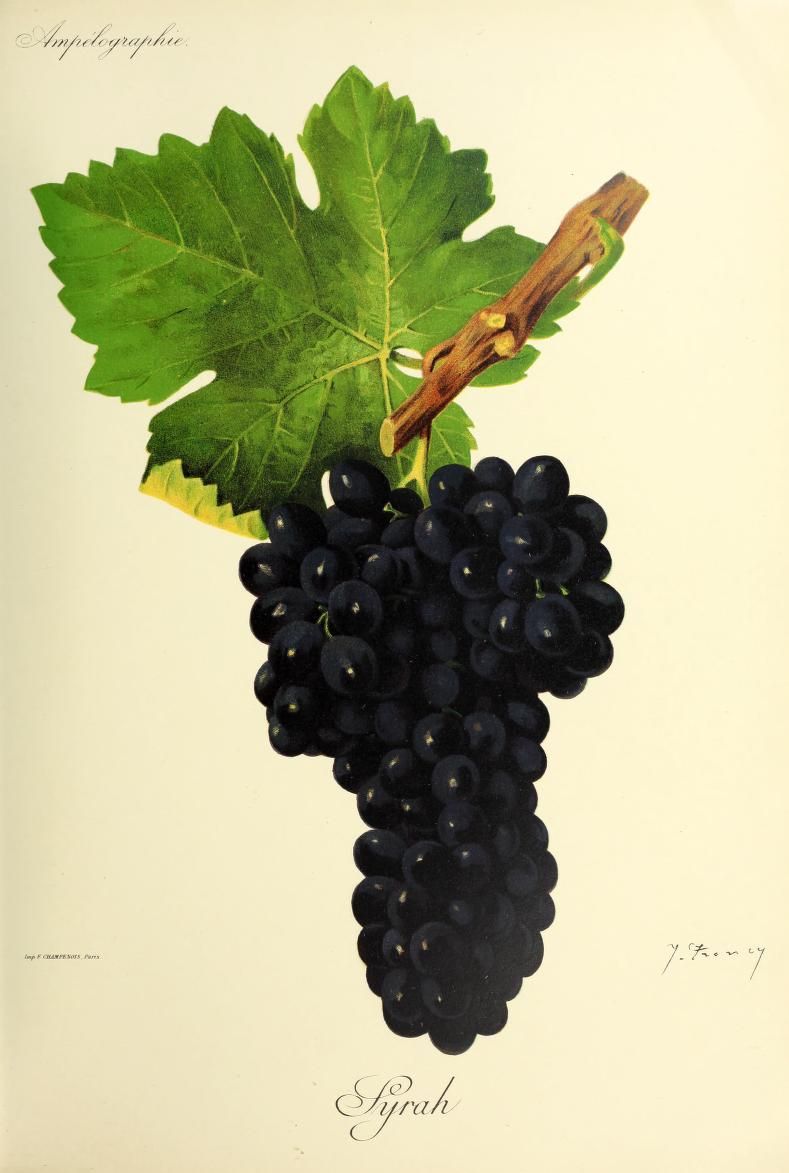
Syrah
Also known as Shiraz, Sérine
Syrah is a dark-skinned Vitis vinifera variety whose historic centre is the northern Rhône and whose Australian name, Shiraz, has become equally familiar. The names identify the same grape. They sometimes signal a producer's stylistic intention, but they are not a dependable code for climate, ripeness, or winemaking.
Temperature explains much of Syrah's range. Relatively cool ripening conditions can preserve acidity and favor the compound responsible for a pepper aroma. Warmer conditions usually advance ripening and can bring more sugar and less acidity, giving the winemaker the potential for more alcohol and a broader texture. Water supply, sun exposure, crop level, harvest date, and cellar choices can reinforce or complicate each tendency.
History and identity
DNA analysis identifies Dureza and Mondeuse Blanche as Syrah's parents.1. J. E. Bowers et al., “A Single Pair of Parents Proposed for a Group of Grapevine Varieties in Northeastern France,” Acta Horticulturae 528 (2000), pp. 129–132, https://doi.org/10.17660/ActaHortic.2000.528.15. Both are associated with southeastern France, which supports a French-Alpine or northern Rhône origin and weighs against stories that the vine came from the Persian city of Shiraz. Parentage does not reveal the exact place or date at which the original seedling arose, however, so the narrower location remains an inference rather than a documented event.
Shiraz is the established Australian name and Sérine is an older regional name still associated with the northern Rhône. Petite Sirah is not another synonym: it usually denotes Durif, a distinct variety whose parents are Syrah and Peloursin.
Viticulture and climate
Syrah has small berries and small to medium bunches. Its long young shoots can be damaged by spring wind and generally need secure trellising. French observations place budbreak and maturity in the middle of the season, but also describe a rapid passage from véraison—the onset of ripening—to maturity. This can leave a short practical harvest window: sugar, acidity, berry condition, and skin development may not move at the same rate.
Heat shifts the balance among sugar, acidity, and yield. In a two-season Mendoza field experiment, an actively heated canopy advanced the season and produced grapes with more soluble solids and less acidity, while yield fell across the three varieties studied, including Syrah.2. Deolindo L. E. Dominguez et al., “Impacts of Climate Change-Induced Temperature Rise on Phenology, Physiology, and Yield in Three Red Grape Cultivars: Malbec, Bonarda, and Syrah,” Plants 13 (2024), article 3219, https://doi.org/10.3390/plants13223219. The experiment illustrates why a warmer site or season can move potential alcohol and freshness in opposite directions. At the cool edge, a grower may need to wait for skins and seeds to mature while monitoring weather and fruit health.
Site and farming modify the temperature signal. Aspect, elevation, canopy shade, wind, soil water, and irrigation all change the conditions experienced by a bunch, sometimes within a single vineyard. Syrah is susceptible to grey rot late in ripening, so a long wait in a cool or wet autumn has a cost. It is also prone to chlorosis on soils with abundant active limestone. A separate disorder known as Syrah decline can redden leaves, damage the graft union, and eventually kill trunks; its cause remains unresolved, and French records show meaningful differences among clones.
Wine character and cellar choices
Syrah commonly provides substantial color and tannin, with weight and aroma varying by harvest and cellar decisions. Grapes harvested with more sugar can yield more alcohol if fermented dry, while retained acidity can make a wine feel more taut. Extraction determines how much skin and seed material reaches the wine, and stem inclusion, fermentation temperature, and maturation can further reshape texture and aroma.
Pepper is the most useful specific sensory marker because it has a demonstrated chemical basis. Rotundone, found chiefly in Syrah's skins, can give black- or white-pepper aromas at very low concentrations, although some people cannot perceive it even at much higher levels. At one Victorian vineyard studied over 15 vintages, wine rotundone was highest in cool, wet seasons and was negatively associated with bunch-zone temperature and solar exposure.3. Pangzhen Zhang et al., “Environmental Factors and Seasonality Affect the Concentration of Rotundone in Vitis vinifera L. cv. Shiraz Wine,” PLOS ONE 10 (2015), e0133137, https://doi.org/10.1371/journal.pone.0133137. Other work has found that shaded bunches and later harvest can favor its accumulation. The weather after véraison and the microclimate around the fruit can matter more than a broad climate label.
A study of commercial Shiraz from six Australian regions found both regional patterns and considerable variation within each region. Black pepper was associated with lower heat accumulation, while greater radiation and evaporation were associated with darker or dried-fruit impressions and more perceived viscosity.4. Wes Pearson et al., “Regionality in Australian Shiraz: Compositional and Climate Measures That Relate to Key Sensory Attributes,” Australian Journal of Grape and Wine Research 27 (2021), pp. 458–471, https://doi.org/10.1111/ajgw.12499. Because vineyard practice and winemaking were not standardized, the results establish associations: cooler examples often emphasize pepper, freshness, and savory character, whereas warmer examples can lean toward riper fruit and a broader palate, with many wines falling between those poles.
Fermentation on the skins extracts both phenolics and rotundone. Rosé made with limited skin contact therefore has much less of the pepper compound than a comparable red wine. For reds, extraction may be kept gentle or extended, whole clusters may be included or removed, and new oak may be conspicuous or absent.
Where it is grown
The northern Rhône remains Syrah's historical reference point, notably in Hermitage, Côte-Rôtie, Cornas, Crozes-Hermitage, and Saint-Joseph. Farther south in France it is widely blended, including with Grenache, as well as made varietally. The contrast is climatic as well as traditional: exposed northern sites need enough warmth to complete ripening, while Mediterranean vineyards more often manage rapid sugar accumulation, water stress, and heat.
Shiraz is the conventional Australian name. Warm regions such as Barossa Valley and McLaren Vale are prominent, but the variety is also grown in cooler or later-ripening districts including Yarra Valley and Canberra District. In Hunter Valley, humidity, rainfall timing, and the shape of the season also affect the fruit.
Washington State gives Syrah another substantial regional context. Walla Walla and Yakima Valley include contrasting sites: warmer parts of the Columbia Valley can give generous fruit and weight, while cooler sites allow a different balance of ripeness and acidity. Some producers also pick earlier and pursue lighter wines, so a change in style can reflect intention as much as location. The regional name alone does not determine whether a wine will be dense, savoury, or relatively restrained.
Chile adds a useful coastal comparison. In Limarí, morning fog and maritime air moderate conditions in an otherwise dry northern landscape; Syrah is one of the region's established varieties. San Antonio also supplies cooler-climate examples. These settings make national labels such as “warm-climate Chile” poor guides to the conditions experienced by a particular vineyard.
Related topics
Sources
- Institut français de la vigne et du vin, INRAE & Institut Agro Montpellier, “Syrah N”, Plantgrape varietal record, edited 1 September 2026, accessed 1 September 2026.
- Institut français de la vigne et du vin, INRAE & Institut Agro Montpellier, “Durif N”, Plantgrape varietal record, edited 31 August 2026, accessed 1 September 2026.
- J. E. Bowers et al., “A Single Pair of Parents Proposed for a Group of Grapevine Varieties in Northeastern France”, Acta Horticulturae 528 (2000), pp. 129–132.
- Deolindo L. E. Dominguez et al., “Impacts of Climate Change-Induced Temperature Rise on Phenology, Physiology, and Yield in Three Red Grape Cultivars: Malbec, Bonarda, and Syrah”, Plants 13 (2024), article 3219.
- Pangzhen Zhang et al., “Environmental Factors and Seasonality Affect the Concentration of Rotundone in Vitis vinifera L. cv. Shiraz Wine”, PLOS ONE 10 (2015), e0133137.
- Australian Wine Research Institute, Pepper Flavour in Wine, fact sheet, updated January 2023.
- Wes Pearson et al., “Characterising Inter- and Intra-Regional Variation in Sensory Profiles of Australian Shiraz Wines from Six Regions”, Australian Journal of Grape and Wine Research 26 (2020), pp. 372–384.
- Wes Pearson et al., “Regionality in Australian Shiraz: Compositional and Climate Measures That Relate to Key Sensory Attributes”, Australian Journal of Grape and Wine Research 27 (2021), pp. 458–471.
- International Organisation of Vine and Wine, Distribution of the World's Grapevine Varieties, 2017.
- Wine Australia, “Shiraz—The Classic Australian Red Wine”, accessed 1 September 2026.
- Ani Duzdabanyan, with contributions from Gwendolyn Elliott, “Syrah will become Washington's defining red wine”, Decanter, 27 July 2026.
- Wines of Chile, “Winegrowing Regions”, Limarí and San Antonio entries, accessed 17 September 2026.