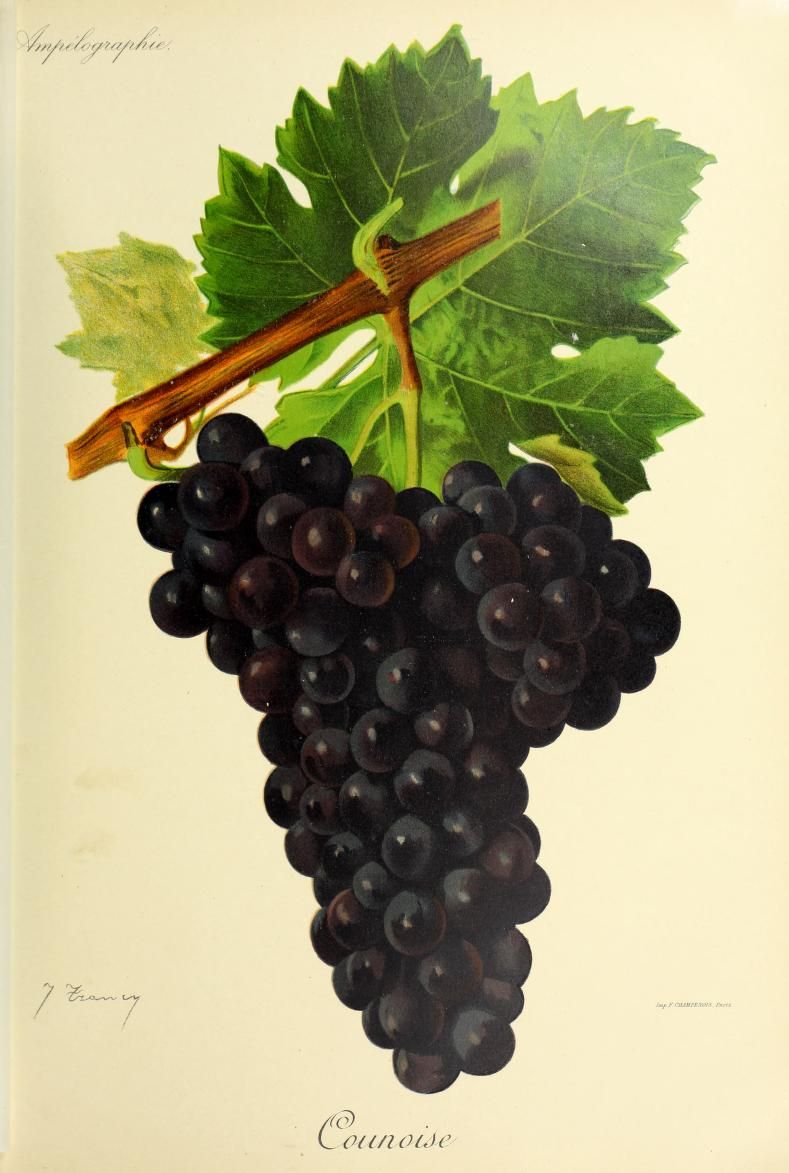
Counoise
Also known as Moustardier
Counoise is a dark-skinned Vitis vinifera variety from southern France. It is a minor grape in the southern Rhône, but its modest color, moderate tannin, acidity, fruit, and spice give it a distinctive blending role. A small proportion can make a blend feel more open and lively beside denser varieties such as Grenache, Syrah, and Mourvèdre.
History and identity
Plantgrape, France's national vine-variety catalogue, places Counoise's likely origin in the Vaucluse, while the regional Rhône authority identifies it with the Rhône Valley. The name Moustardier survives in accounts of older vineyards in Gigondas and Tavel, but Plantgrape lists no official synonym in France or elsewhere in the European Union.1. Institut français de la vigne et du vin, INRAE & Institut Agro Montpellier, “Counoise N”, Plantgrape varietal record, edited 9 June 2026.
The variety has a long association with Châteauneuf-du-Pape. An account preserved by Tablas Creek says that a papal officer brought it from Spain to Pope Urban V when the papacy was based in Avignon in the fourteenth century. That story is legendary rather than a documented origin. Tablas Creek also places Counoise in the old vineyards that helped shape the appellation.2. Tablas Creek Vineyard, “Counoise”, accessed 7 September 2026.
Counoise has nevertheless become scarce in France. Plantgrape records French plantings falling from 885 hectares in 1988 to 312 hectares in 2018. Inter Rhône describes it as very little cultivated. Counoise remains a small component of the region's vineyards.1. Institut français de la vigne et du vin, INRAE & Institut Agro Montpellier, “Counoise N”, Plantgrape varietal record, edited 9 June 2026.3. Inter Rhône, “Counoise”, accessed 7 September 2026.
Viticulture
Counoise is vigorous, semi-erect, and productive, with medium bunches and large berries. It suits short pruning and can be trained as a gobelet, or bush vine. Plantgrape especially associates it with warm, stony hillsides. Its production can fluctuate, and Inter Rhône says that full coloring can be difficult to obtain even when the berries are ripe. That trait helps explain why a healthy, mature crop may still produce a relatively pale wine.3. Inter Rhône, “Counoise”, accessed 7 September 2026.
Its season is long enough to shape where it works. Plantgrape places budbreak 11 days after Chasselas and maturity three and a half to four weeks after it; Inter Rhône summarizes the maturity as mid- to late-ripening. Warm, exposed sites can give the fruit time to finish, while a cool or wet autumn raises the cost of waiting. Grey rot is a particular concern, even though the variety is not very sensitive to downy mildew.1. Institut français de la vigne et du vin, INRAE & Institut Agro Montpellier, “Counoise N”, Plantgrape varietal record, edited 9 June 2026.
Tablas Creek reports the Perrins' interpretation that Counoise's later ripening produces wines with intense spice, bright acidity, and modest alcohol. In a warm southern Rhône blend, that balance can add lift without adding the density associated with Grenache or the deeper color and structure supplied by Syrah and Mourvèdre. The effect depends on site, crop, harvest date, and the proportions used.2. Tablas Creek Vineyard, “Counoise”, accessed 7 September 2026.
Wine character and blending
Counoise makes fruity, lightly colored wines with floral and spicy notes. Its color potential is limited: large berries and incomplete skin pigmentation mean that it is a poor candidate for deepening a blend's hue. Sources also describe its tannins as moderate or soft, so the grape usually contributes a gentler texture than a strongly structured red variety. Extraction, maturity, and yield can still make a Counoise wine feel more or less substantial.
In the southern Rhône, the grape is most useful as a counterweight. Grenache can bring ripe fruit and alcohol, Mourvèdre firmer structure, and Syrah darker color and its own aromatic profile. Counoise adds acidity, fruit, and spice at a scale that may be more perceptible in the blend's balance than as a distinct varietal flavor. The adopted Vinsobres specification lists Counoise N as an accessory grape for red wines.4. Ministère de l'Agriculture et de la Souveraineté alimentaire, “Cahier des charges de l'appellation d'origine contrôlée ‘Vinsobres’”, adopted by arrêté of 8 June 2026 and published 18 June 2026, pp. 1–2.
It is also suitable for rosé. Limited skin contact makes its pale color an advantage, while its fruit and acidity can keep the wine from feeling flat. A varietal red is possible, but the grape's regional identity remains tied to assemblage: it is a small ingredient whose purpose is often clearest in relation to the larger blend.
In the cellar
The first cellar decision is proportion. A little Counoise can adjust a blend's freshness, fruit, and texture; a larger share makes its light body, pale color, and spice more obvious.
Skin contact must be judged with the raw material in mind. Longer extraction can add phenolic weight. Rosé production uses the opposite logic, limiting contact to preserve its lighter structure. Tablas Creek, which has worked with the grape in California since importing cuttings from Château de Beaucastel in 1990, reports that its Counoise is prone to oxidation and uses closed fermenters and foudre aging.2. Tablas Creek Vineyard, “Counoise”, accessed 7 September 2026.
California's small revival
California's renewed interest began with Rhône-variety plantings and the work of Tablas Creek in Paso Robles. Its imported material spent three years in USDA inspection before multiplication and planting. UC Davis Foundation Plant Services now lists both the public Counoise 01 selection, taken from a former UC Davis vineyard, and the French ENTAV-INRA 508 selection. The availability of clean, identified planting material gives growers a practical route to a grape that was once difficult to source.5. Nancy L. Sweet, Grapes of Southern France, University of California, Davis Foundation Plant Services, revised 23 February 2021, PDF; Foundation Plant Services, “Grape Variety: Counoise”, accessed 7 September 2026.
The revival is real but narrow. The UC Davis Grapes of Southern France report recorded about 60 acres in California in 2019, while Tablas Creek's current account gives 58 acres in 2025 and says the plantings derive from its stock. Those figures are approximate and come from different reporting contexts, so they should not be treated as a continuous official acreage series. Its late harvest, bright acidity, moderate alcohol, and softer tannin make sense in warm sites where producers want aromatic complexity in Rhône blends.2. Tablas Creek Vineyard, “Counoise”, accessed 7 September 2026.5. Nancy L. Sweet, Grapes of Southern France, University of California, Davis Foundation Plant Services, revised 23 February 2021, PDF; Foundation Plant Services, “Grape Variety: Counoise”, accessed 7 September 2026.
Related topics
Sources
- Institut français de la vigne et du vin, INRAE & Institut Agro Montpellier, “Counoise N”, Plantgrape varietal record, edited 9 June 2026, accessed 7 September 2026.
- Inter Rhône, “Counoise”, accessed 7 September 2026.
- Nancy L. Sweet, Grapes of Southern France, University of California, Davis Foundation Plant Services, revised 23 February 2021.
- Foundation Plant Services, “Grape Variety: Counoise”, University of California, Davis, accessed 7 September 2026.
- Tablas Creek Vineyard, “Counoise”, accessed 7 September 2026.
- Ministère de l'Agriculture et de la Souveraineté alimentaire, “Cahier des charges de l'appellation d'origine contrôlée ‘Vinsobres’”, adopted by arrêté of 8 June 2026 and published 18 June 2026.