Jerez
The wine-producing region of Jerez extends beyond its namesake city and the three cities of the historic “Sherry triangle.” The wider Marco de Jerez reaches from the Guadalquivir estuary past the Bay of Cádiz and inland toward the Sierra de Cádiz. Its protected vineyard area now covers ten municipalities, nine in Cádiz province and Lebrija in Seville province.1. Junta de Andalucía, current product specifications for Jerez-Xérès-Sherry and Manzanilla-Sanlúcar de Barrameda, sections D.
Two protected designations of origin (PDOs) overlap here. Jerez-Xérès-Sherry covers several dry, sweet, biologically aged, and oxidatively aged wines; Manzanilla-Sanlúcar de Barrameda protects biologically aged dry wine matured specifically in Sanlúcar. They draw grapes from the same delimited area and are administered by the same regulatory council, but they are separate denominations with different ageing geographies. “Sherry” is therefore one of the protected names of the Jerez PDO, not a generic name for every wine made locally.
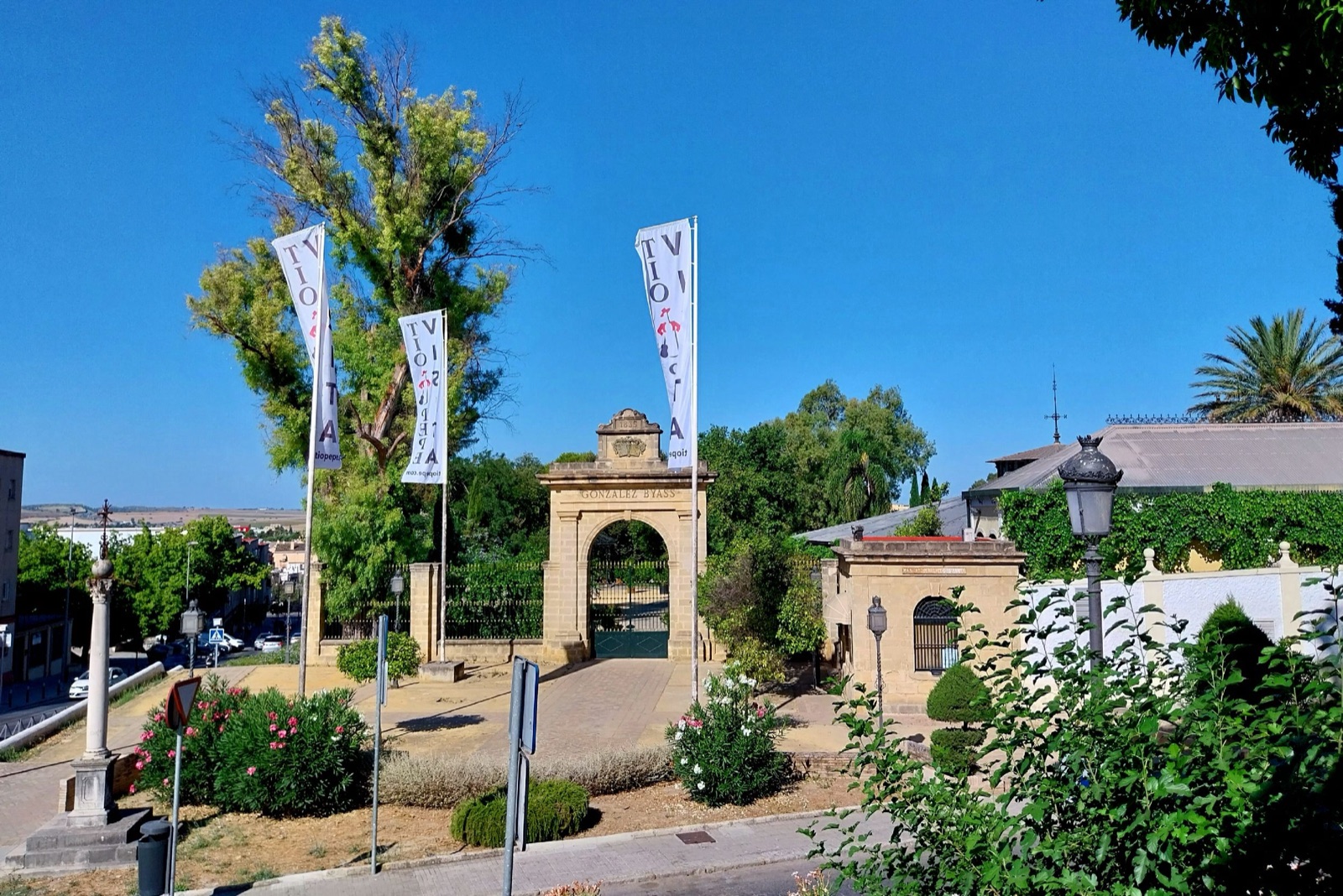
Atlantic climate and varied soils
The region is warm, bright, and exposed, with most rain falling outside the summer growing season. Dry, hot levante winds arrive from inland; humid poniente winds and night breezes come from the ocean. Coastal vineyards and Sanlúcar tend to experience more maritime moderation and humidity than sites farther inland, while slope, exposure, distance from marsh or sea, and the weather of a particular year create further differences. Airflow also matters inside an ageing bodega, where temperature and humidity affect the survival and activity of the surface yeast known as flor.
Albariza, the region's conspicuous white earth, encompasses a family of soft, calcareous marl-derived soils. Their fine textures, abundant carbonate, porosity, and sometimes deep profiles allow winter rain to enter and remain available into the dry season. Measurements from Jerez vineyards show substantial variation in available water and permeability among albariza sites.2. G. Paneque et al., “The albarizas and the viticultural zoning of Jerez-Xérès-Sherry and Manzanilla-Sanlúcar de Barrameda registered appellations of origin,” Terroir 2002. Connections between chalk and wine run through soil depth, structure, rooting, water supply, farming, and harvest timing.
Vines also grow on barros and arenas. Barros generally occupy lower ground and contain more clay, sand, and organic matter than the palest albarizas. Arenas are sand-dominant coastal soils with less limestone and are especially important around Chipiona. These broad names simplify many local variations. The traditional pagos provide a finer geography: they are named rural areas defined by soil, relief, and mesoclimate and may contain several separate vineyards.
Grapes and vineyard wine
Palomino—especially the locally named Palomino Fino or Listán Blanco—is the principal grape and supplies most dry base wine. Its importance lies partly in what happens after harvest: pressing choices, fermentation, fortification or its omission, the development of flor, and years of maturation can reshape a comparatively discreet young wine. Pedro Ximénez and Moscatel de Alejandría are the other established grapes, particularly for sweet wines made from ripe or sun-dried fruit. Moscatel has a strong association with the coastal sandy soils around Chipiona, while Pedro Ximénez is now a much smaller local planting than Palomino.
The current Jerez-Xérès-Sherry specification also authorizes Beba, Perruno, and Vigiriega, although recent council reporting describes their presence as minimal. Manzanilla is narrower in grape terms and permits only Palomino, Palomino Fino/Listán Blanco.
Producers also make young, usually unfortified whites outside both PDOs, often discussed as vinos de pasto. The phrase is a regional and historical usage, not a category in the present Jerez or Manzanilla specifications. Qualifying examples may carry the broader Vino de la Tierra de Cádiz protected geographical indication, whose area and authorized grapes extend beyond the Sherry denominations, or be sold without that indication.3. Junta de Andalucía, Pliego de Condiciones del Vino de la Tierra de “Cádiz”, sections A, B, D, and F. Fortification is no longer universal for protected Jerez and Manzanilla: the current rules allow a qualifying dry wine to be certified as wine rather than liqueur wine when it reaches the required strength without added alcohol. Certification still depends on meeting the denomination's wine type and ageing requirements.
Vineyard and ageing geography
The historic triangle joins Jerez de la Frontera, El Puerto de Santa María, and Sanlúcar de Barrameda. It remains central to the region's commercial history and contains a large concentration of old bodegas and soleras. Before the 2022 revision of the Jerez specification, the triangle also defined the permitted ageing area for protected Jerez, though grapes and base wine could come from the larger production area. That separation has ended for Jerez-Xérès-Sherry. Production and ageing may now take place across the delimited ten-municipality area, although wine labelled Jerez Fino may not be aged in Sanlúcar.4. Consejo Regulador, Memoria de Actividades 2025, pp. 17–18; current Jerez-Xérès-Sherry specification, section C.3.
Manzanilla preserves a different boundary. Its grapes may come from anywhere in the shared production area, but it must undergo at least two years of biological ageing in a registered bodega within Sanlúcar de Barrameda. The law defines Manzanilla by the location of ageing as well as grape origin and method. Sanlúcar's position beside the Guadalquivir estuary generally brings higher humidity and more moderate temperatures than inland Jerez, but the finished wine also depends on the bodega's architecture, position, ventilation, cask management, and the behaviour of flor. Maritime location is one influence alongside these cellar conditions.
The bodega itself shapes ageing. High ceilings, shaded walls, permeable floors, and controlled ventilation help moderate heat and admit humid air. Wines mature in seasoned oak botas, usually with headspace below the bung. Under flor, yeasts consume wine constituents and restrict direct oxygen exposure; without a stable veil, oxidative development becomes more important. The seasoned casks chiefly support biological or oxidative oak maturation. Conspicuous new-oak flavour is secondary.
Both static vintage ageing and the dynamic criaderas y solera system are permitted. In the latter, periodic withdrawals from older casks are replaced with younger wine through successive scales. Blending across vineyards and years can foreground house style while grape source, coastal or inland cellar conditions, and the decisions governing each ageing system remain distinct.
Related topics
Sources
- Junta de Andalucía, Pliego de condiciones de la Denominación de Origen Protegida «Jerez-Xérès-Sherry», consolidated under the Order of 13 May 2026, accessed 1 September 2026.
- Junta de Andalucía, Pliego de condiciones de la Denominación de Origen Protegida «Manzanilla-Sanlúcar de Barrameda», consolidated under the Order of 13 May 2026, accessed 1 September 2026.
- Consejo Regulador de las Denominaciones de Origen Jerez-Xérès-Sherry, Manzanilla-Sanlúcar de Barrameda y Vinagre de Jerez, Memoria de Actividades 2025, especially pp. 13–18.
- G. Paneque, M. Roca, C. Espino, C. Pardo, J. Aldecoa & P. Paneque, “The albarizas and the viticultural zoning of Jerez-Xérès-Sherry and Manzanilla-Sanlúcar de Barrameda registered appellations of origin (Cadiz, Spain)”, Proceedings of the 4th International Terroir Congress, 2002.
- Junta de Andalucía, Pliego de Condiciones del Vino de la Tierra de “Cádiz”, current product specification, accessed 1 September 2026.
- Shawn Hennessey, “Exploring Sherry country”, Decanter, 31 July 2024.