Douro
Douro is a wine region in northeastern Portugal that follows the Douro River and its tributaries upstream toward the Spanish border. The Douro Demarcated Region contains two protected designations: Douro for a broad range of wines and Porto, or Port, for fortified wine.1. Instituto dos Vinhos do Douro e do Porto, “The Wines,” current designations of origin, accessed 1 September 2026. Both draw on the same difficult landscape and many of the same grapes, but their differences extend beyond fortification.
The region follows a network of river valleys. Elevation, slope, aspect, soil depth, and distance from the Atlantic vary sharply, sometimes within one property. These differences help explain why Douro can produce dry red, white, and rosé wines, sparkling and sweet wines, and diverse styles of Port.
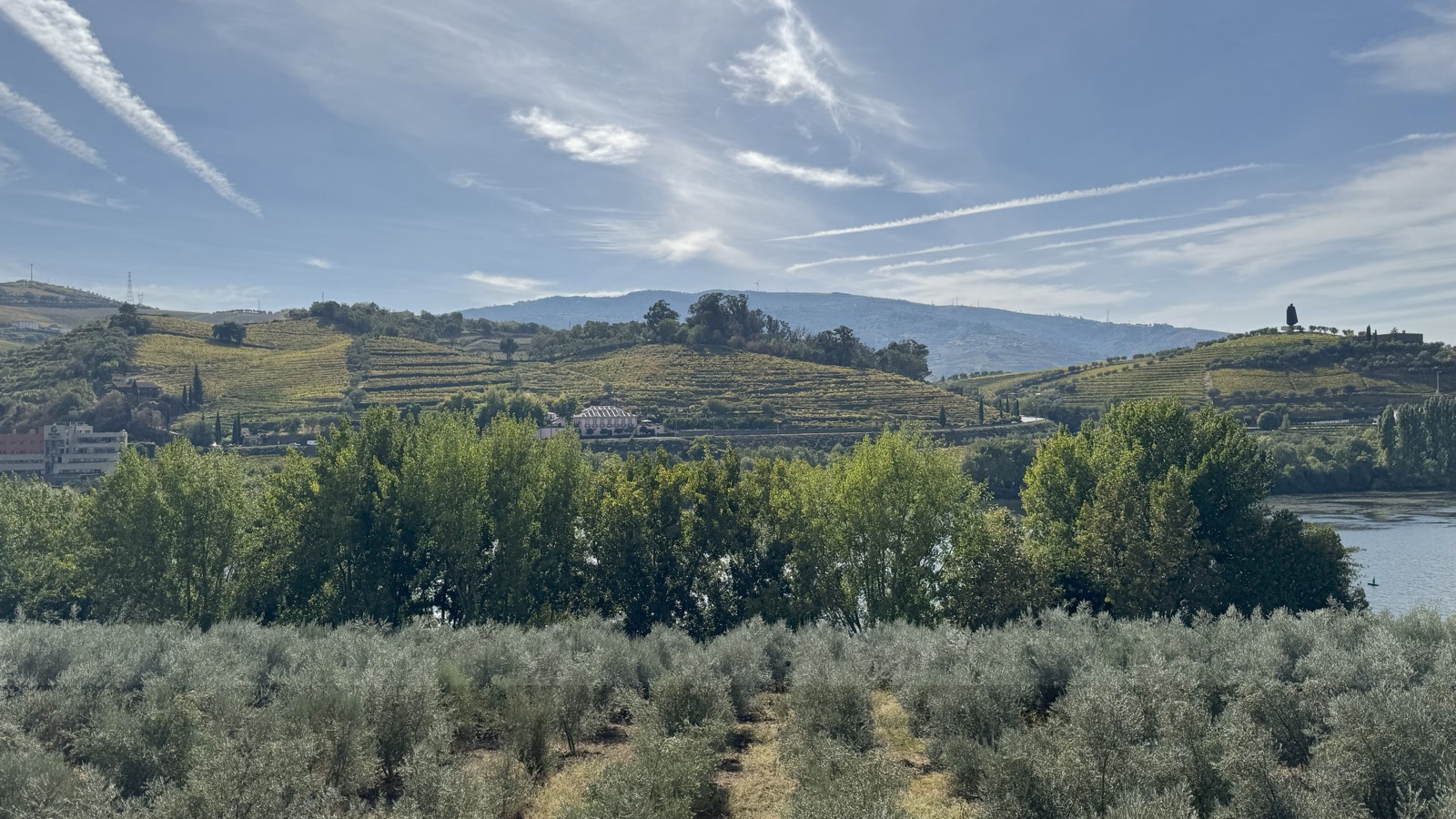
River valleys, slopes, and schist
Mountains separate the Douro from much of the humid Atlantic influence, while the river and its tributaries cut deep valleys through the interior. Vineyards occupy slopes facing many directions and ranging from the warmer valley floor to substantially cooler elevations. A sunny, sheltered parcel near the river may ripen very differently from a high or north-facing site nearby. Terraces and narrow planted platforms make cultivation possible on some steep slopes, but also reflect choices about erosion, water movement, vine density, and machinery access.
Most vineyard land near the river system is schistous, with granite more common around parts of the region's margins. Growers made many vineyard soils by breaking and rearranging the layered rock as they formed terraces and prepared ground for vines. The resulting soils are commonly stony, acidic, and low in organic matter. Fractures can admit roots and water, but soil depth and water-holding capacity remain highly variable, leaving some sites vulnerable to drought. For growers, schist affects how roots penetrate the soil, how water drains, how heat is absorbed, and how vineyards must be established.
Three subregions and a water gradient
The official division into Baixo Corgo, Cima Corgo, and Douro Superior reflects a broad west-to-east climatic and historical progression. Baixo Corgo, in the west, generally receives the most rainfall and has the strongest Atlantic influence. That can support more regular vine growth, but wetter conditions can also increase disease pressure. Cima Corgo occupies the central sector around Pinhão and much of the region's historic vineyard core. It is generally warmer and drier than Baixo Corgo, yet encompasses many elevations, exposures, and tributary valleys.
Douro Superior extends east from the former river obstacle at Cachão da Valeira to Spain. It is generally the hottest and driest subregion, with more continental conditions and larger expanses of lightly planted land. The Instituto dos Vinhos do Douro e do Porto (IVDP) records roughly 1,200 millimetres of annual rainfall at a wet western station and about 380 at Barca d'Alva in the east.2. Instituto dos Vinhos do Douro e do Porto, “Characteristics of the Region,” regional geography, soils, and climate, accessed 1 September 2026. These figures describe locations, not guaranteed conditions across each subregion. Altitude, aspect, tributary valley, soil, and vintage can complicate the west-to-east pattern.
Summer heat and low rainfall create a basic tension. Enough warmth can ripen late grapes and reduce rot pressure, while excessive exposure can dehydrate berries, damage leaves and fruit, or slow photosynthesis through severe water stress. Deep rooting, drought-adapted rootstocks and varieties, canopy shade, soil management, and carefully limited irrigation where used can help, but none removes the constraint. In a three-vintage Douro Superior trial on Touriga Nacional, deficit irrigation partly relieved extreme water stress and improved yield under the study conditions, but more water did not consistently provide additional protection or alter key harvest measurements.3. Inês L. Cabral et al., “Impact of Deficit Irrigation on Grapevine cv. ‘Touriga Nacional’ during Three Seasons in Douro Region: An Agronomical and Metabolomics Approach,” Plants 11 (2022), 732.
Grapes and field blends
Douro rules authorize many grape varieties, although a smaller group dominates modern plantings. Official 2023 data put Touriga Franca first, followed by Tinta Roriz, Touriga Nacional, and Tinta Barroca; together they occupied well over half the vineyard area.4. Instituto dos Vinhos do Douro e do Porto, “Castas,” 2023 vineyard data, accessed 1 September 2026. Touriga Nacional can contribute concentrated skin material and marked aroma. Tinto Cão, Sousão, and Tinta Amarela, among many others, can change acidity, colour, tannin, ripening time, or performance in a particular site.
Older vineyards may be field blends: different varieties are interplanted, then often harvested and fermented together. Staggered ripening and varied responses to heat, drought, and disease can add resilience but also force difficult harvest compromises. A genetic survey of old mixed vineyards in Douro and neighbouring Trás-os-Montes found dozens of known varieties as well as unmatched genotypes, illustrating the diversity obscured by a focus on the principal grapes.5. Diana Augusto et al., “Grapevine Diversity and Genetic Relationships in Northeast Portugal Old Vineyards,” Plants 10 (2021), 2755. Modern planting, by contrast, often concentrates on fewer named varieties that can be harvested separately and blended later.
White grapes also vary with site and production choices. Rabigato, Malvasia Fina, Síria, Moscatel Galego Branco, Viosinho, and Gouveio are among the important names. Higher or less exposed sites can help retain acidity, while grape choice, harvest date, skin contact, fermentation vessel, and maturation distinguish fresh early-drinking whites from more structured wines.
Douro wine and Port
Port and unfortified Douro wine share many vineyards and grapes but diverge during fermentation. For Port, grape spirit is added before all the sugar has fermented. This stops fermentation, raises the alcohol, and usually leaves appreciable residual sugar. Because red Port has only a short fermentation before fortification, colour and tannin must be extracted quickly, whether by foot treading in a traditional lagar or by modern equipment. Blending and maturation can then produce youthful ruby styles, long wood-aged tawny styles, vintage-dated wines, or white and rosé Port. Sweetness also varies.
For an unfortified wine, fermentation normally continues to dryness, so alcohol, extraction, and tannin develop on a different timetable. A producer may co-ferment a field blend, assemble separately harvested parcels, emphasize one grape, or make a varietal wine. Dry reds can range from lightly extracted and early-drinking to firmly structured wines shaped by oak maturation. Whites, rosés, sparkling wines, and Moscatel do Douro extend the region's range. Each designation can favour a different balance of ripeness and acidity. Material suited to a concentrated Port may be too alcoholic or low in acidity for the dry wine a producer wants, while a cooler parcel may be especially useful in an unfortified blend.
The Douro's historic demarcation dates to 1756, when regulators sought to control the origin, quantity, and quality of wine entering the Port trade.6. Instituto dos Vinhos do Douro e do Porto, “História Vinho do Porto,” accessed 1 September 2026. That history explains Port's institutional importance, while unfortified wines now give the region a broader identity.
Related topics
Sources
- Instituto dos Vinhos do Douro e do Porto, “Characteristics of the Region”, accessed 1 September 2026.
- Instituto dos Vinhos do Douro e do Porto, “Castas” and “Vinhos do Douro”, grape and wine references including 2023 planting data, accessed 1 September 2026.
- Instituto dos Vinhos do Douro e do Porto, “The Winemaking”, “The Wines”, and “História Vinho do Porto”, accessed 1 September 2026.
- Inês L. Cabral et al., “Impact of Deficit Irrigation on Grapevine cv. ‘Touriga Nacional’ during Three Seasons in Douro Region: An Agronomical and Metabolomics Approach”, Plants 11 (2022), 732.
- Diana Augusto et al., “Grapevine Diversity and Genetic Relationships in Northeast Portugal Old Vineyards”, Plants 10 (2021), 2755.
- Wine & Spirit Education Trust, “Three Douro subregions that define Port”, 16 September 2025, accessed 1 September 2026.