Touriga Franca
Also known as Touriga Francesa
Touriga Franca is a dark-skinned Portuguese grape. In the Douro it is more widely planted than Touriga Nacional and a major component of both Port and dry red blends. Its value is practical as well as sensory: the vine crops more regularly than Touriga Nacional, its fruit copes well with the Douro's heat, and its wines can add colour, tannin, fruit, and a distinctly floral lift.
A blend may contain either Touriga in a leading or supporting proportion, and site, crop level, harvest date, extraction, and maturation all change the result. Touriga Franca is also bottled alone, but its large area and affinity with other Douro grapes make blending its central regional role.
History and identity
Touriga Franca was officially called Touriga Francesa until Portugal's 2000 list of wine grapes adopted the present name. The older name did not establish a French origin. A Portuguese varietal reference places the grape in northern Portugal, while warning that early mentions of vaguely named Tourigas cannot confidently be assigned to the modern variety. The first secure history is therefore less clear and probably more recent than the broad Touriga name suggests.
Microsatellite analysis identified Touriga Franca as an offspring of Touriga Nacional and Marufo, and later single-nucleotide polymorphism analysis confirmed the parentage.1. Isaura Castro, Juan Pedro Martín, José M. Ortiz & Olinda Pinto-Carnide, “Varietal discrimination and genetic relationships of Vitis vinifera L. cultivars from two major Controlled Appellation (DOC) regions in Portugal,” Scientia Horticulturae 127 (2011), pp. 507–514, https://doi.org/10.1016/j.scienta.2010.11.018; Diana Augusto et al., “Grapevine Diversity and Genetic Relationships in Northeast Portugal Old Vineyards,” Plants 10 (2021), 2755, https://doi.org/10.3390/plants10122755. Sexual reproduction combines genetic material from two parents and creates a new variety; cuttings then preserve that new individual. Touriga Franca consequently shares ancestry and some family resemblances with Touriga Nacional while retaining its own genetic identity, vine morphology, and growing behaviour.
The visible differences are substantial. Touriga Franca generally has medium berries in medium to large, fairly compact bunches, whereas Touriga Nacional typically has smaller berries and smaller bunches. Franca is usually more productive and regular in its fruit set. Nacional's smaller, thick-skinned berries can give a high ratio of skin to juice and make it especially useful for concentrated colour, tannin, and aroma; Franca can supply more dependable volume with its own colour and aroma.
Viticulture in a hot region
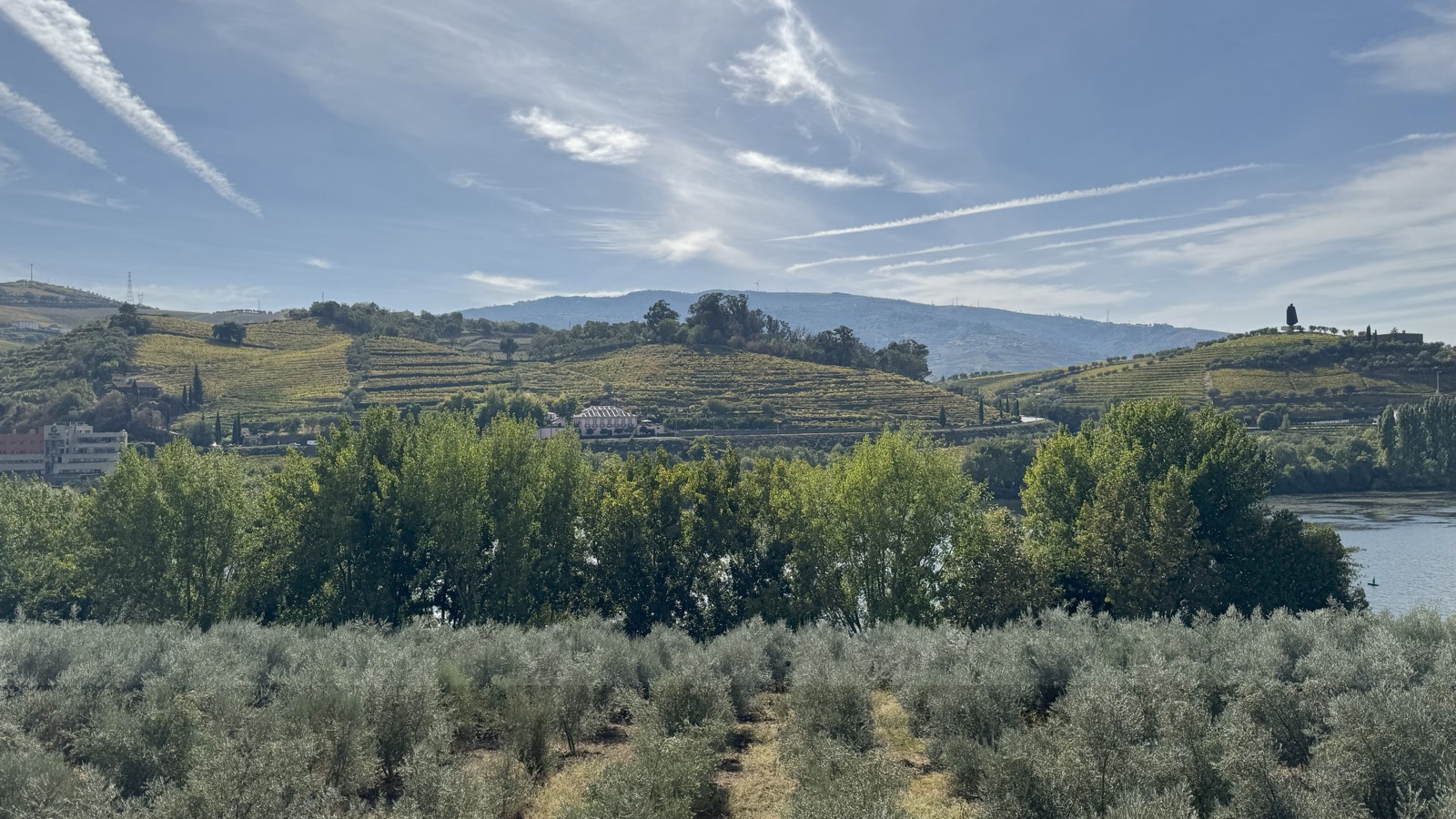
Touriga Franca has a medium-to-long growing cycle and reaches satisfactory ripeness in warm conditions. Its bunches resist heat damage relatively well, and the vine tolerates strong sunlight, helping explain its suitability for warm, exposed Douro slopes. This is heat tolerance in a practical vineyard sense: berries can remain sound while accumulating sugar and phenolic maturity under conditions that can shrivel more vulnerable grapes.
Water supply affects berry growth, bunch compactness, photosynthesis, and the pace of ripening. In a three-season trial on Touriga Franca in the hot Douro Superior, rainfed vines generally performed less well than vines under moderate deficit irrigation, although irrigation effects on yield and berry composition were inconsistent from year to year.2. Inês L. Cabral, Anabela Carneiro, Tiago Nogueira & Jorge Queiroz, “Regulated Deficit Irrigation and Its Effects on Yield and Quality of Vitis vinifera L., Touriga Francesa in a Hot Climate Area (Douro Region, Portugal),” Agriculture 11 (2021), 774, https://doi.org/10.3390/agriculture11080774. Rootstock, soil depth, exposure, canopy shade, crop, and the timing of water stress influence the outcome. Severe stress can slow ripening or dehydrate fruit.
The compact bunches bring a different risk in damp conditions: grey rot can develop, and humid or fertile sites may trade greater production for weaker ripening.
Floral character and structure
Floral character, often compared to roses or wild flowers, is one of Touriga Franca's most recognizable contributions to a blend. A Douro analysis recorded free terpenes including nerol, geraniol, and citronellol in the variety, compounds associated with floral aromas.3. Vine to Wine Circle, “Touriga-Franca (PT),” including a 2003 Douro aroma analysis, https://www.vinetowinecircle.com/castas_post/touriga-franca/. Their concentration varies with season and site, and fermentation, blending, oxygen exposure, and maturation can preserve, transform, or mask their aromas.
Fruit character and firm tannin commonly accompany that perfume. Skin pigments and phenolic material can give substantial colour and structure, but neither is constant; the specialist varietal record reports especially large year-to-year variation in colour intensity. Extraction choices matter as well. A short, vigorous extraction before Port is fortified expresses the raw material differently from a complete dry fermentation or an extended maceration.
Its place in the Douro blend
Official 2023 vineyard data put Touriga Franca at 10,727 hectares, or 25.0% of the Douro's planted area. It was the region's most planted variety, well ahead of Tinta Roriz at 14.3% and Touriga Nacional at 10.3%.4. Instituto dos Vinhos do Douro e do Porto, “Castas,” 2023 vineyard data, https://www.ivdp.pt/pt/vinha/castas/.
Franca's scale follows from the way its traits fit the regional system. Regular crops give growers a more dependable supply; heat-resistant fruit suits many warm parcels; and colour, tannin, fruit, and floral aroma remain useful in both fortified and dry wines. Touriga Nacional may contribute a different aromatic intensity and more concentrated skin material, while Tinta Roriz, Tinta Barroca, Tinto Cão, and numerous older field-blend varieties alter ripening, acidity, texture, or volume. Douro and Port rules allow a much broader set of grapes.
Outside the Douro, Touriga Franca is grown elsewhere in Portugal, including warmer southern regions.
Sources
- Instituto dos Vinhos do Douro e do Porto, “Castas”, including 2023 planting data and the institute's Touriga Franca varietal summary, and “Vinificação”, accessed 1 September 2026.
- Vine to Wine Circle, “Touriga-Franca (PT)”, varietal record, accessed 1 September 2026.
- Isaura Castro, Juan Pedro Martín, José M. Ortiz & Olinda Pinto-Carnide, “Varietal discrimination and genetic relationships of Vitis vinifera L. cultivars from two major Controlled Appellation (DOC) regions in Portugal”, Scientia Horticulturae 127 (2011), pp. 507–514.
- Diana Augusto et al., “Grapevine Diversity and Genetic Relationships in Northeast Portugal Old Vineyards”, Plants 10 (2021), 2755.
- Inês L. Cabral, Anabela Carneiro, Tiago Nogueira & Jorge Queiroz, “Regulated Deficit Irrigation and Its Effects on Yield and Quality of Vitis vinifera L., Touriga Francesa in a Hot Climate Area (Douro Region, Portugal)”, Agriculture 11 (2021), 774.