Beaujolais
Beaujolais is a wine region on the eastern edge of the Massif Central, between Lyon and Mâcon, and the name of its broad regional appellation. It is closely identified with Gamay, Beaujolais Nouveau, and carbonic maceration. The region also produces non-nouveau red and rosé wine, white wine from Chardonnay, Beaujolais carrying the Villages mention, and the red wines of ten separate cru appellations.
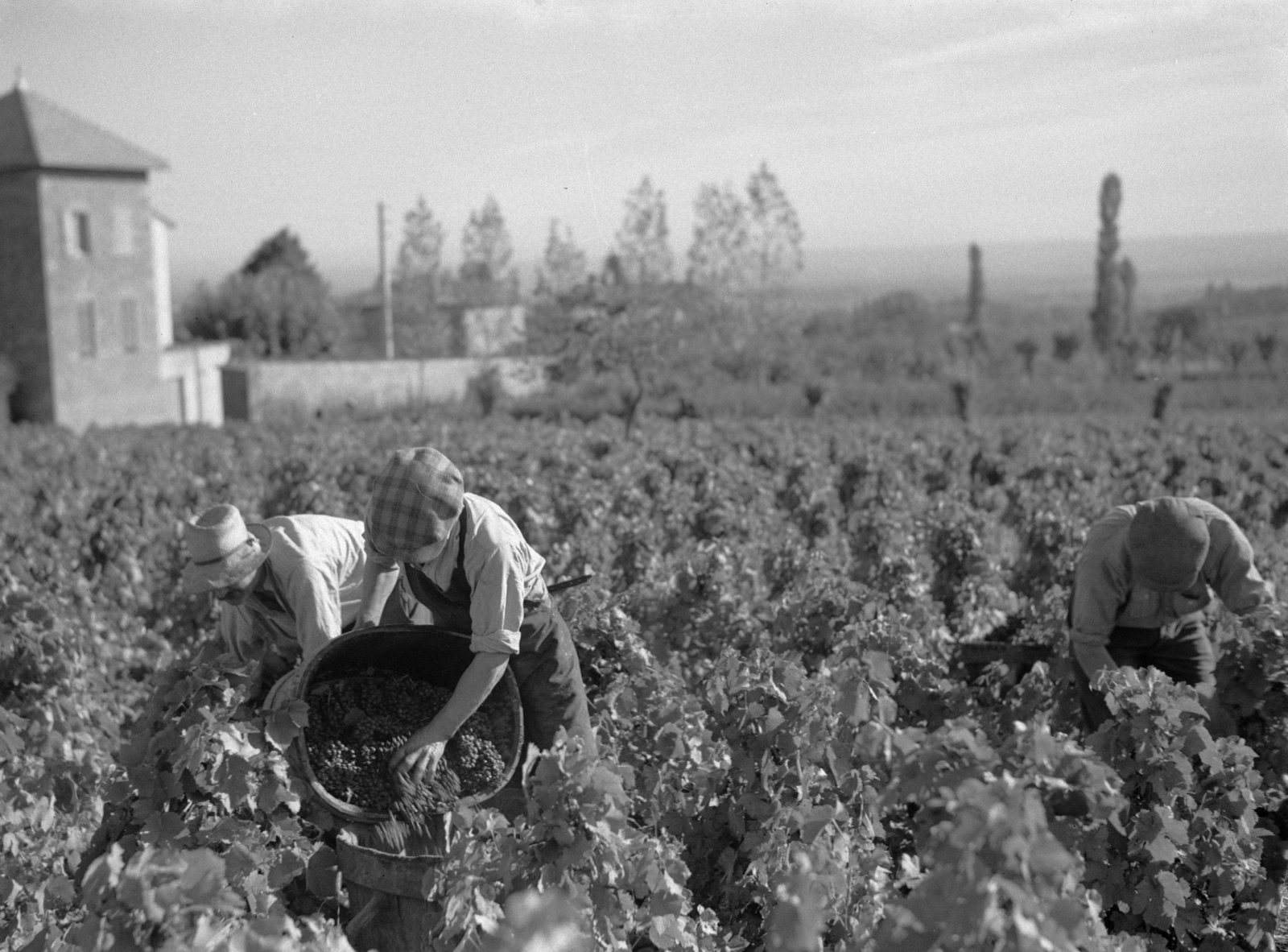
Geography and a mosaic of soils
The vineyard runs for about 55 kilometres along the slopes between the Monts du Beaujolais to the west and the Saône plain to the east. Most sites face east or south, but elevation, slope, and exposure change substantially within this narrow strip. The mountains reduce the direct influence of westerly weather, while the Saône valley channels warmer air from the south. Continental, oceanic, and southern influences therefore meet in a landscape where storms, summer heat, rainfall, wind, and harvest conditions can differ over short distances.1. French Ministry of Agriculture, Cahier des charges de l'appellation d'origine contrôlée « Beaujolais », approved 5 August 2026, sections IV and X.1.a.
The useful first approximation is a north–south geological contrast. In the north, old Paleozoic granites, porphyries, schists, diorites, and volcano-sedimentary rocks weather into soils that may be sandy or clay-rich and are generally acidic. Farther south, younger Triassic and Jurassic limestone formations more often underlie deeper, more clay-rich soils. This is not a clean dividing line. Ancient river terraces, slope deposits, and alluvial fans cover the bedrock in many places, while metamorphic and volcanic formations interrupt any simple map of granite in the north and limestone in the south.
A regional soil survey conducted from 2009 to 2017 distinguished, among its common groups, soils formed from granite, the mixed formations locally called pierres bleues, hard limestone, clay with chert, and older clay-rich or sandy alluvio-colluvial deposits. It also found substantial variation within these groups.2. Jean-Yves Cahurel et al., “Soil quality in Beaujolais vineyard: Importance of pedology and cultural practices,” IVES Conference Series, Terclim 2022; Inter Beaujolais, “Discovering the Beaujolais terroirs,” on the 2009–2018 SIGALES survey. Rock name alone consequently says little about soil depth, texture, water storage, rooting, or vine management. Even within granitic Fleurie, for example, steep upper slopes can have shallow sandy soils and exposed bedrock, while colluvium downslope produces deeper soils with more clay and fine material.
These differences affect vine water supply, drainage, temperature, and the timing of ripening. An observatory of Gamay sites in Beaujolais found strong vintage and site effects; appellation explained the timing of ripening poorly, and measured soil composition had only a weak relationship with the grape and wine characteristics studied.3. V. Lempereur, S. Preys & J.-Y. Cahurel, “Etude des effets millésime, situation et sol à partir d'un observatoire du Gamay en beaujolais,” IVES Conference Series, Terroir 2010.
Gamay and the region's other wines
Gamay is the principal variety for red and rosé Beaujolais and for the ten crus. Its fertility makes pruning and crop management consequential, while its compact bunches make fruit health and harvest handling important in wet years. The combination of site, season, crop, and extraction helps explain why Gamay here can yield both immediately supple wines and firmer wines capable of developing in bottle.
Current regional rules permit limited accessory varieties in red and rosé vineyards, some only as mixed plants within a parcel. The cru rules also center Gamay but preserve a narrow allowance for mixed plantings: under the current Fleurie specification, for example, Aligoté, Chardonnay, and Melon may together occupy no more than 15 percent of a parcel and must be interplanted with the principal variety.4. French Ministry of Agriculture, current Beaujolais specification, section V; Cahier des charges de l'appellation d'origine contrôlée « Fleurie », approved 20 February 2024, section V.
For white Beaujolais—including wine carrying the Villages mention—the current regional specification requires Chardonnay alone.
Appellations
The broad Beaujolais appellation covers red, rosé, and white still wine. Within its own specification, Villages is a supplementary geographical mention for wine from a delimited group of northern communes; qualifying wines may instead carry the approved commune name. Beaujolais Supérieur is a red-only mention defined by production conditions including lower permitted yield and greater minimum grape ripeness. It is not a separate place-name or an official verdict that every such wine is superior in the glass.5. French Ministry of Agriculture, current Beaujolais specification, sections II, III, VII–IX, and XII.
The ten crus—Brouilly, Chénas, Chiroubles, Côte de Brouilly, Fleurie, Juliénas, Morgon, Moulin-à-Vent, Régnié, and Saint-Amour—are different. Each is a separately delimited appellation for red wine, with its own specification. A cru name tells the reader where the grapes qualified to come from; it does not prescribe a single cellar method or rank that cru against the other nine.
Chiroubles and Fleurie are strongly associated with weathered pink granite, yet depth and texture change down their slopes. Côte de Brouilly wraps around steep Mont Brouilly and combines the so-called blue-rock formations with granite and slope debris. Juliénas includes schist, diorite, sandstone, and clay, while Saint-Amour includes granite, schist, clay, limestone, and piedmont deposits. Broadly granitic Brouilly still contains blue-rock, sedimentary, piedmont, and colluvial ground. Differences also occur within a named lieu-dit, and two producers can farm and vinify neighbouring parcels differently.
A producer may use a broader appellation when eligible wine is not claimed under a narrower one, and a blend of sites can be as deliberate as a single-parcel bottling. Current cru rules permit a cadastral lieu-dit on the label, but that does not make the site a classified tier. As of September 2026, the Fleurie specification contains no premier cru category: the Institut national de l'origine et de la qualité (INAO) describes proposed Fleurie lieux-dits as candidates, not recognized premiers crus.6. French Ministry of Agriculture, current Fleurie specification, sections II and XII; INAO, “Séance itinérante du CRINAO Bourgogne-Beaujolais-Savoie-Jura dans le Beaujolais,” 21 May 2025.
Production choices and Nouveau
Traditional Beaujolais vinification is usually semi-carbonic rather than a pure application of carbonic maceration. Whole bunches fill the vat; berries near the bottom break and begin an ordinary yeast fermentation, whose carbon dioxide creates anaerobic conditions for intact berries above. Intracellular metabolism and yeast fermentation thus proceed together. The proportion of whole fruit, temperature, vatting time, pumping over, cap management, pressing, and the treatment of free-run and press wine all change the result.
Producers are not confined to that approach. They may extend maceration and work the cap for greater extraction, destem some or all of the crop, or mature wine in concrete, steel, large cask, or smaller barrel. Semi-carbonic practice can produce a cru intended to age, while destemmed vinification can make a relatively accessible wine.7. International Organisation of Vine and Wine, “Carbonic maceration,” International Code of Oenological Practices, II.1.7; Inter Beaujolais, “The Grower's Work”; James Lawther, “Beaujolais: revival of the fittest,” Decanter, updated 17 October 2016.
Nouveau and primeur are regulated early-release mentions, not methods and not synonyms for the region. Under the current Beaujolais specification, they apply only to red or rosé Beaujolais, with or without the Villages mention. The wine must come from that year's harvest, remain in vat for no more than ten days, and be packaged before the end of the harvest year. The permitted production calculation excludes land delimited for the ten crus. These rules encourage rapid vinification and an immediately approachable wine, but they do not require one precise carbonic recipe.5. French Ministry of Agriculture, current Beaujolais specification, sections II, III, VII–IX, and XII.
Benchmark producers
Domaine Marcel Lapierre in Morgon is a reference for the region's movement toward organic farming and restrained additions, shaped by Marcel's work with Jules Chauvet and continued by his family. The domaine sorts fruit carefully, uses whole-bunch semi-carbonic maceration, and completes its Morgon's fermentation and ageing in used barrels. Some bottlings receive sulfur dioxide and others do not; the practice is more specific than a blanket claim that all its wines are made without added sulfites.8. Jérôme Gautheret, report on the Lapierre family, Le Monde, 8 August 2023; Domaine Marcel Lapierre, “Viticulture and vinification,” accessed 14 September 2026.
Château Thivin offers a contrasting reference centred on Côte de Brouilly and the craft of parcel blending. Les Sept Vignes assembles seven parcels across different faces of Mont Brouilly, principally on the local blue-rock formations. Whole-bunch proportions vary with the vintage, and the component wines mature in large oak casks before blending. It illustrates how differences within one cru can be combined in a single wine, rather than necessarily bottled as separate sites.9. James Lawther, “Beaujolais: revival of the fittest,” Decanter, updated 17 October 2016; Château Thivin, “Les sept vignes,” accessed 14 September 2026.
Related topics
Sources
- French Ministry of Agriculture, Cahier des charges de l'appellation d'origine contrôlée « Beaujolais », approved 5 August 2026 and published 20 August 2026, accessed 1 September 2026.
- French Ministry of Agriculture, Cahier des charges de l'appellation d'origine contrôlée « Fleurie », approved 20 February 2024, accessed 1 September 2026.
- Légifrance, Décret n° 2009-1343 du 29 octobre 2009 relatif aux appellations d'origine contrôlées « Brouilly », « Chénas », « Chiroubles », « Côte de Brouilly », « Fleurie », « Juliénas », « Morgon », « Moulin-à-Vent », « Saint-Amour » et « Régnié », consolidated through 20 September 2023, accessed 1 September 2026.
- Institut national de l'origine et de la qualité, “Séance itinérante du CRINAO Bourgogne-Beaujolais-Savoie-Jura dans le Beaujolais”, 21 May 2025, accessed 1 September 2026.
- Jean-Yves Cahurel et al., “Soil quality in Beaujolais vineyard: Importance of pedology and cultural practices”, IVES Conference Series, Terclim 2022.
- V. Lempereur, S. Preys & J.-Y. Cahurel, “Etude des effets millésime, situation et sol à partir d'un observatoire du Gamay en beaujolais”, IVES Conference Series, Terroir 2010.
- Inter Beaujolais, “Discovering the Beaujolais terroirs”, “Our 12 appellations”, and “The Grower's Work”, accessed 1 September 2026.
- International Organisation of Vine and Wine, “Carbonic maceration”, International Code of Oenological Practices, II.1.7, accessed 1 September 2026.
- James Lawther, “Beaujolais: revival of the fittest”, Decanter, updated 17 October 2016.
- Jérôme Gautheret, report on the Lapierre family, “Vins d'exception en héritage” series, Le Monde, 8 August 2023, p. 21; clipping hosted by the domaine.
- Domaine Marcel Lapierre, “Viticulture and vinification”, accessed 14 September 2026.
- Château Thivin, “Les sept vignes”, current parcel and winemaking description, accessed 14 September 2026.