Aligoté
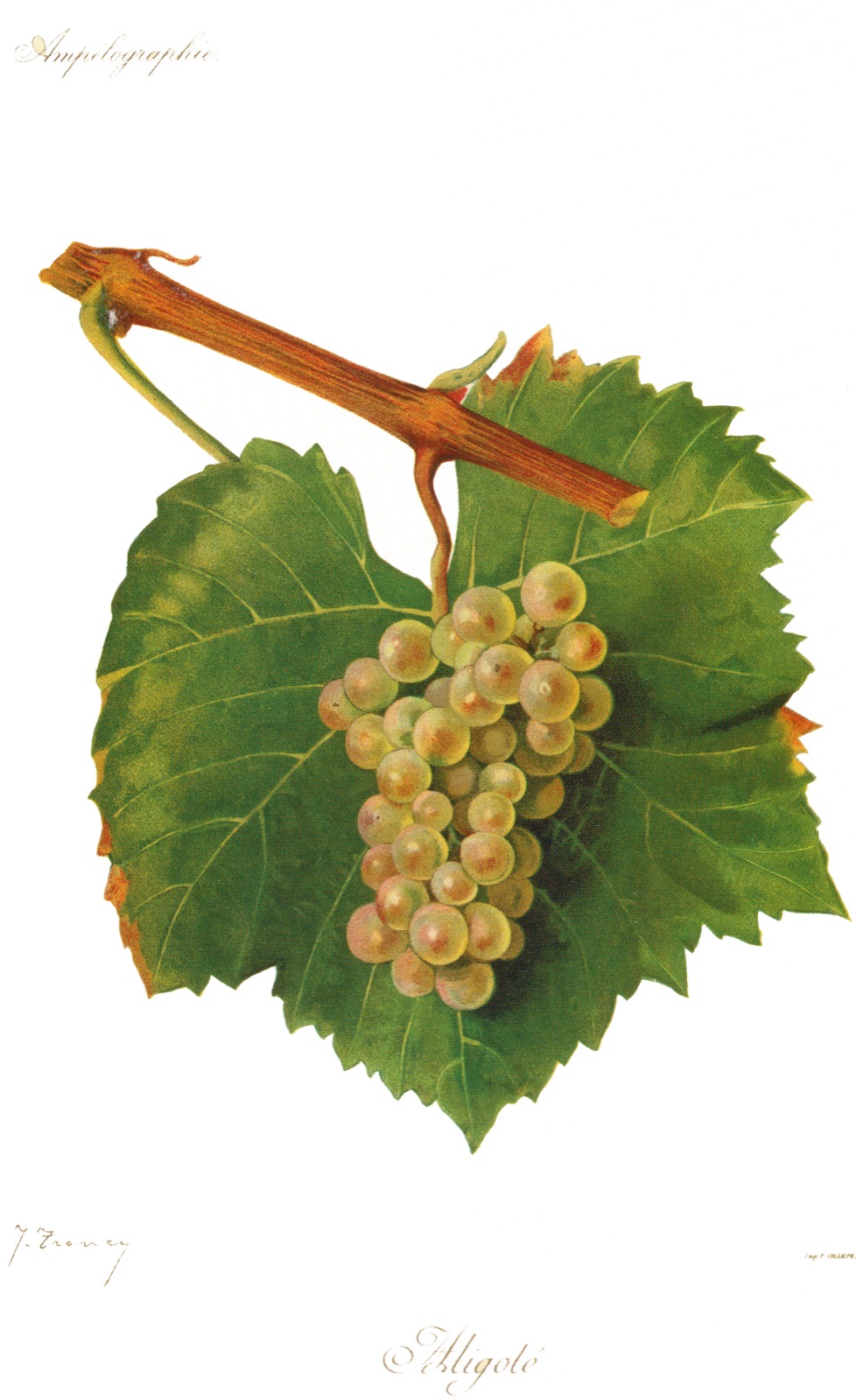
Aligoté is a white Vitis vinifera variety most closely associated with Burgundy. Its wines are defined by lively acidity, which can make them direct and refreshing. The grape is particularly important in Bouzeron, the only Burgundian village appellation made exclusively from Aligoté.
History
Bourgogne Wines places its emergence there in the seventeenth century. Published genetic analyses indicate that it resulted from a cross between Pinot and Gouais blanc, the same two lineages involved in Chardonnay.1. UMT Géno-Vigne (INRAE, IFV and L'Institut Agro Montpellier), Plantgrape, “Aligoté B”, varietal record, edited 7 September 2026, accessed 7 September 2026.
For much of its modern history, Aligoté was compared with Chardonnay, which occupied more of Burgundy's most valued sites. Bourgogne Wines records that Aligoté was sometimes planted alongside Chardonnay in prestigious vineyards before phylloxera, and that the regional Bourgogne Aligoté appellation was created in 1937.
Bouzeron provides a more specific history of esteem. INAO says the local wine has had a reputation for several centuries and reports that, in the nineteenth century, it sold for prices comparable to Pouilly-Fuissé and the third cuvées of Meursault.2. Institut national de l'origine et de la qualité (INAO), “Bouzeron”, accessed 7 September 2026. The regional “Aligoté de Bouzeron” appellation became the communal AOP Bouzeron in 1998.
Viticulture
Plantgrape describes Aligoté as fertile and well suited to northern areas. It buds one day after Chasselas and reaches first-period maturity about a week and a half after it, making it an early-ripening variety by that reference. It has small bunches and berries; its fertility makes crop level an important variable. The variety is relatively little affected by powdery mildew but is fairly susceptible to downy mildew and grey rot; it also often shows millerandage, in which berries within a bunch develop unevenly.1. UMT Géno-Vigne (INRAE, IFV and L'Institut Agro Montpellier), Plantgrape, “Aligoté B”, varietal record, edited 7 September 2026, accessed 7 September 2026.
Plantgrape's French surface series records 1,883 hectares in 1958, 1,188 in 1979, and 1,974 in 2018.1. UMT Géno-Vigne (INRAE, IFV and L'Institut Agro Montpellier), Plantgrape, “Aligoté B”, varietal record, edited 7 September 2026, accessed 7 September 2026.
Wine character and site
Plantgrape calls Aligoté wines lively and nervy, while Bourgogne Wines emphasizes freshness and fruity acidity. The structure is the most dependable generalization: Aligoté commonly retains a marked, mouthwatering acidity, but aromatic intensity and typicity vary with terroir, vintage, and production level. Bourgogne Wines describes a range that can include white-fleshed fruit, white flowers, lemon, hazelnut, and saline impressions.
Bouzeron is the clearest example of site being part of the grape's identity. The appellation covers Bouzeron and Chassey-le-Camp in the Côte Chalonnaise, where the vines grow on marly limestone slopes. INAO presents the appellation as a particularly good fit between Aligoté's characteristics and those slopes.2. Institut national de l'origine et de la qualité (INAO), “Bouzeron”, accessed 7 September 2026. Contemporary reporting also describes renewed interest in hillside Aligoté and in old plantings, alongside the formation of Les Aligoteurs, a producer-and-wine-lover group advocating for the variety.3. Roger Morris, “Why Aligoté is Burgundy's Rising White Star”, Wine Enthusiast, updated 4 May 2023.
Where it is grown
Burgundy remains Aligoté's principal home. Bourgogne Wines reports about 2,000 hectares in France, more than 1,800 of them in Burgundy, extending from the Chablis area to the Mâconnais; the figure belongs to that source's published regional overview rather than to the dated Plantgrape series.4. Bourgogne Wines (BIVB), “Aligoté: a 100% Bourgogne varietal”, accessed 7 September 2026. Bourgogne Aligoté is the broad regional expression, while Bouzeron is the distinctive communal appellation devoted solely to the grape.
In the cellar
Bourgogne Wines says some examples can be held for a few years, during which varietal aromas may give way to more site-derived character.4. Bourgogne Wines (BIVB), “Aligoté: a 100% Bourgogne varietal”, accessed 7 September 2026. Producers have traditionally used brief stainless-steel ageing for many Bourgogne Aligoté wines, while some now use oak, including new wood. Those choices can broaden or mark the wine.
Sources
- UMT Géno-Vigne (INRAE, IFV and L'Institut Agro Montpellier), “Aligoté B”, Plantgrape varietal record, edited 7 September 2026, accessed 7 September 2026.
- Institut national de l'origine et de la qualité (INAO), “Bouzeron”, accessed 7 September 2026.
- Bourgogne Wines (BIVB), “Aligoté: a 100% Bourgogne varietal”, accessed 7 September 2026.
- Roger Morris, “Why Aligoté is Burgundy's Rising White Star”, Wine Enthusiast, updated 4 May 2023.