Trousseau
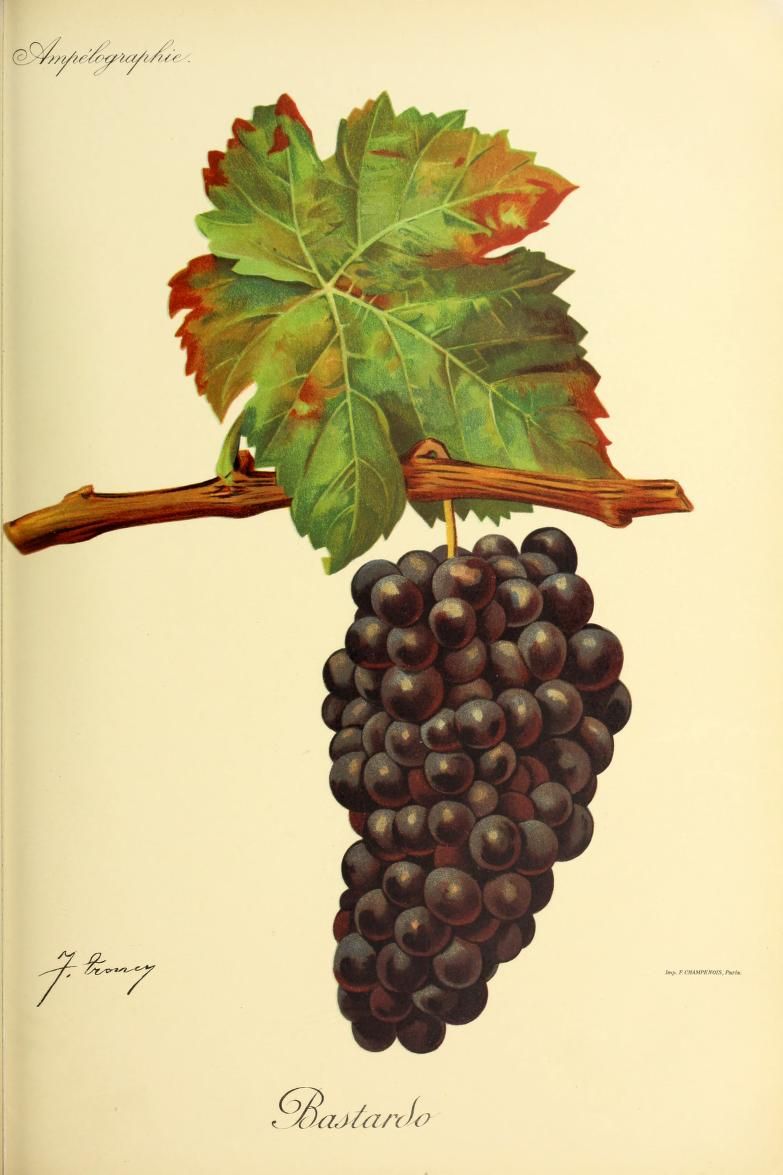
Also known as Bastardo, Merenzao
Trousseau is a dark-skinned Vitis vinifera grape associated most strongly with the Jura in eastern France. It is a vigorous vine that needs a warm, well-exposed site to ripen properly, and its wines often occupy a firmer, deeper-colored place in the Jura red-wine spectrum than Poulsard. The same variety is called Bastardo in Portugal and Merenzao in Spain, names that show how far this relatively regional French grape has traveled.
History and identity
Plantgrape identifies Trousseau as originating in the Jura. Published genetic analyses carried out in Montpellier make it probably a descendant of Savagnin, and the Jura appellation specification gives the variety a secure local record from 1732.1. French Ministry of Agriculture, Cahier des charges de l'appellation d'origine contrôlée « Côtes du Jura », Chapter I, section X.1(b), homologated 20 September 2022, published in the JORF 25 September 2022 and in the ministry bulletin 29 September 2022.
Plantgrape lists Bastardo for Portugal and Cyprus and Merenzao for Spain; it also records those names as officially recognized in France for plant-propagation material. In Portugal, the Instituto da Vinha e do Vinho (IVV) describes Bastardo as a red European grape grown throughout the country, with its greatest expansion in the Douro.2. Plantgrape, “Trousseau N.”; Instituto da Vinha e do Vinho, “Bastardo.”
Viticulture
Trousseau is vigorous and ripens early relative to many wine grapes. Plantgrape says it must be planted in well-exposed terroirs to reach proper maturity. The Jura specification is more specific about the local fit: Trousseau needs very warm, gravelly soils. Exposure and heat therefore help the fruit complete ripening, while the vine's vigor makes site and pruning choices part of the crop and maturity equation.3. French Ministry of Agriculture, Cahier des charges de l'appellation d'origine contrôlée « Côtes du Jura », Chapter I, section X.3; Plantgrape, “Trousseau N.”
The variety has small bunches and medium-sized berries, a high potential for sugar accumulation, and susceptibility to grey rot, leafhoppers, and wood diseases. Both short and long pruning can suit it, depending on climate. High yields can produce lighter-colored wine.3. French Ministry of Agriculture, Cahier des charges de l'appellation d'origine contrôlée « Côtes du Jura », Chapter I, section X.3; Plantgrape, “Trousseau N.”
Wine character
Trousseau can produce warm, full-bodied wines with noticeable tannin and often more color than Jura wines made from Poulsard. The regional specification describes Poulsard as contributing a characteristic light ruby color, while Trousseau is often more colored and more tannic.4. French Ministry of Agriculture, Cahier des charges de l'appellation d'origine contrôlée « Côtes du Jura », Chapter I, section X.2.
The contrast helps explain why the two varieties can play different roles in Jura red and rosé blends or as separate wines. The IVV describes young Bastardo with fruit and wild-berry aromas and says its wines can develop more complex aromas with ageing.2. Plantgrape, “Trousseau N.”; Instituto da Vinha e do Vinho, “Bastardo.”
Where it is grown
The Jura remains Trousseau's defining home. The adopted Côtes du Jura rules list it among the principal grapes for red and rosé wines and permit it in vin de paille, the region's straw wine.5. French Ministry of Agriculture, Cahier des charges de l'appellation d'origine contrôlée « Côtes du Jura », Chapter I, section V.1(b–c).
The IVV records Bastardo across Portugal, especially in the Douro, and also in Australia, South Africa, California, Spain, France, and Argentina.2. Plantgrape, “Trousseau N.”; Instituto da Vinha e do Vinho, “Bastardo.”
Related topics
Sources
- Institut français de la vigne et du vin, INRAE & Institut Agro Montpellier, “Trousseau N”, Plantgrape varietal record, accessed 7 September 2026.
- French Ministry of Agriculture, Cahier des charges de l'appellation d'origine contrôlée « Côtes du Jura », homologated 20 September 2022, published in the JORF 25 September 2022 and in the ministry bulletin 29 September 2022.
- Instituto da Vinha e do Vinho, “Bastardo”, updated 9 April 2018, accessed 7 September 2026.