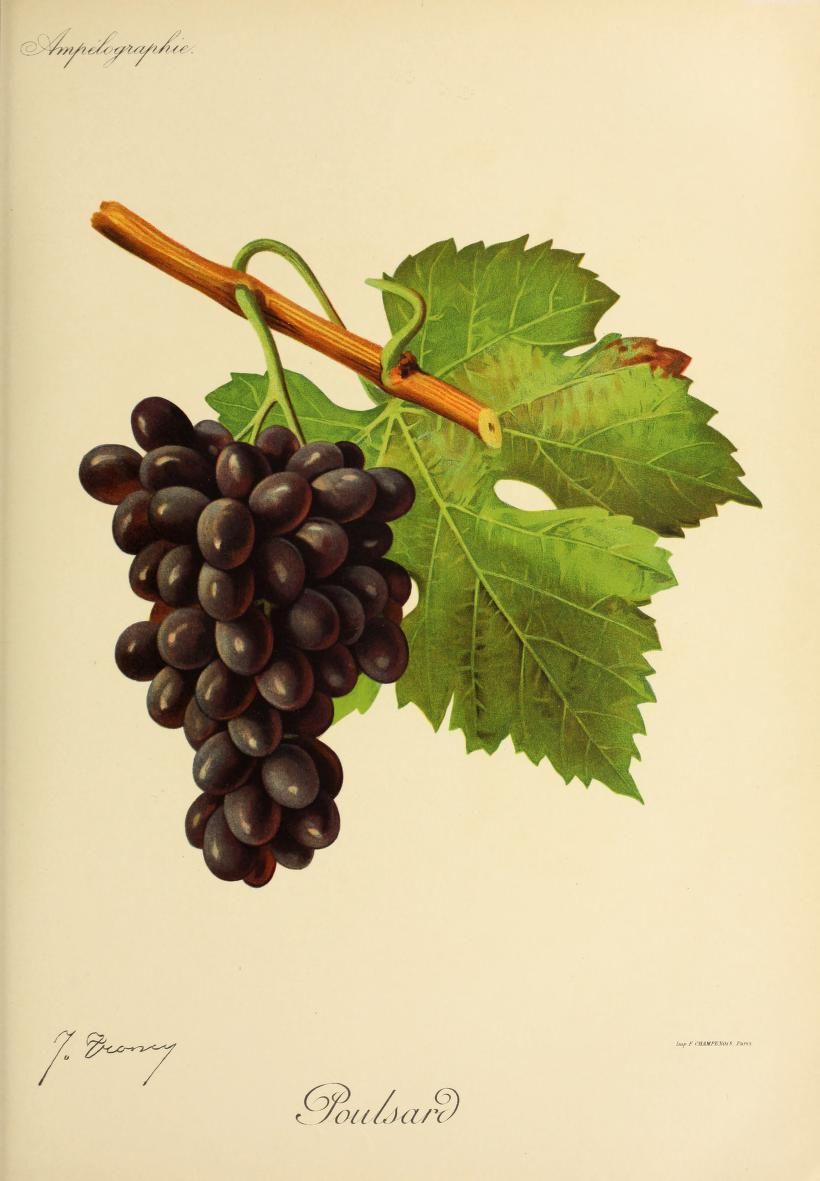
Poulsard
Also known as Ploussard
Poulsard is a red Vitis vinifera variety native to the Jura vineyards of eastern France. It is one of the grapes that makes Jura's red and rosé wines recognizable: its wines are often lightly coloured and delicate.
Identity and naming
Poulsard is the canonical name used by the French varietal catalogue. In France, Ploussard may officially be used for plant propagation material, and the Côtes du Jura specification calls it the local name. These are names for the same variety, not separate Jura grapes. Plantgrape describes Poulsard as native to the Jura; genetic analyses suggest a close relationship to Rèze.1. Plantgrape, “Poulsard N,” “Origin.”
The variety has a long documentary presence in the region. The Côtes du Jura specification says that Poulsard is recorded in the Jura from 1620, while describing it, Trousseau, and Savagnin as typically Jurassian varieties. Plantgrape records 257 hectares in France in 2018.2. The 2018 area figure is from the Plantgrape varietal record; the 1620 documentary date is from the Côtes du Jura specification.
Viticulture and site
Poulsard is a delicate vine in the practical sense that its crop and health are easily disrupted. Plantgrape identifies sensitivity to spring frost, coulure (poor fruit set), and heat, as well as particular susceptibility to powdery mildew. It requires long pruning and trellising. The record places it especially well on marly and limestone soils, conditions common in the Jura where marl, clay, limestone, slope, and exposure form a patchwork of vineyard sites.
In the Vassal collection, it budbreaks about one day before Chasselas and reaches maturity roughly a week and a half after it. Small bunches and medium-to-large berries are characteristic of the variety.
The Jura's climate and topography sharpen these differences. The Côtes du Jura area is a cool, rainy, oceanic-influenced region with continental effects, and its vineyards occupy exposed hills between roughly 300 and 450 metres. Marl and clay can retain coolness at depth, while limestone scree helps warm and drain the surface.
Wine character in the Jura
Plantgrape describes Poulsard wines as aromatic, not very full-bodied, and marked by finesse, with variable colour that can occasionally reach an onion-skin shade. In the Côtes du Jura specification, Poulsard contributes a characteristic light-ruby colour and fruit aromas to red and rosé wines. The same document contrasts the darker colour of Pinot Noir and the more tannic, often more coloured character of Trousseau.
In the cellar
Within Côtes du Jura, Poulsard is a principal variety for red and rosé wines, and it may also be used in vin de paille.3. Cahier des charges de l’AOP « Côtes du Jura », V.1 and X.2.
Related topics
Sources
- Institut français de la vigne et du vin, INRAE & Institut Agro Montpellier, “Poulsard N”, Plantgrape varietal record, accessed 7 September 2026.
- Institut national de l’origine et de la qualité, Cahier des charges de l’AOP « Côtes du Jura », homologated 20 September 2022, published 29 September 2022.