Savagnin
Also known as Savagnin blanc, Naturé, Weißer Traminer
Savagnin is a white Vitis vinifera variety whose most distinctive home is the Jura in eastern France. Its importance there comes from a useful combination: the berries can accumulate substantial sugar while retaining high acidity, and the resulting wine can support both fresh, topped-up whites and the long, yeast-influenced élevage of vin jaune.
History and identity
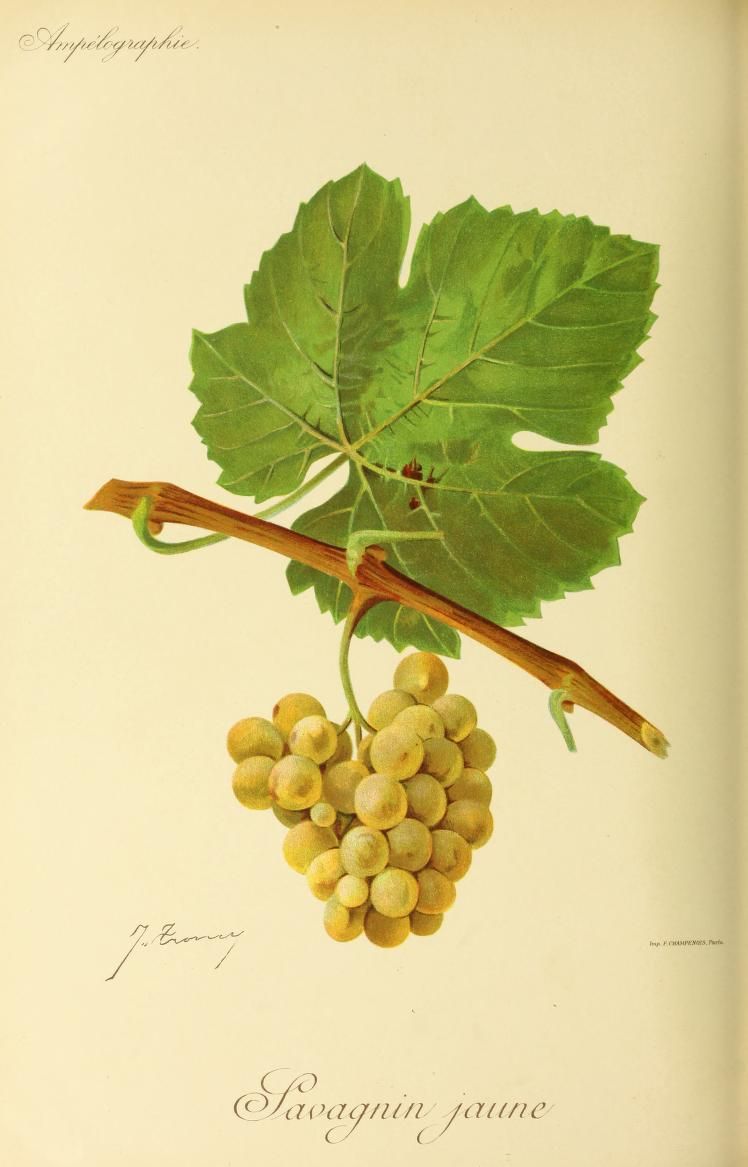
Savagnin blanc belongs to the old Traminer group. Plantgrape lists it under white Traminer names in several European catalogues, including Weißer Traminer in Germany, and notes that its ampelographic description corresponds to that of Gewürztraminer except for the ripe berry skin: Savagnin's is green-yellow, while Gewürztraminer's is pink. The precise origin of Savagnin remains uncertain, with Franche-Comté and the Palatinate both proposed in the varietal record.
Ancient DNA gives the variety a firmer historical anchor. A grape seed from La Madeleine in Orléans, dated to 1050–1200 CE, was an identical genetic match to modern Savagnin Blanc. The result is evidence for roughly nine centuries of vegetative propagation. The same study calls Savagnin Blanc “Traminer Weiss” and reports written use of the name by the year 1539.1. Jazmín Ramos-Madrigal, Anne Kathrine Wiborg Runge, Laurent Bouby et al., “Palaeogenomic insights into the origins of French grapevine diversity,” Nature Plants (2019), PDF p. 13. It also describes earlier archaeological material as having a parent–offspring relationship with Savagnin, which suggests an older presence or close relatives without establishing that the modern variety itself was already growing there.
Viticulture
Savagnin has small bunches and berries, thick skin, and a strong preference for marly soils. The thick skin helps it resist grey rot, an advantage in the Jura's cool, wet continental climate. Wood diseases are a more serious weakness. It is usually trained and pruned long, and Plantgrape records eight certified French clones.
Plantgrape classifies Savagnin as early-season, reaching maturity about a week and a half after Chasselas in its Vassal collection comparison.
The variety's central viticultural trait is the balance between sugar and acid. Plantgrape records very high sugar-accumulation potential while maintaining high acidity.
Wine character and Jura styles
Savagnin produces powerful, full-bodied white wines with the structure to age. In a topped-up wine, the cellar protects the wine from excessive air by replacing evaporated wine in the barrel. This ouillé style keeps the grape's fresh, high-acid character in view. Jura producers also make topped-up Savagnin as a variety and use it in Chardonnay–Savagnin blends, practices also described by Lorch. The Côtes du Jura specification identifies Chardonnay and Savagnin as the principal white grapes and describes the main dry white as generally a blend of the two.
The contrasting route is sous voile, ageing under a surface veil of yeast. Here Savagnin's acidity and concentration give the wine a firm frame for the long maturation, while the veil changes its aroma and texture. These wines can show the nutty, spicy, and apple-like character associated with the Jura's oxidative tradition, but the exact balance varies with cellar conditions and the length of élevage. Sherry has a related tradition of biological ageing.
Vin jaune
Vin jaune is the clearest expression of Savagnin's Jura identity. Under the adopted Côtes du Jura specification, wine claiming the mention must come from Savagnin B; Enfariné and Gringet are also conditionally permitted.2. Institut national de l'origine et de la qualité, Cahier des charges de l'AOP Côtes du Jura, adopted 20 September 2022, V.1(d) and IX.2(a). It must age in oak without topping-up until 15 December of the sixth year after harvest, with at least 60 months under the veil. The wine begins as a dry white; during the prolonged maturation, naturally developing yeasts at the surface enable a controlled oxidative process and produce the style's characteristic “goût de jaune.”
Related topics
Sources
- Institut français de la vigne et du vin, INRAE & Institut Agro Montpellier, “Savagnin blanc B”, Plantgrape varietal record, accessed 7 September 2026.
- Jazmín Ramos-Madrigal, Anne Kathrine Wiborg Runge, Laurent Bouby et al., “Palaeogenomic insights into the origins of French grapevine diversity”, Nature Plants (2019).
- Institut national de l'origine et de la qualité, Cahier des charges de l'AOP Côtes du Jura, homologated 20 September 2022.
- Wink Lorch, “Jura wine styles”, GuildSomm International, accessed 7 September 2026.
- James Lawther MW, “Jura in-depth and wines not to miss”, Decanter, accessed 7 September 2026.