Picpoul Blanc
Also known as Piquepoul Blanc, Picpoul, Piquepoul
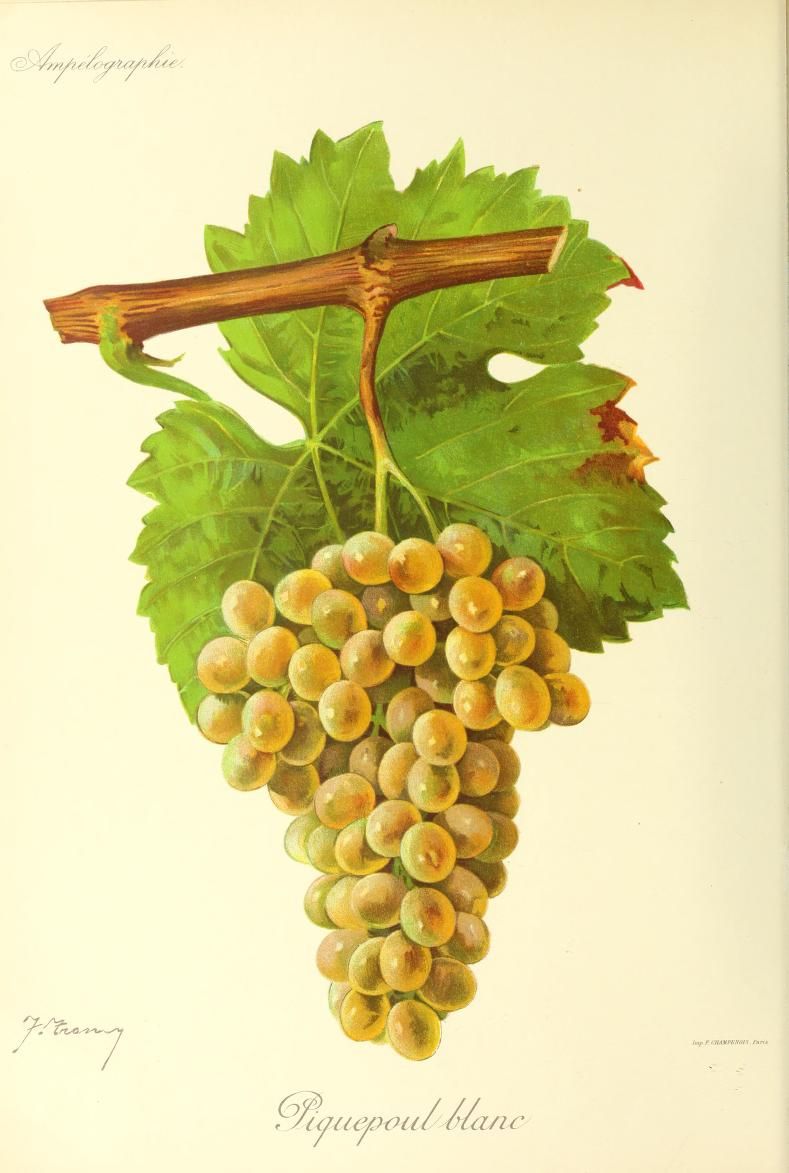
Picpoul Blanc, also written Piquepoul blanc, is a white Vitis vinifera grape of southern France. It is best known through Picpoul de Pinet, the appellation in the Hérault that makes white wine exclusively from this variety, but the grape also has a smaller, useful place in southern Rhône vineyards. Its importance comes from a combination that can be valuable in Mediterranean conditions: it ripens relatively late yet can retain a distinctly fresh, tangy line in the finished wine.
Names and identity
Piquepoul is the spelling used in the Rhône Valley, while Picpoul is common in Languedoc and in the name Picpoul de Pinet. Other regional forms include Picapoll, Picpouille, Avillo, and Picapulla. Picapoll Blanco, however, is a distinct variety from Piquepoul/Picpoul blanc, despite the similar name.1. Foundation Plant Services, University of California, Davis, “Grape Variety: Piquepoul blanc,” noting that recent DNA analysis distinguishes Picapoll blanco from Piquepoul/Picpoul blanc: https://fps.ucdavis.edu/FGRfamilies.cfm?varietyid=3394. Piquepoul gris and Piquepoul noir are colour forms of the Piquepoul group. Plantgrape identifies Blanc as a white mutation of Noir.2. Plantgrape, “Piquepoul blanc B,” identifying Piquepoul blanc as the white mutation of Piquepoul noir: https://www.plantgrape.fr/en/varieties/fruit-varieties/219/export.
Inter Rhône gives a Langue d'Oc explanation in which Piquepoul refers to a place with a rocky peak. The etymology remains a regional tradition.
Viticulture in a Mediterranean climate
Picpoul Blanc is relatively late-ripening, vigorous, and productive. Its clusters are medium-sized and compact; short pruning is recommended, and very fertile soils are best avoided. Crop level, water supply, exposure, disease pressure, and the season influence when a parcel reaches useful ripeness.
Late ripening can be an advantage in a hot, sunny region when the site has enough time and water to carry the fruit to maturity. The Picpoul de Pinet specification describes the area north of the Étang de Thau as relatively dry, with deep, draining soils and humid maritime influence. In its account, those conditions help the late variety mature while preserving the floral, citrus, and fresh qualities associated with the appellation.
The grape's high apparent acidity is therefore partly a harvest and site question. Warmth can increase sugar and reduce acid in grapes generally, but a late variety harvested at a suitable point may retain enough acid to make a dry wine feel lively rather than broad. The result also depends on crop load, water status, the season, and the balance between ripeness and freshness.
Wine character and cellar choices
Picpoul Blanc usually makes dry, still white wine. Inter Rhône describes the wine as relatively neutral, with discreet citrus and floral notes, and values it for tangy freshness and finesse in blends. The appellation specification for Picpoul de Pinet similarly describes pale, youthful wines with floral and citrus notes and a characteristic acidic edge. Pressing, fermentation, vessel, lees contact, and harvest date can change the balance of fruit, texture, and freshness.
The main cellar decision is how to preserve the grape's point of difference while bringing it to adequate ripeness. The Picpoul de Pinet rules emphasise careful transport and pressing to preserve finesse and balance, and the wines are generally released young. That makes sense for a wine whose appeal depends on freshness, while oxygen exposure, oak, lees contact, or malolactic fermentation can produce fuller interpretations.
Picpoul de Pinet
Picpoul de Pinet is a protected geographical name, not a synonym for every wine made from Picpoul Blanc. Under the current specification,3. Ministère de l'Agriculture et de la Souveraineté alimentaire, Cahier des charges de l'appellation d'origine protégée « Picpoul de Pinet », I, III, IV and V, adopted December 2024: https://info.agriculture.gouv.fr/boagri/document_administratif-dc09ed16-3b99-45bc-b1f4-9a5fceebd3ec/telechargement. it is reserved for still white wine from a delimited area covering Castelnau-de-Guers, Florensac, Mèze, Montagnac, Pinet, and Pomerols, with a permitted nearby area for vinification. The wine must come exclusively from Piquepoul B—the French catalogue's notation for the white-berried variety.
The association is historically strong because the appellation's identity was preserved through changes in French regional appellation structures, and because the growers built a clone conservatory for the local material. The legal name therefore joins place, grape, and production rules. A bottle labelled Picpoul de Pinet tells the reader more than “Picpoul Blanc”: it identifies a regulated origin and a specific, single-variety white-wine tradition.
Southern Rhône blends
In the southern Rhône, Picpoul Blanc is a supporting grape rather than one of the region's dominant white varieties. The current Côtes du Rhône rules list it among the accessory white grapes, alongside the principal group of Bourboulenc, Clairette, Grenache Blanc, Marsanne, Roussanne, and Viognier. The white wines must be based mainly on the principal varieties, so Picpoul can contribute without defining the appellation's blend. The same rules also list it as an accessory option in red and rosé wines, subject to the applicable blending limits.4. Ministère de l'Agriculture et de la Souveraineté alimentaire, Cahier des charges de l'appellation d'origine contrôlée « Côtes du Rhône », V and IX, adopted December 2024: https://info.agriculture.gouv.fr/boagri/document_administratif-0a35319f-f582-456a-bc41-dad3dd4ceb28/telechargement.
That legal position matches the grape's practical role. In a warm blend, Picpoul can supply a sharper acid impression and a light, discreetly aromatic freshness, countering varieties that contribute more alcohol, body, or ripe fruit. Proportions, harvest dates, fermentation, and maturation determine the final balance.
Sources
- Foundation Plant Services, University of California, Davis, “Grape Variety: Piquepoul blanc”, accessed 7 September 2026.
- Institut français de la vigne et du vin, INRAE & Institut Agro Montpellier, “Piquepoul blanc B”, Plantgrape varietal record, accessed 7 September 2026.
- Inter Rhône, “Piquepoul blanc”, grape-variety profile, accessed 7 September 2026.
- Institut national de l'origine et de la qualité, “Picpoul de Pinet”, appellation record, accessed 7 September 2026.
- Ministère de l'Agriculture et de la Souveraineté alimentaire, Cahier des charges de l'appellation d'origine protégée « Picpoul de Pinet », homologated by order of 9 December 2024, published 19 December 2024, adopted specification.
- Ministère de l'Agriculture et de la Souveraineté alimentaire, Cahier des charges de l'appellation d'origine contrôlée « Côtes du Rhône », homologated 10 December 2024, PDF.