Marsanne
Marsanne is a white Vitis vinifera grape of the northern Rhône. It is valued for breadth, weight, and a distinctive ability to develop with bottle age, even though its acidity is usually medium to low rather than sharply refreshing. That combination makes it useful both as a substantial varietal wine and as the fuller partner to Roussanne in the region's white-wine tradition.
Viticulture
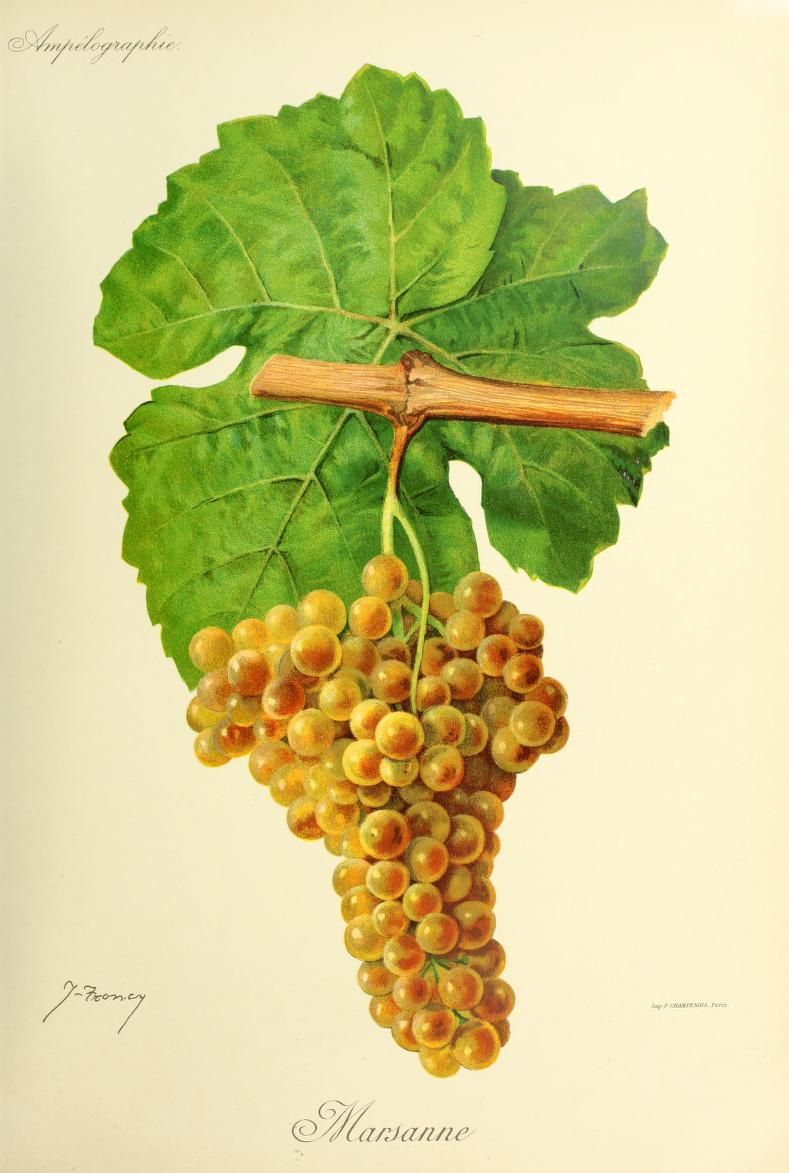
Marsanne is a mid-ripening variety with large clusters and small, golden to red-tinged berries. It is vigorous, particularly on fertile soils, and performs well on the warm, rocky sites common in the northern Côtes du Rhône.1. Inter Rhône, “Marsanne,” grape-variety profile. The source describes Marsanne as mid-ripening, vigorous on fertile soils, suited to warm rocky soils, powerful, and medium to low in acidity; it also describes floral aromas developing toward hazelnut with ageing. Those traits make the harvest a balance between ripeness and freshness. A warm site or a late harvest can push the wine toward greater alcohol and broader texture while leaving less acid to give it lift. Cooler exposure, water availability, crop level, and the season can shift that balance.
Fertile soil can support more vegetative growth and fruit production, while a poor, stony site may impose a different balance of water and growth. Canopy, yield, fruit health, and harvest date therefore affect how much of Marsanne's potential weight becomes useful texture and how much reads as heaviness. The northern Rhône's rocky slopes provide a regional setting in which the variety can ripen without losing all structural definition.
Wine character
Marsanne commonly makes a powerful, medium- to full-bodied white with a broad palate and a relatively soft acid line. Floral impressions are common in young wines; the official Rhône description specifically points to a progression toward hazelnut with ageing and notes that a slight bitterness may appear on the finish.1. Inter Rhône, “Marsanne,” grape-variety profile. The source describes Marsanne as mid-ripening, vigorous on fertile soils, suited to warm rocky soils, powerful, and medium to low in acidity; it also describes floral aromas developing toward hazelnut with ageing. Picking, fermentation, lees contact, wood, alcohol, and bottle condition can change the balance between fruit, texture, freshness, and savoury development.
Its low-to-moderate acidity explains both its appeal and its limits. Acidity is one source of tension, but body can also come from extract, alcohol, lees, and the wine's phenolic and colloidal structure. Marsanne can therefore feel substantial without being aggressively acidic. In a warm vintage or from a late-picked parcel, that breadth may dominate; in a cooler site or earlier harvest, the same grape can feel more lifted.
Floral notes can recede as dried-fruit, nutty, honeyed, or savoury impressions become more apparent, and the texture may seem more integrated. The direction and speed of that development depend on vintage, alcohol, acidity, sulfur dioxide, closure, and storage. A well-made, balanced wine may mature compellingly; a broad, low-acid wine with poor storage may simply lose freshness.
Northern Rhône importance
Marsanne's clearest historical and contemporary identity is northern Rhône white wine. It is central to the white wines of Hermitage, Crozes-Hermitage, Saint-Joseph, and Saint-Péray. In the Hermitage appellation rules, white wines are made from Marsanne and Roussanne, and the same two varieties are permitted for the sweet vin de paille style.2. Ministère de l'Agriculture et de la Souveraineté alimentaire, Cahier des charges de l'appellation d'origine contrôlée « Hermitage », sections III and V. Saint-Péray also uses Marsanne for both still and sparkling white wines.1. Inter Rhône, “Marsanne,” grape-variety profile. The source describes Marsanne as mid-ripening, vigorous on fertile soils, suited to warm rocky soils, powerful, and medium to low in acidity; it also describes floral aromas developing toward hazelnut with ageing.
Marsanne's ripeness and weight suit the Rhône's sunny, rocky slopes, while its aromatic and structural development give white wines a style distinct from the region's more perfumed Viognier.
Marsanne and Roussanne
Marsanne is frequently partnered with Roussanne because the two varieties offer different kinds of balance. Marsanne contributes power, body, and a hazelnut-leaning development; Roussanne is described by the Rhône authority as finer, floral, complex, and capable of long ageing.3. Inter Rhône, “Roussanne,” grape-variety profile. The comparison in the article is an editorial interpretation of the two official profiles, not a claim that every blend follows the same sensory formula. A blend can therefore retain Marsanne's substance while adding aromatic lift and a different structural shape. The exact result depends on proportion, harvest dates, site, and whether the grapes are fermented and matured together or separately.
The partnership does not require every bottle to contain both grapes. Hermitage and other northern Rhône whites may be Marsanne-led or varietal, while the appellation rules define the permitted grapes rather than a single mandatory recipe.
In the cellar
Marsanne's breadth makes oxygen and maturation choices consequential. Fermenting or ageing in neutral vessels can preserve a clearer view of the fruit and regional texture; lees contact can add further roundness, while oak can add aroma and controlled oxygen exposure. New or small barrels can make wood more obvious. Oak maturation and lees aging are separate tools with overlapping effects.
The most important cellar decision is consequently compositional: preserve enough freshness to carry Marsanne's weight, then let bottle age develop its nutty and savoury side. Blending with Roussanne, harvesting before full softness, protecting acidity, or choosing a restrained vessel are different ways of pursuing that balance.
Sources
- Inter Rhône, “Marsanne”, grape-variety profile, accessed 7 September 2026.
- Ministère de l'Agriculture et de la Souveraineté alimentaire, Cahier des charges de l'appellation d'origine contrôlée « Hermitage », adopted 10 December 2024 and published 12 December 2024, sections III and V.
- Inter Rhône, “Roussanne”, grape-variety profile, accessed 7 September 2026.
- University of California, Davis Foundation Plant Services, Rhone, grape-variety reference, revised 23 February 2021, pp. 68–70.