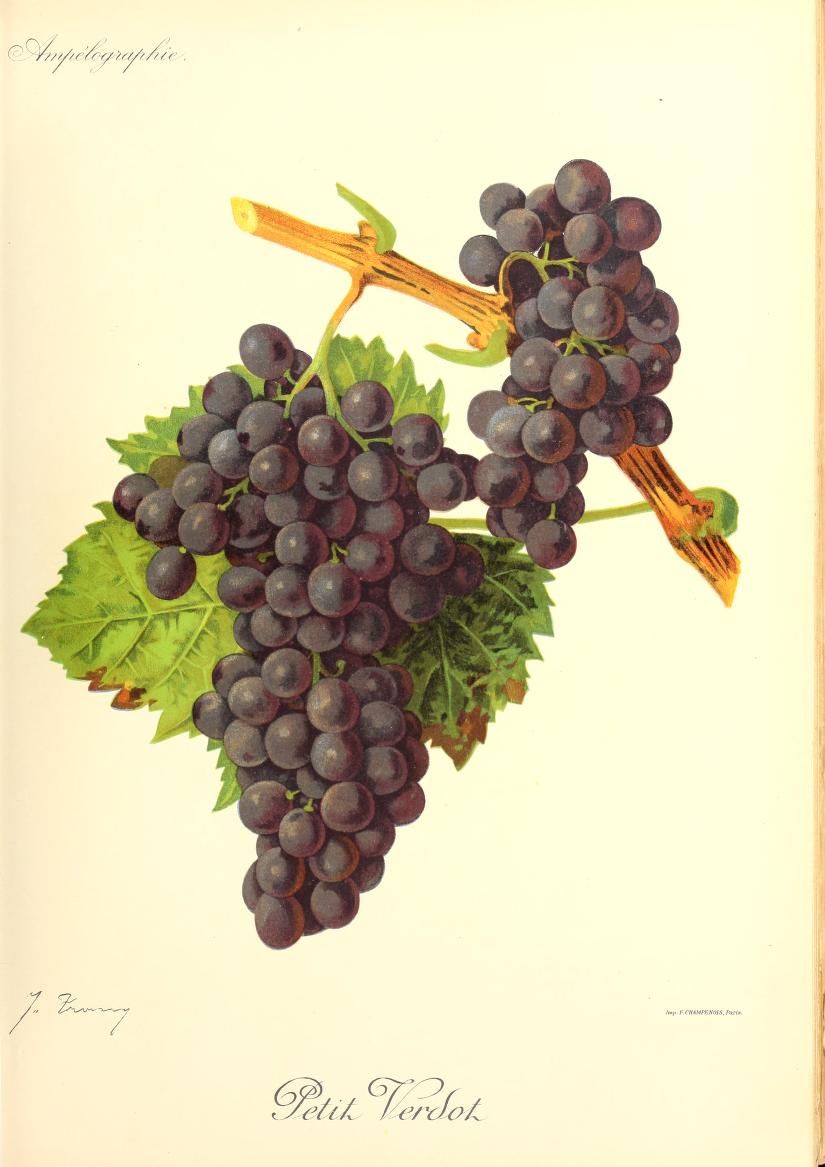
Petit Verdot
Petit Verdot is a red southwestern French grape that contributes colour, tannin, and acidity to Bordeaux blends. Its relatively late ripening helps explain its limited role there and its wider possibilities in warmer growing regions. Where it matures reliably, it can also make a varietal wine with considerable structure.
Growing season and water supply
Petit Verdot combines relatively early budbreak with late harvest. The two ends of that season expose it to different hazards: spring frost can damage new growth, while a cool or wet autumn can limit the maturity of the crop. Site selection therefore needs to account for spring and autumn conditions as well as summer warmth.
Warm conditions improve the chances of ripening, but Petit Verdot should not be assumed to tolerate any hot, dry site. Plantgrape specifically stresses regular water supply in southern growing regions. It also describes fragile shoot bases and shoots that tend to spread horizontally, making support and training important practical considerations.
California observations show why yield claims need context. UC viticulturist Matthew Fidelibus reports substantial differences among clones and sites: material that was productive in the San Joaquin Valley differed from lower-yielding selections observed at Lodi. Yield expectations therefore need to be matched to the clone and site.
The same account reports good colour development under hot conditions but also sunburn risk where fruit becomes overexposed. Canopy architecture and trellising can protect berries while allowing the vine to ripen its crop. Heat sufficient for maturity and excessive direct exposure are separate management questions.
Wine character and blending
Plantgrape describes ripe Petit Verdot as capable of combining substantial sugar with acidity, deep colour, and powerful tannins. These properties make it useful in small proportions: a modest addition can change a blend's structure without requiring Petit Verdot to supply most of its volume.
In Bordeaux it commonly accompanies Cabernet Sauvignon and Merlot. The useful proportion depends on the maturity and balance of all the components. Its concentration and firmness have to fit the rest of the blend.
For a varietal bottling, that firmness becomes a central cellar consideration. Maceration determines how much skin and seed material enters the wine. A deeply coloured crop does not in itself call for maximal extraction, especially when the intended wine should be approachable relatively young.
Where it is grown
Within Bordeaux, Petit Verdot is particularly associated with the Médoc and Graves. The Bordeaux wine council identifies warmth and adequate water as important to its success and notes the opportunities a warmer climate can offer this late variety. Those opportunities remain dependent on the site and season.
California provides examples of cultivation in warm inland conditions. Australia also uses the grape in blends and varietal wines. Wine Australia's 2025 snapshot places most reported Australian Petit Verdot crush in the Riverland, followed by the Riverina, showing how strongly production is associated with those warm inland regions.1. The snapshot's regional crush data refer to 2025. Its vineyard-area figures come from an older survey and should not be treated as a 2025 planting census.
Sources
- Plantgrape, “Petit Verdot”, cultivation, water requirements, and wine properties.
- Conseil Interprofessionnel du Vin de Bordeaux, “Petit Verdot”, its Bordeaux distribution and blending role.
- Matthew Fidelibus, “Petit Verdot”, University of California grape-variety resource, updated 2023; California observations on phenology, clones, yield, and sunburn.
- Wine Australia, “Petit Verdot: Variety Snapshot 2025”, September 2025, crush distribution and wine-label categories.