Catawba
Catawba is a pink-to-red-skinned American grape with an important place in nineteenth-century wine history and a continuing role in regional white and rosé wines. It connects the early Ohio wine industry with current producers exploring American grape traditions.
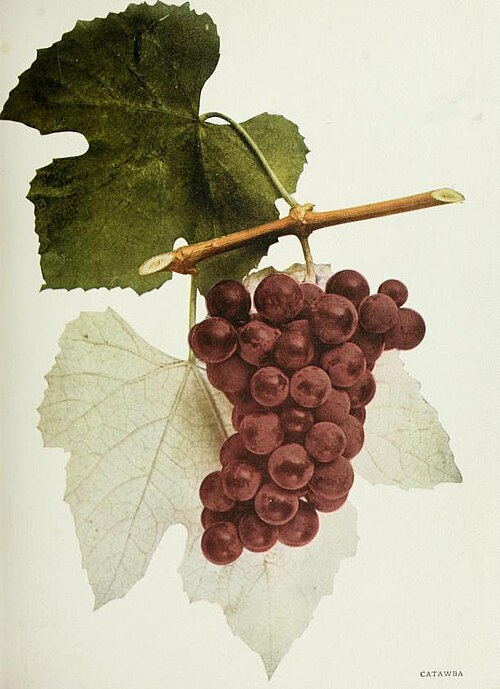
Ohio's sparkling wine
In Julia Fine's historical account for Harvard's Arnold Arboretum, John Adlum helped distribute Catawba cuttings and Nicholas Longworth built a substantial wine business around the grape near Cincinnati. Sparkling Catawba became particularly successful in the mid-nineteenth century.1. Julia Fine, “Catawba: Back to the Future of the American Wine Industry,” Arnoldia, historical account and cited correspondence. The variety's exact place of origin remains less certain than that documented commercial history.
Disease was also central to the story. Black rot damaged crops and contributed to the decline of the Cincinnati industry. Catawba's American ancestry did not make it immune to an American pathogen.
Continuing regional styles
Missouri's wine organization describes fragrant pink wines with strawberry-like impressions and noticeable sweetness. The University of Missouri also records dry and sweet uses, together with late ripening and vigorous growth. Those are useful reminders that a grape does not have one compulsory fermentation endpoint.
Fine's account discusses renewed interest from Cincinnati's Skeleton Root and New York producers. These projects place the grape's history inside contemporary wine culture. Comparing their wines with a sweet regional rosé draws attention to pressing, fermentation, and residual sugar, while the risks of canopy crowding remain relevant in the vineyard.
Sources
- Julia Fine, “Catawba: Back to the Future of the American Wine Industry”, Arnoldia, Arnold Arboretum, 1 December 2022.
- Missouri Wine and Grape Board, “Catawba”, contemporary regional styles, accessed 22 September 2026.
- University of Missouri Extension, Home Fruit Production: Grape Culture, Catawba entry, reviewed March 2026.