Barolo
Barolo is a red-wine appellation in the Langhe hills of Piedmont, south of Alba, and the name of the wine made under its rules. Current Barolo Denominazione di Origine Controllata e Garantita (DOCG) rules require vineyards planted exclusively to Nebbiolo, grapes from a delimited zone, and specified production and maturation. Barolo varies substantially with site, season, farming, and cellar decisions.
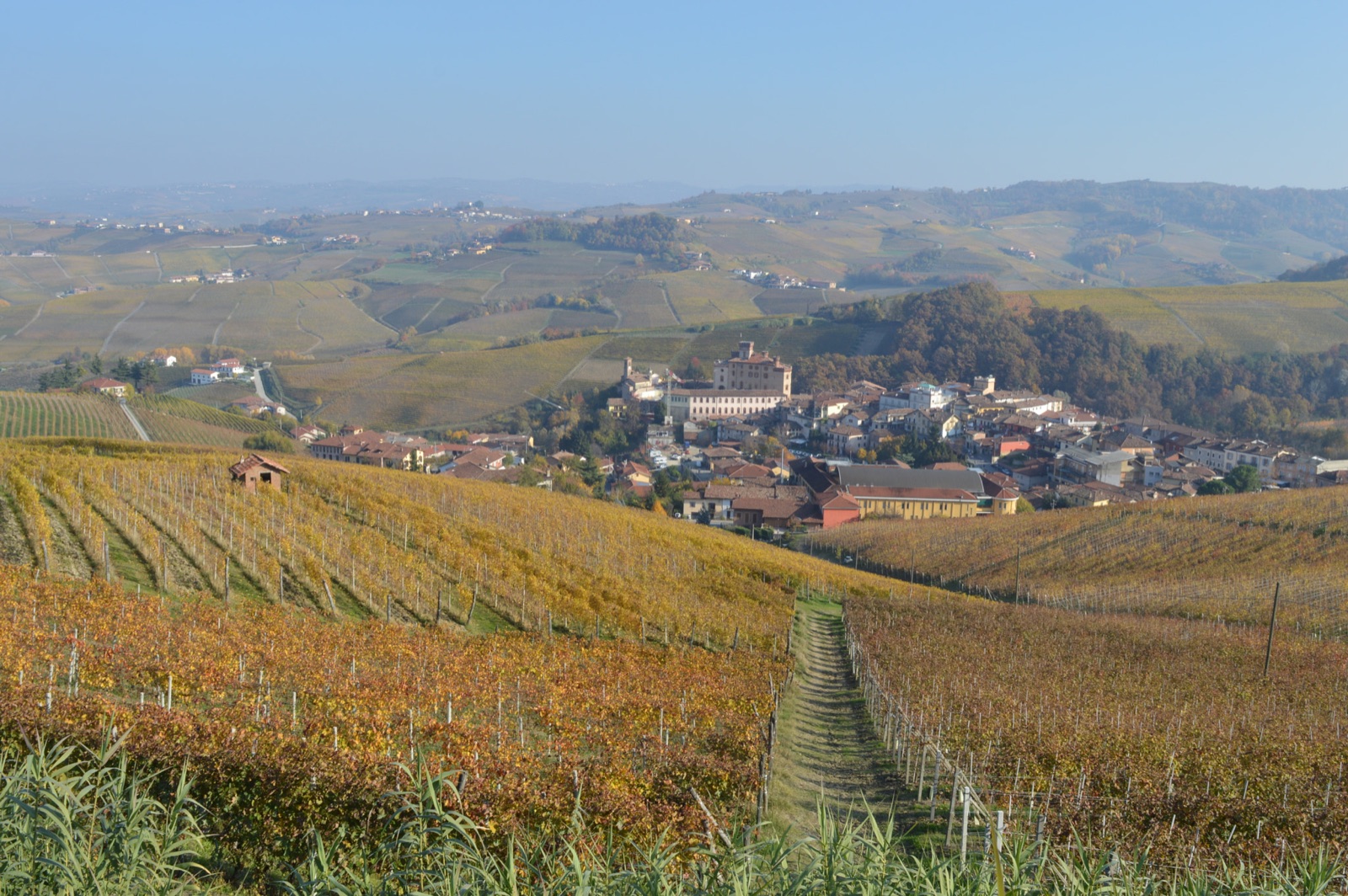
Geography and growing conditions
The zone occupies a set of ridges in the southwestern Langhe, within the province of Cuneo. It includes all of the communes of Barolo, Castiglione Falletto, and Serralunga d'Alba, and designated parts of La Morra, Monforte d'Alba, Novello, Verduno, Grinzane Cavour, Diano d'Alba, Cherasco, and Roddi. The rules admit only hillside vineyards between 170 and 540 metres above sea level; valley floors and insufficiently sunny sites are excluded, as are directly north-facing slopes for new plantings.1. Ministero dell'agricoltura, della sovranità alimentare e delle foreste, Disciplinare di produzione della DOCG Barolo, consolidated 4 March 2026, articles 1–5 and 8.
The hills developed from layered marine sediments. The Lequio Formation, with alternating marl and sandstone, appears in central and southern Serralunga and eastern Monforte. Sant'Agata Fossili marls spread through several central and western areas, while Diano sandstones occur in parts of Monforte, Castiglione Falletto, Barolo, and Diano d'Alba; gravel, gypsum-bearing strata, and other formations add further local differences. Geological boundaries therefore do not match commune boundaries neatly.
Elevation, slope, and aspect change sunlight, temperature, wind, and water movement over short distances. A study using weather records from 1996–2019 found that maximum temperatures and the Huglin heat index declined consistently with elevation across the topographically complex zone, while minimum temperatures behaved differently.2. Alena Wilson, Silvia Guidoni & Vittorino Novello, “Geospatial trends of bioclimatic indexes in the topographically complex region of Barolo DOCG,” IVES Conference Series, Terclim 2022. These relationships affect late-ripening Nebbiolo. Soil depth, water availability, canopy and crop management, harvest date, and vintage can alter the result.
Communes and named sites
Commune names are useful coordinates, not official grades or dependable style categories. Broad descriptions of, for example, La Morra, Serralunga d'Alba, or Monforte d'Alba can orient a reader, but each contains different elevations, exposures, soils, and producers. Some geological formations also continue from one commune into another.
Since the 2010 vintage, the regulations have defined menzioni geografiche aggiuntive (additional geographical mentions, commonly abbreviated MGA). These include commune-wide mentions and smaller named areas such as Cannubi, Bussia, and Monvigliero. An MGA states where the grapes came from; it does not rank the place, guarantee a uniform soil or exposure, or prescribe a cellar method. A producer may instead use the unqualified Barolo name for wine that does not claim one of these narrower origins. The further term vigna, followed by a registered vineyard name, may appear only together with an MGA and brings additional traceability and production conditions.1. Ministero dell'agricoltura, della sovranità alimentare e delle foreste, Disciplinare di produzione della DOCG Barolo, consolidated 4 March 2026, articles 1–5 and 8.
An MGA can contain multiple parcels and producers, and two wines from the same named area can differ through vine age, farming, harvest decisions, fermentation, extraction, maturation vessel, and blending choices. A producer can also blend several sites to balance their different contributions.
Wine and maturation
Nebbiolo can combine relatively modest colour with substantial acidity and tannin. In Barolo, the long growing season makes the balance among sugar, acidity, and skin and seed maturity especially dependent on site and year. Maceration and extraction then determine how the cellar handles the grape's phenolic material.
The current rules require ordinary Barolo to mature for at least 38 months from 1 November of the harvest year, including 18 months in wood; release is permitted from 1 January of the fourth year after harvest. Riserva requires at least 62 months in total, again with 18 months in wood, and may be released from 1 January of the sixth year.1. Ministero dell'agricoltura, della sovranità alimentare e delle foreste, Disciplinare di produzione della DOCG Barolo, consolidated 4 March 2026, articles 1–5 and 8. The rules do not specify barrel size, the age of the wood, or how the remaining time must be divided among vessel and bottle.
Large, seasoned casks and smaller or newer barrels can therefore both produce legal Barolo, as can different approaches to extraction and blending. Wood can moderate and reshape tannin through time and oxygen exposure, but compulsory wood ageing does not require an obvious oak flavour. Bottle development can further soften texture and change aroma after legal release, though longevity varies by site, vintage, producer, storage, and the individual wine.
Historical development
Winegrowing around the village long predates the modern appellation, but old references do not necessarily describe today's wine. A documented Turin notice offered bottled vino di Barolo for sale in 1828, and a Genoa advertisement used vino Barolo in 1833; neither establishes the precise grape composition or production method.3. Debora de Fazio, “Deonimici di-vini,” Treccani Lingua Italiana, 11 August 2023, citing the 29 November 1828 Gazzetta Piemontese and 26 October 1833 Gazzetta di Genova notices.
During the nineteenth century, landowners and technicians changed both vineyard organization and cellar practice. Camillo Benso di Cavour brought Paolo Francesco Staglieno to Grinzane in 1836 to direct harvest and fermentation work, and Staglieno described his methods in an 1837 manual. Giulia and Tancredi Falletti, Cavour, the Savoy estates, Staglieno, and later Louis Oudart all belong to the documented development and wider circulation of Langhe Nebbiolo wines. The familiar story in which Oudart alone transformed a uniformly sweet local wine into dry Barolo is too simple: the evidence points to overlapping experiments, improving control of fermentation and wine stability, and a gradual emergence of the modern dry wine.4. Paola Gullino, “Dalla teoria alla sperimentazione: successi e inconvenienti,” in Silvia Cavicchioli, ed., Camillo Cavour e l'agricoltura, 2011, pp. 173–74; Kerin O'Keefe, Barolo and Barbaresco: The King and Queen of Italian Wine, 2014.
Legal definition came later. The present specification traces the delimited zone to a 1933 ministerial decree; Barolo received DOC status in 1966 and DOCG status in 1980. The 2010 amendments formally delimited the additional geographical mentions now seen on labels.1. Ministero dell'agricoltura, della sovranità alimentare e delle foreste, Disciplinare di produzione della DOCG Barolo, consolidated 4 March 2026, articles 1–5 and 8. These stages progressively fixed the relationship among name, grape, place, and production rules.
Related topics
Sources
- Ministero dell'agricoltura, della sovranità alimentare e delle foreste, Disciplinare di produzione della DOCG Barolo, consolidated 4 March 2026, accessed 1 September 2026.
- Consorzio di Tutela Barolo Barbaresco Alba Langhe e Dogliani, official Barolo additional geographical mentions map, reflecting the 2010 production rules, accessed 1 September 2026.
- Consorzio di Tutela Barolo Barbaresco Alba Langhe e Dogliani, “Climate & Geology”, accessed 1 September 2026.
- Alena Wilson, Silvia Guidoni & Vittorino Novello, “Geospatial trends of bioclimatic indexes in the topographically complex region of Barolo DOCG”, IVES Conference Series, Terclim 2022.
- Paola Gullino, “Dalla teoria alla sperimentazione: successi e inconvenienti”, in Silvia Cavicchioli, ed., Camillo Cavour e l'agricoltura, Istituto per la Storia del Risorgimento Italiano, 2011.
- Debora de Fazio, “Deonimici di-vini”, Treccani Lingua Italiana, 11 August 2023.
- Kerin O'Keefe, Barolo and Barbaresco: The King and Queen of Italian Wine, University of California Press, 2014.