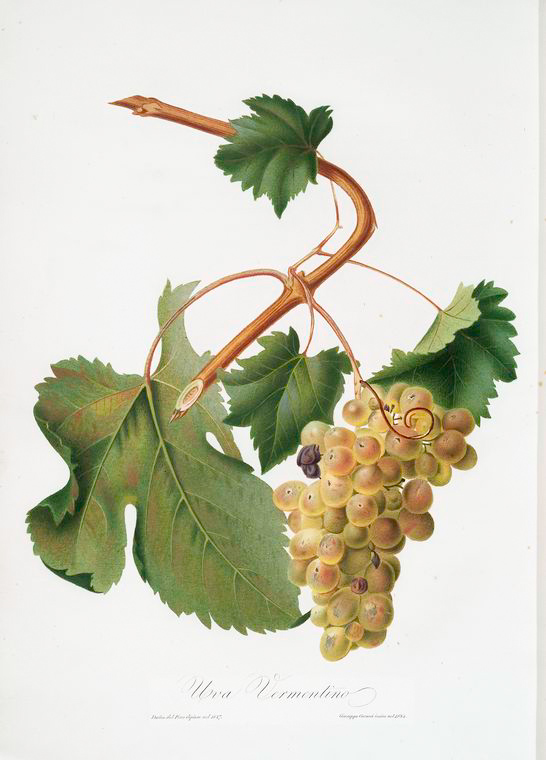
Vermentino
Also known as Rolle, Garbesso, Vermentinu, Favorita, Pigato
Vermentino is a pale-skinned Vitis vinifera grape of the western Mediterranean. It is strongly associated with Sardinia, Liguria, Tuscany, Corsica, and Provence, although national catalogues also list it in Bulgaria, Malta, and Spain.
Names complicate the map. French propagation material may be sold under the names Rolle, Garbesso, or Vermentinu; Italian catalogues recognize Favorita and Pigato as names for Vermentino. These are catalogue-level synonymies, while local names still carry regional context.1. Institut français de la vigne et du vin, INRAE & Institut Agro Montpellier, “Vermentino B,” Plantgrape varietal record, accessed 7 September 2026, https://www.plantgrape.fr/en/varieties/fruit-varieties/285/export.
Rolle, Pigato, and identity
The French name Rolle is especially familiar in Provence, while Vermentinu is used in Corsica. Pigato is associated with Liguria and Favorita with parts of north-western Italy, as regional names for the variety. Plantgrape's varietal record treats these names as official designations of Vermentino in their respective national systems.1. Institut français de la vigne et du vin, INRAE & Institut Agro Montpellier, “Vermentino B,” Plantgrape varietal record, accessed 7 September 2026, https://www.plantgrape.fr/en/varieties/fruit-varieties/285/export.
A 2010 record in Italy's CNR research repository likewise describes the synonymy of Vermentino, Pigato, and Favorita as established and reports selections from Sardinia, Tuscany, and Liguria. It also notes distinctive clonal traits within the cultivar.2. F. Mannini, “Il Vermentino un vitigno mediterraneo: l'origine e la selezione clonale,” CNR Institutional Research Information System, 2010, https://iris.cnr.it/handle/20.500.14243/69137.
A Mediterranean distribution
Plantgrape describes Vermentino as long established in Corsica and Provence and suggests an Italian origin, while stopping short of presenting a settled historical birthplace. The CNR record places important Italian cultivation in Sardinia, Tuscany, and Liguria. These records place its cultivation history on islands and the western Italian and French coasts.1. Institut français de la vigne et du vin, INRAE & Institut Agro Montpellier, “Vermentino B,” Plantgrape varietal record, accessed 7 September 2026, https://www.plantgrape.fr/en/varieties/fruit-varieties/285/export.2. F. Mannini, “Il Vermentino un vitigno mediterraneo: l'origine e la selezione clonale,” CNR Institutional Research Information System, 2010, https://iris.cnr.it/handle/20.500.14243/69137.
The distribution is also broader than the best-known coastal regions. Its appearance in the catalogues of Bulgaria, Italy, Malta, and Spain shows that the variety has travelled within Europe, with local planted areas varying. Within Italy alone, Sardinian, Ligurian, and Tuscan examples sit in different climates and wine cultures.
Agronomy
Plantgrape calls Vermentino a southern variety adapted to hot areas and dry, relatively infertile terroirs. It describes the vine as vigorous and rather productive, with short pruning and careful training recommended to keep the vegetation in order. It also reports some sensitivity to grey rot and sour rot, and considerable sensitivity to powdery mildew.1. Institut français de la vigne et du vin, INRAE & Institut Agro Montpellier, “Vermentino B,” Plantgrape varietal record, accessed 7 September 2026, https://www.plantgrape.fr/en/varieties/fruit-varieties/285/export.
Wine character
Plantgrape describes Vermentino's wines as balanced and full-bodied, with aromatic richness that includes floral and pear-like associations, though they can sometimes lack acidity.1. Institut français de la vigne et du vin, INRAE & Institut Agro Montpellier, “Vermentino B,” Plantgrape varietal record, accessed 7 September 2026, https://www.plantgrape.fr/en/varieties/fruit-varieties/285/export. Local selection and growing conditions influence that balance.
Sources
- Institut français de la vigne et du vin, INRAE & Institut Agro Montpellier, “Vermentino B”, Plantgrape varietal record, accessed 7 September 2026.
- F. Mannini, “Il Vermentino un vitigno mediterraneo: l'origine e la selezione clonale”, CNR Institutional Research Information System, 2010.